Mapping Specialists (maps) and Amanda Montañez (graphs).
Join Our Community of Science Lovers!
On supporting science journalism
If you're enjoying this article, consider supporting our award-winning journalism by subscribing. By purchasing a subscription you are helping to ensure the future of impactful stories about the discoveries and ideas shaping our world today.
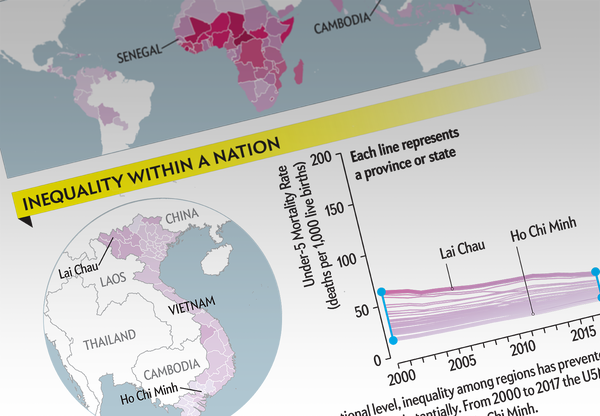
Actions taken in response to goals set by the United Nations have reduced the deaths of children younger than five from 93 per 1,000 live births in 1990 to 39 in 2018. Low- and middle-income countries, which generally have higher under-5 mortality rates (U5MR) than their richer counterparts, have achieved some of the largest decreases. A recent paper in Nature suggests there is more to the story, however. Researchers who studied local U5MR rates in districts, counties, states and provinces within 99 low- and middle-income nations from 2000 to 2017 found great variability within many countries—especially those with particularly high or low rates overall. In some cases, though, subnational gaps have narrowed substantially. One important insight: in some countries, the ratio of infant (younger than one) deaths to under-5 deaths has risen, suggesting that preventing fatalities among the youngest children may be tougher to attain.
Credit: Mapping Specialists (maps) and Amanda Montañez (graphs); Source: “Mapping 123 Million Neonatal, Infant and Child Deaths between 2000 and 2017,” by Roy Burstein et al., in Nature, Vol. 574; October 17, 2019
Subscribe to Support Independent Journalism
Great science journalism requires human expertise, time, effort and creativity. And it costs money. That’s why I and the journalists here at Scientific American hope you’ll join our community.
When you subscribe, you are supporting staff and freelance journalists who are passionate about telling science stories that are true, important and compelling. Our editors and reporters are often experts in their fields, which means they understand the nuances of big discoveries and can untangle the breakthroughs from the hype. With a subscription, you are also supporting rigorous fact-checking to ensure the words we publish are precise and accurate. And you’re supporting original illustrations, graphics and photos that bring you closer to an advanced laboratory, an ice sheet in Antarctica or a space mission in orbit. You’re helping us craft other types of high-quality journalism as well: Our newsletters are carefully written, edited and curated by staffers you have or will come to know and love. Our Science Quickly podcast is based on original reporting, collaboration with editors and scientists and exacting production.
Subscriptions keep this engine running so we can continue to deliver thoughtful, rigorous and independent science journalism to you. In an era of viral misinformation, this work is crucial. If you value what we do, I hope you’ll consider joining us as a subscriber
Thank you,
Jeanna Bryner, Editor in Chief, Scientific American