
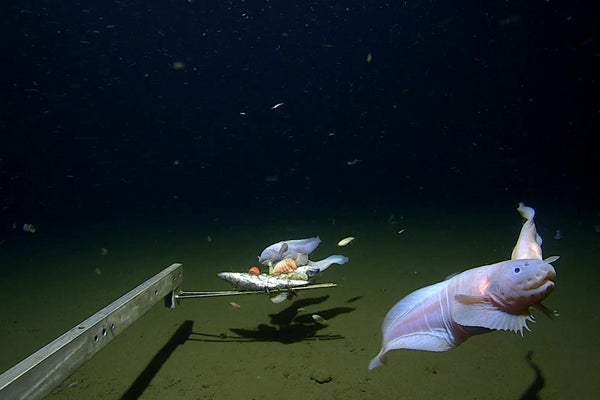
Scientists exploring a marine trench near Japan were astonished to see a fish in one of the deepest parts of the ocean, at 8,336 meters (about five miles) below the surface. The tadpole-shaped, translucent snailfish is probably living at the greatest depth possible.
“They can't really go any deeper,” says marine scientist Alan Jamieson of the University of Western Australia, who led the team that made the discovery. The previous record holder, a snailfish seen in the Mariana Trench—the world's deepest location—was filmed 8,178 meters under the surface in 2017.
Fish can tolerate high pressures at extreme depths because of cellular compounds called osmolytes. Osmolyte concentrations increase at greater depths to ensure that fish cells can withstand such bone-crushing pressures, but these compounds reach their maximum concentration at around 8,400 meters. So that's the theoretical limit of fish physiology. “If anyone does find fish deeper than this, it will not be by much,” Jamieson says.
On supporting science journalism
If you're enjoying this article, consider supporting our award-winning journalism by subscribing. By purchasing a subscription you are helping to ensure the future of impactful stories about the discoveries and ideas shaping our world today.
Ichthyologist Prosanta Chakrabarty, curator of fishes at Louisiana State University's Museum of Natural Science, is impressed that the fish could survive at 800 times the surface's water pressure. “At that depth everything from gas exchange for breathing to nearly every physiological function seems impossible,” he says. “I can barely swim to the bottom of a swimming pool without my ears popping.”
Jamieson's team discovered the snailfish in August 2022 at the bottom of the Izu-Ogasawara Trench, near the main islands of Japan. The farthest depths of the Japanese trench reach about 1.7 degrees Celsius (35 degrees Fahrenheit), Jamieson says, which is slightly warmer than the neighboring Mariana. This divergence is key: osmolytes are less effective at low temperatures, and these snailfish live near the edge of what's possible. “The difference is a fraction of a degree, so we wouldn't care,” Jamieson says. “But it makes a difference to marine animals.”
To photograph the fish, researchers onboard the DSSV Pressure Drop sent down an autonomous underwater “lander” equipped with cameras, lights and batteries, along with a weight to lower the contraption to the seafloor. The lander carried dead fish as bait to lure deep-sea crustaceans, and the snailfish came to eat the crustaceans—including the record-breaking juvenile snailfish at 8,336 meters. Although the team couldn't identify its exact species, two others from the species Pseudoliparis belyaevi were caught in baited traps nearby, at a depth of 8,022 meters.
Each of the more than 400 known snailfish species adapts to where it lives, from shallow waters to extreme depths, Jamieson says. “Each trench has its own snailfish in it,” he says. “Once they've evolved to cope in a trench, they cannot decompress to get from one trench to another.”