
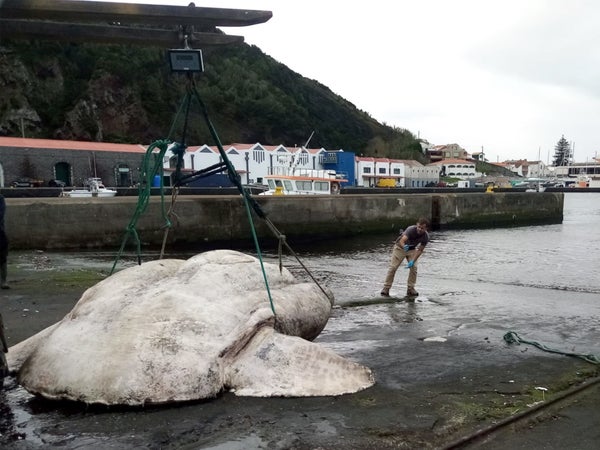
A bulbous corpse found bobbing off a tiny island in the Azores is the heaviest bony fish ever measured.
The record breaker is a bump-head sunfish (Mola alexandrini). Taller than it is long, with a truncated back fin and mushroom-colored skin, the fish weighed in at just more than three tons (2,744 kilograms). This beats out the previous bony fish record holder, another bump-head sunfish caught off the coast of Japan in 1996 that tipped the scales at more than 2.5 tons (2,300 kilograms). (Cartilaginous fish such as whale sharks can grow even bigger than bony fish.)
Fish lose weight because of water loss after they die, so the new record breaker may have been even heavier in life, says aquatic ecologist Chris Harrod of the University of Antofagasta in Chile, who was not involved in the discovery but has studied ocean sunfish, also called mola. These weird, wheel-shaped fish live in temperate and tropical oceans around the world—but they remain mysterious, thanks to their solitary seafaring lifestyle. “They’re just a little bit alien,” Harrod says.
On supporting science journalism
If you're enjoying this article, consider supporting our award-winning journalism by subscribing. By purchasing a subscription you are helping to ensure the future of impactful stories about the discoveries and ideas shaping our world today.
There are three species of these sunfish—Mola mola, Mola tecta and Mola alexandrini—whichcan be difficult to tell apart without genetic analysis. As they get large, M. alexandrini fish often develop distinctive head and chin bumps, which were apparent on the new specimen. A DNA analysis confirmed its identity. Mola are known for their dramatic growth curve: When they hatch, they weigh mere milligrams, but they rapidly pack on size and massto become the largest bony fish in the sea, says Tierney Thys, a marine biologist and co-editor of The Ocean Sunfishes: Evolution, Biology and Conservation (CRC Press, 2021). The smallest larva ever weighed was 3.7 milligrams.
“Since this new world record is so big, it’s a 700 million times increase in weight if you go from the littlest tiny larvae that we have,” Thys adds.
A sunfish’s size and centimeters-thickskin protect it from predators, Thys says. Bigger fish can also lay more eggs, and Mola females release tens of millions at a time, she says.
The new record-breaking sunfish was 10.66 feet (3.25 meters) long and 11.78 feet (3.59 m) tall, reported researchers led by José Nuno Gomes-Pereira of the Atlantic Naturalist Association in Portugal in the Journal of Fish Biology. It was found dead and afloat near Faial Island in December 2021 and was towed onshore, where scientists had to bring out a forklift and crane to weigh it. The fish had a bruise from a boat strike near its head, but scientists aren’t sure whether that was a fatal blow or a postmortem injury.
Despite the fish’s death, it is heartening to see that sunfish can currently survive to reach such a massive sizein the wild, Thys says. “I think it’s a hopeful sign,” she says, “that we still have big animals out there that can cause us to gasp with awe.”
Editor’s Note (10/24/22): This article was edited after posting to correct the descriptions of head and chin bumps on Mola alexandrini and of the size of mola larvae.