World’s Heaviest Bony Fish Was Misidentified

The bump-head sunfish, and not the ocean sunfish, is the world’s largest bony fish

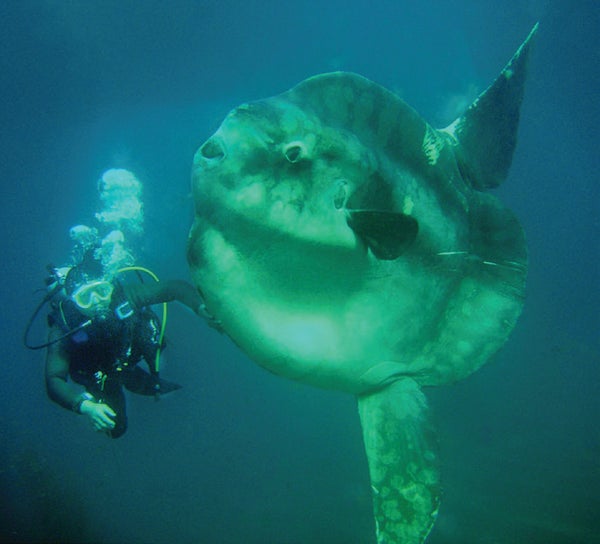
Mola alexandrini and human.

Hasama Underwater Park

Join Our Community of Science Lovers!

Scientists have long thought the ocean sunfish (Mola mola) was the largest of the bony fishes, a group of animals with skeletons made of bone instead of cartilage. It turns out they were wrong. A research team reported in January in Ichthyological Research that the biggest is, in fact, the bump-head sunfish (Mola alexandrini), specimens of which had previously been misidentified as M. mola.

Etsuro Sawai, a biologist at Hiroshima University in Japan, led the group that reexamined hundreds of sunfish specimens and scientific records from around the world. Bump-head sunfish, distinguishable by small lumps on the head and chin, can grow up to 10 feet (three meters) long and weigh more than 5,000 pounds (2,300 kilograms).

The study suggests there may be “many more such instances of misidentification of animal species”—especially considering that the sunfish is relatively large and hard to miss—says Byrappa Venkatesh, a geneticist at the Institute of Molecular and Cell Biology in Singapore, who was not involved in the new research.


On supporting science journalism

If you're enjoying this article, consider supporting our award-winning journalism by subscribing. By purchasing a subscription you are helping to ensure the future of impactful stories about the discoveries and ideas shaping our world today.


Co-author Marianne Nyegaard, an ichthyologist at Australia's Murdoch University, says this type of clarification is vital in biology and “important in understanding, for example, the ecological consequences of climate change.” Temperature changes could shift the known ranges of different species that previously were not correctly distinguished.

Douglas Main is an independent journalist who covers environmental issues, the natural world and a range of other scientific topics. His writing has appeared in the New York Times, the Atlantic, MIT Technology Review, Hakai Magazine and other publications. Until recently, he was a senior writer and editor at National Geographic. Follow him on X (formerly Twitter) at @douglas_main.

More by Douglas Main
Scientific American Magazine Vol 318 Issue 3This article was published with the title “Fishy Behemoth” in Scientific American Magazine Vol. 318 No. 3 (), p. 21
doi:10.1038/scientificamerican0318-21

It’s Time to Stand Up for Science

If you enjoyed this article, I’d like to ask for your support. Scientific American has served as an advocate for science and industry for 180 years, and right now may be the most critical moment in that two-century history.

I’ve been a Scientific American subscriber since I was 12 years old, and it helped shape the way I look at the world. SciAm always educates and delights me, and inspires a sense of awe for our vast, beautiful universe. I hope it does that for you, too.

If you subscribe to Scientific American, you help ensure that our coverage is centered on meaningful research and discovery; that we have the resources to report on the decisions that threaten labs across the U.S.; and that we support both budding and working scientists at a time when the value of science itself too often goes unrecognized.

In return, you get essential news, captivating podcasts, brilliant infographics, can't-miss newsletters, must-watch videos, challenging games, and the science world's best writing and reporting. You can even gift someone a subscription.

There has never been a more important time for us to stand up and show why science matters. I hope you’ll support us in that mission.

Thank you,

David M. Ewalt, Editor in Chief, Scientific American

Subscribe