
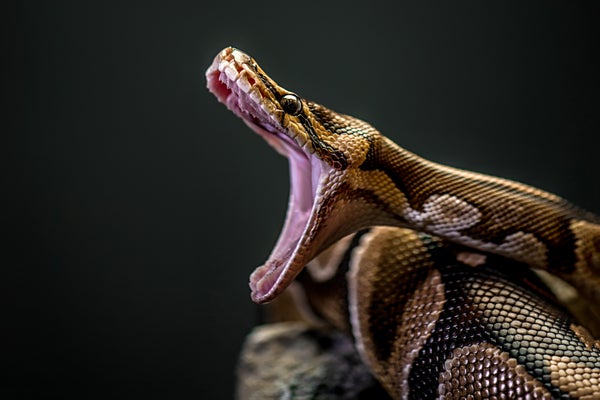
Invasive Burmese pythons slithering through the Florida Everglades eat almost anything they can get their jaws around—and that’s a lot. As the snakes’ numbers have risen, small mammal populations have plummeted. But larger animals aren’t safe either; people have spotted these pythons swallowing alligators and white-tailed deer whole. How do snakes with mouths a few inches wide devour something that huge?
Answer: They open their mouths very wide, with the help of some newly measured stretching power. A recent study shows Burmese pythons’ mouths can stretch four times wider than their skulls, creating a gaping maw four to six times bigger than a similarly sized brown tree snake’s.
Most snakes cannot take bites and must engulf prey whole. To do so, a typical snake opens its mouth at the joint in the middle of its jaw, and the two halves of the lower jaw flare out to the sides; the skin and tissue in between stretch to accommodate the food. The skin eventually snaps back, but “after they swallow a very big meal, [their chins] are baggy for a while,” says University of Cincinnati vertebrate morphologist Bruce Jayne.
On supporting science journalism
If you're enjoying this article, consider supporting our award-winning journalism by subscribing. By purchasing a subscription you are helping to ensure the future of impactful stories about the discoveries and ideas shaping our world today.
And some snakes can open wider than others. For a study in Integrative Organismal Biology, Jayne and his colleagues examined Burmese pythons from Florida and brown tree snakes from Guam (where the latter are invasive). The researchers took anatomical measurements of snakes after death, then stretched the reptiles’ jaws with funnels of increasing size. Finally, the scientists stuffed potential prey—including anesthetized alligators—through the funnels and measured deer remains recovered from a python stomach.
The experiment showed just how wide each species’ mouth could get. The secret to the Burmese pythons’ superior skill? Extra stretch in the tissues between their jaw bones. Some 43 percent of their gap width capacity could be attributed to this tissue, compared with 17 percent for the tree snakes.
According to Marion Segall, a herpetologist at London’s Natural History Museum, who was not involved in the study, the two distantly related invasive snakes make a good comparison because they have each evolved to snag large prey relative to their sizes. Future work will explore what properties make the pythons’ jaws so flexible.
Just because a python can eat a whole deer doesn’t mean venison is often on the menu. “Most [tree snakes and pythons] are opportunistic and will catch anything that passes by, [so] they will probably not target the largest prey,” Segall says. But to avoid presenting such an opportunity in the Everglades, even a big deer should probably sleep with one eye open.