High-Tech Seafloor Mapping Is Finding Surprising Structures Everywhere

Giant coral towers, vast reefs and other formations are captivating explorers

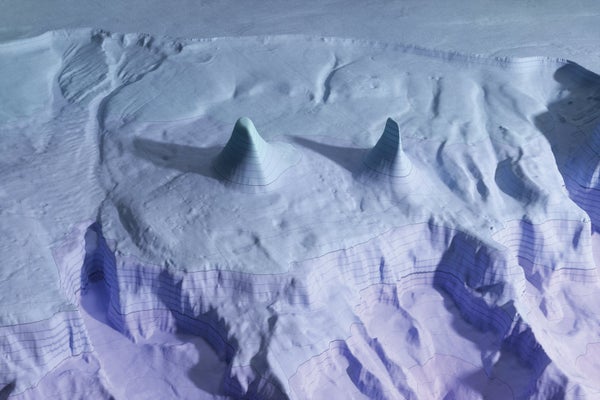
REEF TOWER
SOUTH PACIFIC, 50 MILES EAST OF CAPE YORK PENINSULA, AUSTRALIA Scientists at James Cook University in Australia were charting underwater habitats just beyond the northern end of the Great Barrier Reef using multibeam sonar when they came on a freestanding coral reef tower 1,640 feet tall—taller than the Empire State Building. The base of the wedge, shaped like a shark fin, is almost a mile across, and the tip is only 130 feet below the sea surface. Subsequent dives by a remotely operated vehicle showed the tower was teeming with fish and exhibited no signs of the coral bleaching that has tormented the Great Barrier Reef.

Join Our Community of Science Lovers!

Oceanographers are fond of saying that we know more about the moon's surface than we do about Earth's seafloor. It's true. As of 2017, only 6 percent of the global seabed had been mapped, typically by ships with sonar instruments sailing back and forth in straight lines across a local section of sea.
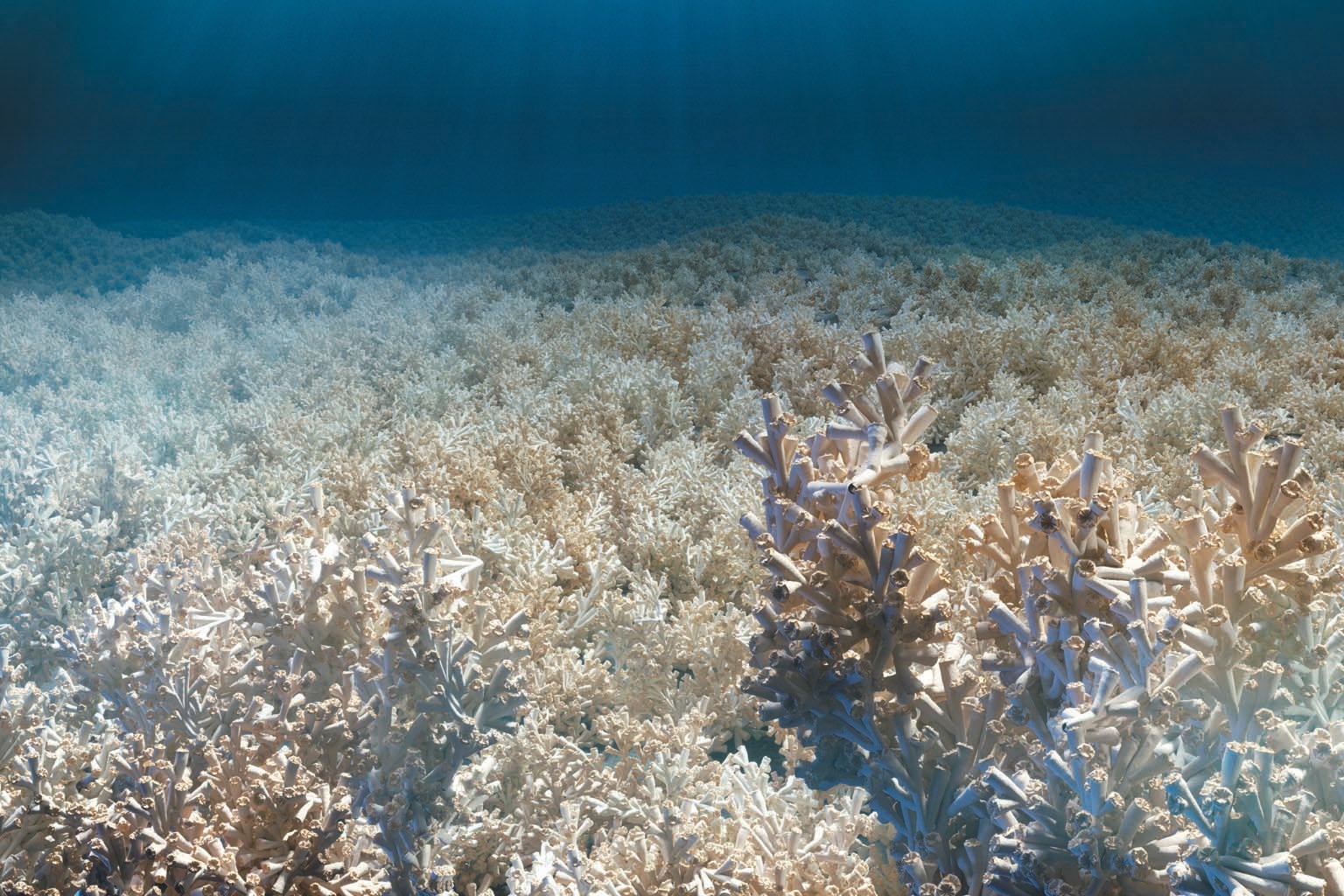
MILLION MOUNDS CORAL PROVINCE
NORTH ATLANTIC, 100 MILES EAST OF GEORGIA, U.S.
Investigators at the National Oceanic and Atmospheric Administration have finished mapping the “million mounds” deep-sea province. Thousands of coral mounds, each 30 to 300 feet high, blanket 11,000 square miles of ocean floor, making it the largest deep-sea coral ecosystem ever discovered. At a depth of 2,000 to 2,600 feet, the seafloor receives no sunlight, so the white corals don’t house symbiotic algae that give shallow reefs their color. When old corals in the mounds die, their skeletons provide the foundation for new corals; some mounds have been growing for thousands of years.

Credit: Maciej Frolow

But since then, nations have become eager to chart the seafloor within their own “exclusive economic zones,” which reach 200 nautical miles from their shores, in part to look for critical minerals they can scrape up using big mining machines. The other push is Seabed 2030—an effort to map Earth's entire seafloor by 2030, run jointly by the Nippon Foundation and the nonprofit General Bathymetric Chart of the Oceans.


On supporting science journalism

If you're enjoying this article, consider supporting our award-winning journalism by subscribing. By purchasing a subscription you are helping to ensure the future of impactful stories about the discoveries and ideas shaping our world today.


RYDER GLACIER SILL
​​​​Geologists at Stockholm University were puzzled about why the front edge of Ryder Glacier, at the Sherard Osborn Fjord, was losing less ice than the faces of other Greenland glaciers. Using multibeam sonar on an icebreaker in the fjord, they discovered two parallel sills of bedrock (red), separated by a basin, that cross the fjord. The inner sill, about 3.8 miles across and 1,600 to 1,900 feet high, blocks relatively warm Atlantic Ocean water from reaching the glacier and melting its underside, slowing the glacier’s demise.

Credit: Maciej Frolow

The goal is to collect and stitch together mapping done by governments, industries and research institutions everywhere. Public release of previously private bathymetric data is helping to widen the areas plotted. And uncrewed, remotely operated vehicles fitted with sonar that can zoom around underwater for days at a time are speeding the pace of mapping. By June 2022 an impressive 21 percent of the world's seafloor had been charted. The more experts map, the more surprises they find—such as the three unexpected, unusual formations revealed here.

Mark Fischetti was a senior editor at Scientific American for nearly 20 years and covered sustainability issues, including climate, environment, energy, and more. He assigned and edited feature articles and news by journalists and scientists and also wrote in those formats. He was founding managing editor of two spin-off magazines: Scientific American Mind and Scientific American Earth 3.0. His 2001 article “Drowning New Orleans” predicted the widespread disaster that a storm like Hurricane Katrina would impose on the city. Fischetti has written as a freelancer for the New York Times, Sports Illustrated, Smithsonian and many other outlets. He co-authored the book Weaving the Web with Tim Berners-Lee, inventor of the World Wide Web, which tells the real story of how the Web was created. He also co-authored The New Killer Diseases with microbiologist Elinor Levy. Fischetti has a physics degree and has twice served as Attaway Fellow in Civic Culture at Centenary College of Louisiana, which awarded him an honorary doctorate. In 2021 he received the American Geophysical Union’s Robert C. Cowen Award for Sustained Achievement in Science Journalism. He has appeared on NBC’s Meet the Press, CNN, the History Channel, NPR News and many radio stations.

More by Mark Fischetti
Scientific American Magazine Vol 327 Issue 2This article was published with the title “Every Inch of the Seafloor” in Scientific American Magazine Vol. 327 No. 2 (), p. 40
doi:10.1038/scientificamerican0822-40

It’s Time to Stand Up for Science

If you enjoyed this article, I’d like to ask for your support. Scientific American has served as an advocate for science and industry for 180 years, and right now may be the most critical moment in that two-century history.

I’ve been a Scientific American subscriber since I was 12 years old, and it helped shape the way I look at the world. SciAm always educates and delights me, and inspires a sense of awe for our vast, beautiful universe. I hope it does that for you, too.

If you subscribe to Scientific American, you help ensure that our coverage is centered on meaningful research and discovery; that we have the resources to report on the decisions that threaten labs across the U.S.; and that we support both budding and working scientists at a time when the value of science itself too often goes unrecognized.

In return, you get essential news, captivating podcasts, brilliant infographics, can't-miss newsletters, must-watch videos, challenging games, and the science world's best writing and reporting. You can even gift someone a subscription.

There has never been a more important time for us to stand up and show why science matters. I hope you’ll support us in that mission.

Thank you,

David M. Ewalt, Editor in Chief, Scientific American

Subscribe