
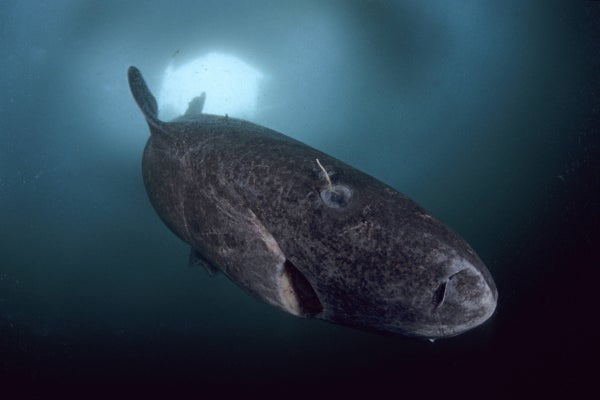
Everything about a Greenland shark’s life is slow: their heart beats about once every 12 seconds; they swim at an average speed of just a foot per second; they grow at a sluggish rate of just one centimeter (0.4 inch) a year; and they don’t reach sexual maturity until their 150th birthday. The sluggish living makes sense for steely behemoths that live comfortably into their 200s and possibly to 400 or more.
Recently, scientists found that the sharks keep their eyesight well into senescence, not only quashing some suspicions that the animals were blind but also revealing their vision remains functional in low light for more than a century. Understanding how these sharks keep all their parts humming along for so long offers insights into aging—which one day could help researchers extend the human life span. And now a new study shows how the sharks’ heart can beat steadily for centuries without any apparent malfunction.
Long-lived animals are often equipped with age-defying traits, such as efficient DNA repair mechanisms, evolved protection from tumors and adept immune systems. The Greenland shark, which can grow to more than 16 feet long, is a prime example: its genome is full of genes linked to anti-inflammation, cancer suppression and resistance to cellular damage. But what about its most vital organ?
On supporting science journalism
If you're enjoying this article, consider supporting our award-winning journalism by subscribing. By purchasing a subscription you are helping to ensure the future of impactful stories about the discoveries and ideas shaping our world today.
In the new study, Alessandro Cellerino of the Biology Laboratory at the Superior Normal School (SNS) in Italy and his colleagues investigated whether the shark’s heart was somehow armored against the wear and tear that comes with age. So they analyzed heart tissue from Greenland sharks for hallmarks of aging and compared it with the hearts of the much smaller velvet belly lantern shark—a deep-sea shark with a far shorter life span—and the short-lived African turquoise killifish, an organism that scientists often use as a model for accelerated aging.
It turned out that the Greenland sharks, all of which were estimated to be between 100 and 155 years of age, had a decrepit heart. The hearts of these sharks showed severe fibrosis, which happens when scar tissue accumulates and causes stiffness that can impair pumping over time, the researchers wrote. Inside the sharks’ cardiomyocytes—the cells that mechanically pump the heart—the team found massive amounts of lipofuscin, an age-related pigment that is produced when damaged cell machinery doesn’t break down properly. And sure enough, the analysis showed damage to the cardiac mitochondria, which power the cells, and oversize lysosomes, which help break down cellular material.
These same aging indicators didn’t show up in the comparison hearts.
“All in all, the analyzed Greenland shark samples showed clearly recognizable signs of classic aging at the molecular and tissue level,” Cellerino said in a German-language statement. “This proves that aging processes also take place in the heart tissue of this species.” The findings were published on April 23 in Aging Cell.
Despite their aging heart, the sharks seemed quite able to get around—some of the specimens in the study were collected by longline fishing in Greenland waters, suggesting the sharks could find bait and successfully capture it.
The team isn’t sure exactly how the hearts of the Greenland sharks seem to operate so smoothly. The sharks are known to have lower blood pressure compared with other species; that fact, along with the distinct structure of their ventral aorta, could keep their heart muscle elastic despite the damage caused by age, the researchers speculated.
The study results provide a window into “how one of Earth’s longest-lived vertebrates manages cellular and tissue aging in a vital organ,” the researchers wrote in the paper. The sharks’ resilience to aging could help scientists better understand longevity in vertebrates, including humans. “These findings may also inform translational approaches to mitigate age-related cardiac decline in humans,” the study authors wrote.