New Issue: Orbital Catastrophe Ahead? Read Now

These Bizarre, Centuries-Old Sharks May Have a Hidden Longevity Superpower

The very, very long-lived Greenland sharks were long thought to be practically blind. But a new study finds that they not only can see but also maintain their vision into old age

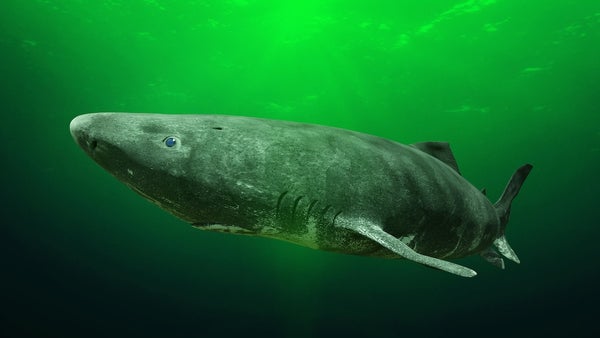
A Greenland shark seen in near profile with ambient green lighting

A Greenland shark (Somniosus microcephalus).

dotted zebra/Alamy Stock Photo

Join Our Community of Science Lovers!

Greenland sharks are a biological anomaly. The animals can grow to more than 20 feet long, weigh more than a ton and can live for nearly 400 years, making the species the longest-living vertebrate on the planet—a fact that could help unlock secrets to enhancing longevity.

And now, in a study published this week in Nature Communications, scientists dial in to one of the Greenland shark’s more remarkable features: it has functioning eyes and, more remarkably, maintains its vision well into senescence.

Biologists have long believed these sharks to be practically blind, in part because of their tendency to attract parasites that attack and lodge themselves inside the sharks’ corneas. But this work challenges that belief, the researchers write, showing that even centuries-old Greenland sharks retain a visual system “well-adapted for life in dim light.”


On supporting science journalism

If you're enjoying this article, consider supporting our award-winning journalism by subscribing. By purchasing a subscription you are helping to ensure the future of impactful stories about the discoveries and ideas shaping our world today.


“Evolutionarily speaking, you don’t keep the organ that you don’t need,” said Dorota Skowronska-Krawczyk, an associate professor of physiology and biophysics at the University of California, Irvine, and a co-author of the paper, in a statement. “After watching many videos, I realized this animal is moving its eyeball toward the light.”

Skowronska-Krawczyk and her colleagues analyzed samples taken from sharks that were more than a century old and found no obvious signs of retinal degeneration, which, she notes, is a “remarkable” finding, considering their advanced age.

The researchers say the work offers a jumping off point for future research into how the sharks preserve their vision over such long periods of time, work that could eventually inform studies of age-related vision loss in humans—and how it might be prevented.

“Not a lot of people are working on sharks, especially shark vision,” said Emily Tom, a Ph.D. student at the University of California, Irvine, who is also a co-author of the study, in the same statement.

“We can learn so much about vision and longevity from long-lived species like the Greenland shark,” Tom said.

Editor’s Note (1/9/26): This story was edited after posting to include an image of a Greenland shark.

Jackie Flynn Mogensen is a breaking news reporter at Scientific American. Before joining SciAm, she was a science reporter at Mother Jones, where she received a National Academies Eric and Wendy Schmidt Award for Excellence in Science Communications in 2024. Mogensen holds a master’s degree in environmental communication and a bachelor’s degree in earth sciences from Stanford University. She is based in New York City.

More by Jackie Flynn Mogensen

Subscribe to Support Independent Journalism

Great science journalism requires human expertise, time, effort and creativity. And it costs money. That’s why I and the journalists here at Scientific American hope you’ll join our community.

When you subscribe, you are supporting staff and freelance journalists who are passionate about telling science stories that are true, important and compelling. Our editors and reporters are often experts in their fields, which means they understand the nuances of big discoveries and can untangle the breakthroughs from the hype. With a subscription, you are also supporting rigorous fact-checking to ensure the words we publish are precise and accurate. And you’re supporting original illustrations, graphics and photos that bring you closer to an advanced laboratory, an ice sheet in Antarctica or a space mission in orbit. You’re helping us craft other types of high-quality journalism as well: Our newsletters are carefully written, edited and curated by staffers you have or will come to know and love. Our Science Quickly podcast is based on original reporting, collaboration with editors and scientists and exacting production.

Subscriptions keep this engine running so we can continue to deliver thoughtful, rigorous and independent science journalism to you. In an era of viral misinformation, this work is crucial. If you value what we do, I hope you’ll consider joining us as a subscriber

Thank you,

Jeanna Bryner, Editor in Chief, Scientific American

Subscribe