
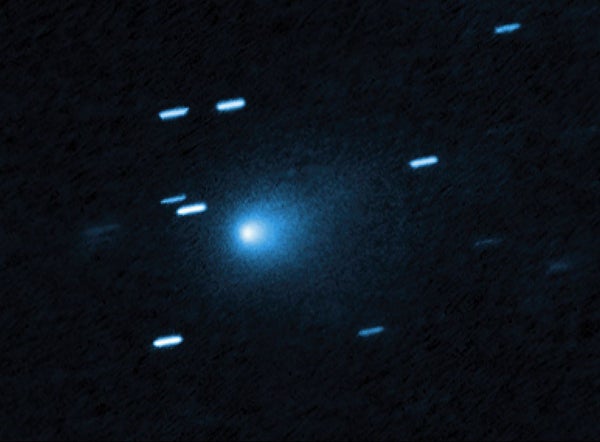
A comet from another star system is due to make its closest—and final—approach to Earth this week before it continues on its journey back toward interstellar space.
Interstellar Comet 3I/ATLAS will pass within 167 million miles of our planet on Friday, when it will appear to us like a bright star in the night sky. For comparison, Mars is currently around 250 million miles from Earth. Eager sky watchers armed with a pair of good binoculars or a backyard telescope should be able to spot the comet—and of course, astronomers are watching closely.
Scientists have been scrutinizing 3I/ATLAS since its discovery in July, but Friday offers the best opportunity yet to observe the comet: as just the third stray object known to have entered our solar system from interstellar space, 3I/ATLAS holds clues to how solar systems form elsewhere in the universe. The United Nations’ International Asteroid Warning Network is also observing 3I/ATLAS, tracking its path through the sky in a bid to strengthen planetary defense against so-called near-Earth objects like comets and asteroids.
On supporting science journalism
If you're enjoying this article, consider supporting our award-winning journalism by subscribing. By purchasing a subscription you are helping to ensure the future of impactful stories about the discoveries and ideas shaping our world today.
It remains a mystery where 3I/ATLAS came from. Like the other two interstellar visitors, the comet is on a hyperbolic path, meaning it is moving too fast to be gravitationally bound to our sun. When it was discovered, it was traveling at around 137,000 miles an hour—nearly 40 miles a second. “It’s like glimpsing a rifle bullet for a thousandth of a second,” said astronomer David Jewitt, who has observed the comet using the Hubble Space Telescope, to NASA earlier this year. “You can’t project that back with any accuracy to figure out where it started on its path.”
Astronomers hope Friday’s approach will shed some light on this interstellar stranger. The dust and gas that the comet has been releasing as the sun has warmed its icy interior may offer insights into how it formed, for example. The Virtual Telescope Project plans to live stream the approach starting at 11 P.M. EST on December 18.