
NASA just dropped a trove of new images of interstellar Comet 3I/ATLAS, as seen by some of the space agency’s spacecraft.
The release comes after NASA scientists and engineers waited through the six-week government shutdown to see whether spacecraft stationed across the inner solar system would catch sight of Comet 3I/ATLAS, an illustrious and intriguing object that is only the third known interloper from beyond our own solar system.
Today’s reveal showed what the agency was able to accomplish anyway during these prime observation opportunities.
On supporting science journalism
If you're enjoying this article, consider supporting our award-winning journalism by subscribing. By purchasing a subscription you are helping to ensure the future of impactful stories about the discoveries and ideas shaping our world today.

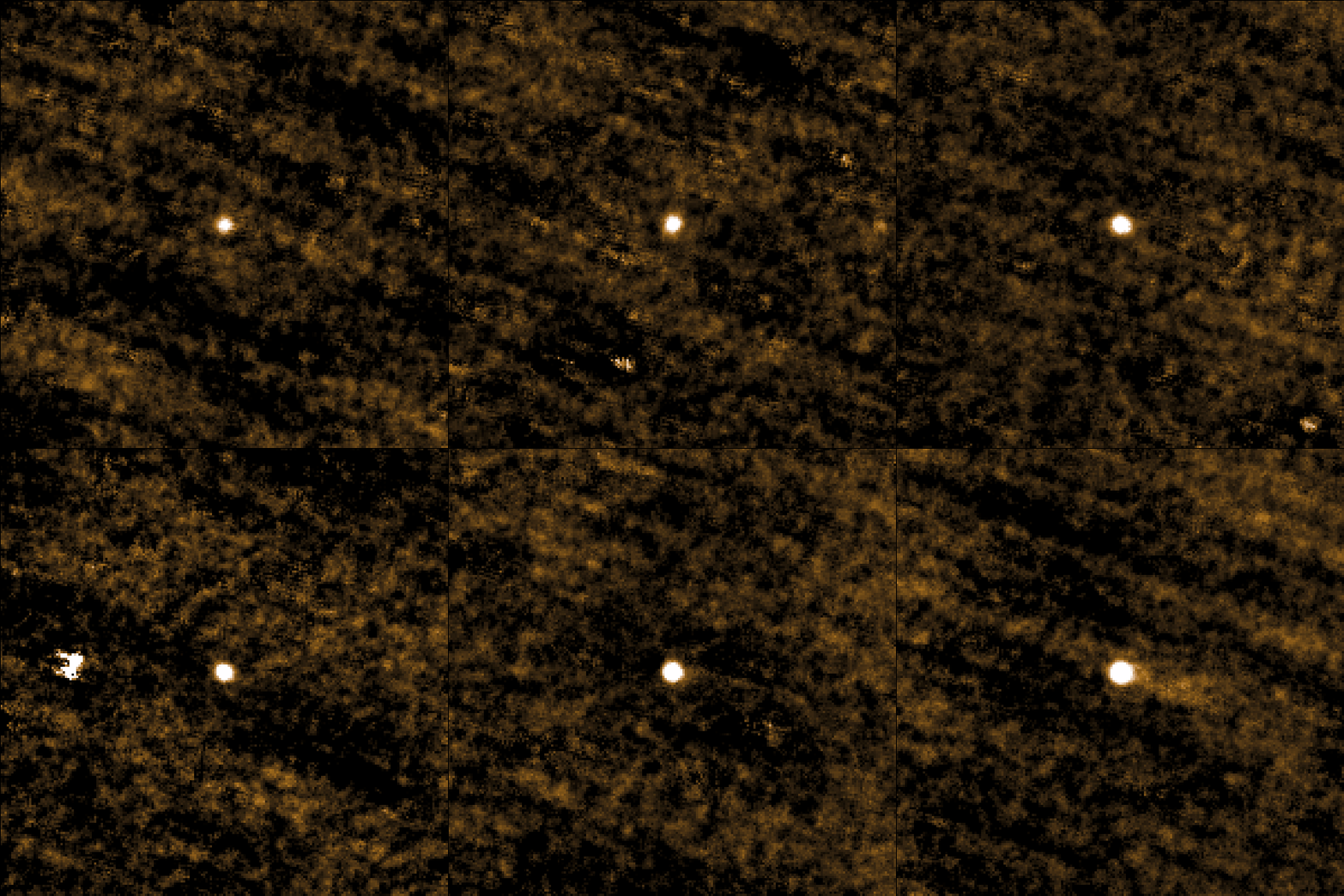
This image shows the halo of gas and dust, or coma, surrounding comet 3I/ATLAS, the third interstellar object ever detected by astronomers as it passes through our solar system. It was taken on October 9, 2025, by an instrument onboard NASA’s Mars Atmosphere and Volatile Evolution (MAVEN) spacecraft, which has been studying Mars from its orbit since 2014. The instrument, the Imaging Ultraviolet Spectrograph, takes pictures in the ultraviolet part of the spectrum to reveal the chemical composition of objects. The center of the image has the brightest pixel, indicating where the comet is. The next brightest shades in the image indicate areas where the instrument detected atoms of hydrogen coming from the comet. This hydrogen is released when sunlight heats the comet, causing its water ice to turn directly into vapor. Once released into space, the water molecules break apart into oxygen and hydrogen atoms.
NASA/Goddard/LASP/CU Boulder
The new images come from a wide range of NASA missions, including planetary science missions such as the Perseverance Mars rover and the Mars Atmosphere and Volatile Evolution (MAVEN) orbiter, as well as the asteroid missions Psyche and Lucy and the sun-studying spacecraft Polarimeter to Unify the Corona and Heliosphere (PUNCH).
“We are so happy to have our incredible fleet of NASA science spacecraft all across the solar system,” said Nicky Fox, associate administrator of NASA’s Science Mission Directorate. “Boy, were they ready for this event.”
READ MORE: The Race to Study an Interstellar Comet from Deep Space
Scientists first detected 3I/ATLAS on July 1 using a telescope called Asteroid Terrestrial-Impact Last Alert System (ATLAS) based in Chile. The combination of the comet’s remarkable speed—it was zipping through the solar system at 137,000 miles per hour—and its unusual trajectory suggested that 3I/ATLAS was not from our celestial neighborhood.
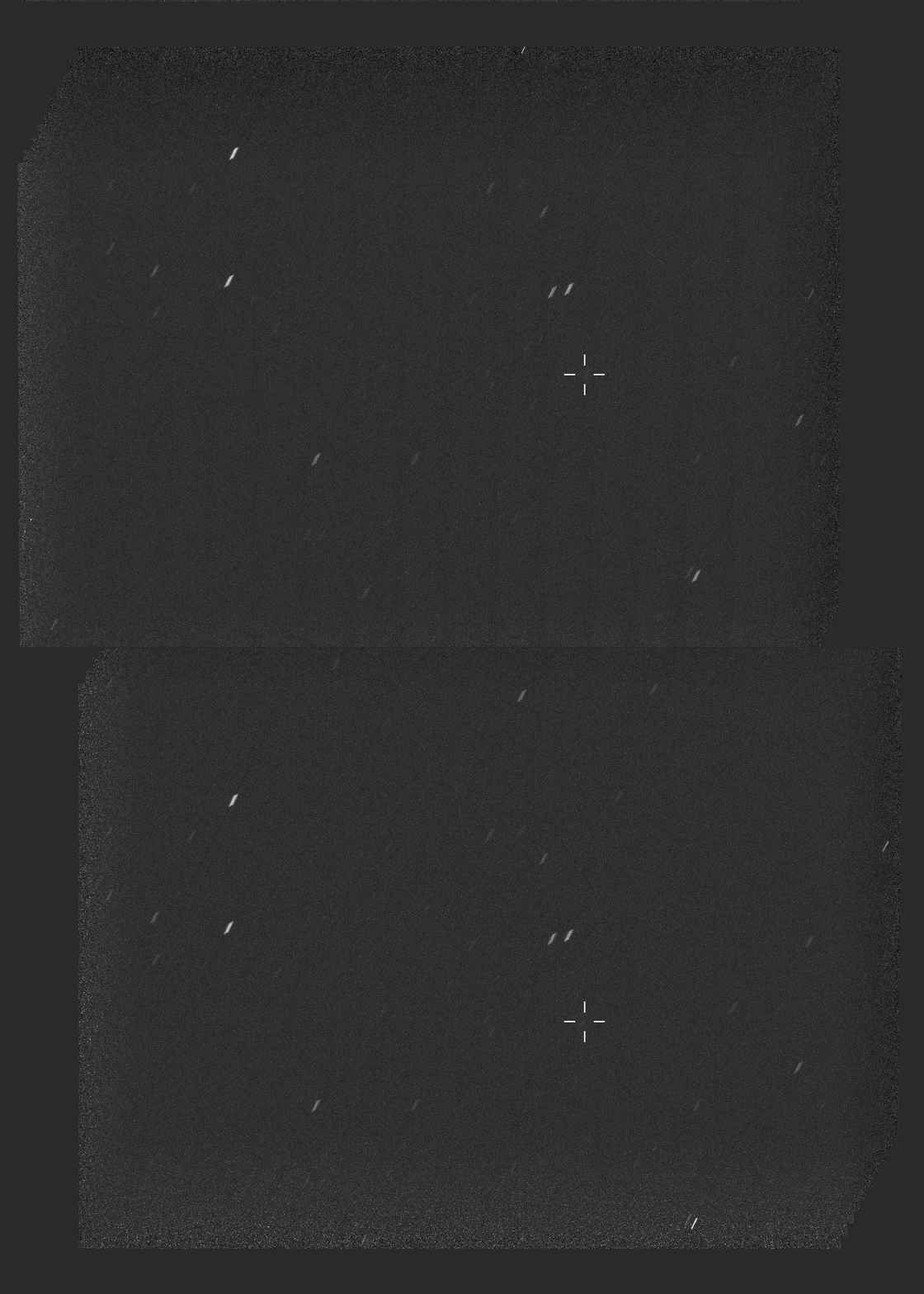
Interstellar comet 3I/ATLAS is seen as a faint smudge against a background star field in two images taken by the Mastcam-Z instrument aboard NASA’s Perseverance Mars rover on October 4, 2025. At the time it was imaged, the comet was about 18.6 million miles from the rover, which was exploring the rim of the Red Planet’s Jezero Crater.
NASA/JPL-Caltech/ASU/MSSS
That made the comet only the third confirmed interstellar object—following 1I/‘Oumuamua, discovered in 2017, and Comet 2I/Borisov, discovered in 2019. Limited by these brief visits, astronomers have hustled to gather as many observations of the Comet 3I/ATLAS as possible. To do so, they have recruited instruments on Earth, in orbit and even farther afield.
“Each one of these has been special and precious, and everybody drops everything to look at them,” said Karen Meech, a planetary astronomer at the University of Hawaii, in an interview with Scientific American in October.
Past observations have revealed that the comet is unusually rich in carbon dioxide and that this material appears to have been buried below the object’s surface. That suggests Comet 3I/ATLAS formed in a much colder location, farther from its star, than our own solar system’s comets did, and that if likely had been warmed by its own or another star before its visit to our solar system.
Scientists are still digging into everything the newly released observations show. Simultaneously, the quest to catch sight of Comet 3I/ATLAS continues—the James Webb Space Telescope, notably, will attempt additional observations in December, NASA officials noted today. That instrument will likely be the final NASA mission able to see the comet on its path out of the solar system.
“I am excited to see what new things we learn about our friendly solar system visitor in the days and in fact the years to come,” Fox said.