
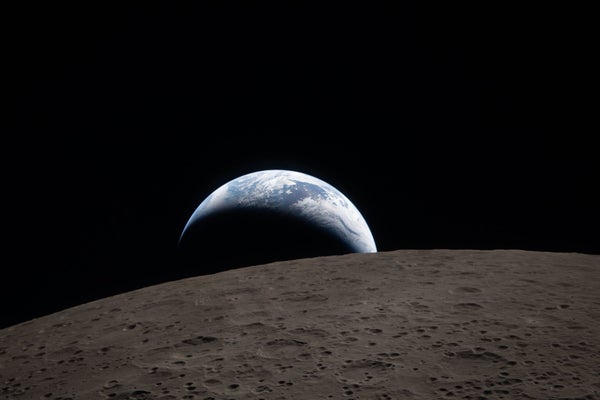
As the crew of NASA’s Artemis II mission shot around the moon on Monday—going farther from our world than any human has gone before—the astronauts had Earth on their mind.
Looking at our home planet as they rounded the moon’s far side, the crew captured a new “Earthrise”—a stunning re-creation of sorts of one of the most iconic photographs of our world ever taken. The original “Earthrise” was snapped by the late astronaut William Anders during the Apollo 8 mission on December 24, 1968.
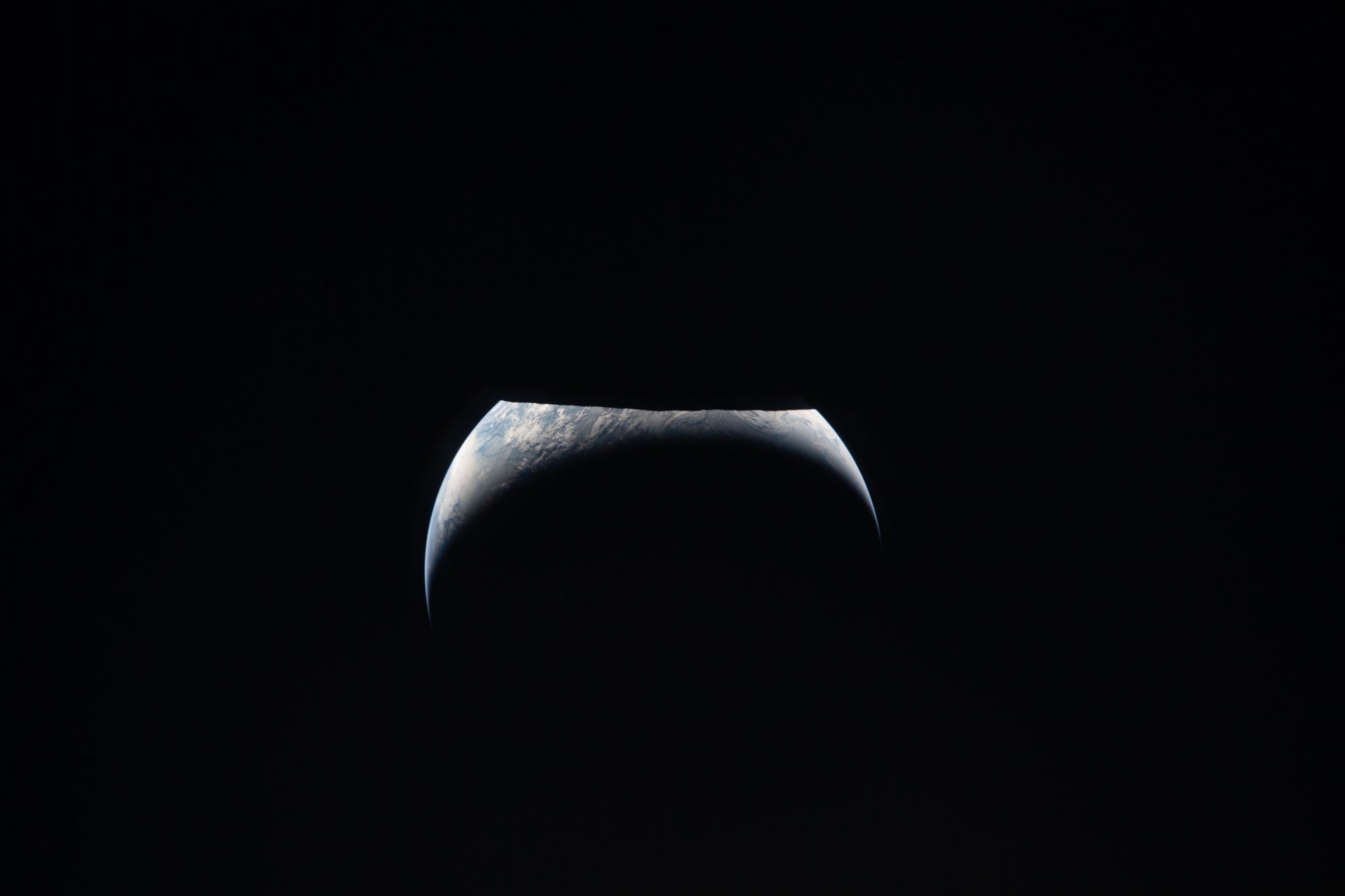
“Earthrise” captured through the Orion spacecraft window on April 6 at 7:22 P.M. EDT on Monday.
NASA
On supporting science journalism
If you're enjoying this article, consider supporting our award-winning journalism by subscribing. By purchasing a subscription you are helping to ensure the future of impactful stories about the discoveries and ideas shaping our world today.
And less than an hour before, the Artemis II crew also captured “Earthset,” showing our planet appearing to set behind the moon. During the period in between the two imaging opportunities, NASA astronauts Reid Wiseman, Victor Glover, and Christina Koch and Canadian Space Agency astronaut Jeremy Hansen lost contact with Houston Ground Control for around 40 minutes as the Orion spacecraft rounded the far side of the moon.
At the moment the astronauts would have seen Earthset and Earthrise, much of Earth’s eastern hemisphere would have been visible to them. “To Asia, Africa and Oceania: We are looking back at you,” Koch said after the crew rounded the moon's far side and regained their signal with Houston on Monday. “We hear you can look up and see the moon right now. We see you, too.”
The original iconic “Earthrise” image, showing all of humanity hanging in the vastness of space, is credited with helping to spark a global environmental movement.

The iconic 1968 “Earthrise” picture
Unlike Artemis II, however, the Apollo 8 crew orbited the moon a total of 10 times. The Orion spacecraft won’t orbit the moon. Anders took the image on the fourth orbit of Apollo 8’s spacecraft.
“There’s the Earth comin’ up,” Anders said at the time. “Wow, is that pretty!”
Anders later compared the sight of the Earth to “a fragile Christmas tree ornament.”
“I thought to myself, it's too bad we don't treat it more like a Christmas tree ornament,” Anders said in a 2023 NASA interview. “It's really too bad, we're shooting missiles and rockets and whatnot at each other on this tiny little place we call home,” Anders added. “It's the only home in the universe for us humans. And it's too bad we don't treat it a little better.”