
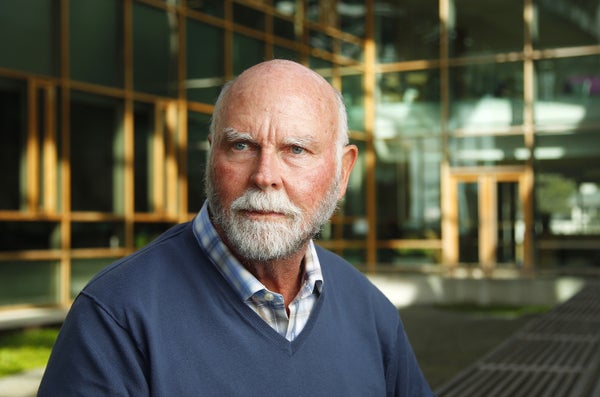
J. Craig Venter, the scientist who raced to decode the human genome, has died at age 79.
Venter rose to fame in the field for publishing the first bacterial genome ever decoded, along with a list of gene annotations, in 1995. The achievement kicked off an age of discovery in genetics, with researchers racing to decode the genomes of other pathogens—and eventually animals.
As founder of Celera Genomics in 1998, Venter honed his method of decoding—whole-genome shotgun sequencing—which can rapidly sequence different parts of the genome at the same time and then uses machine learning to reassemble them in the right order. The technique allowed him to enter the race to decode the human genome late.
On supporting science journalism
If you're enjoying this article, consider supporting our award-winning journalism by subscribing. By purchasing a subscription you are helping to ensure the future of impactful stories about the discoveries and ideas shaping our world today.
Celera went up against an international, U.S.-government-backed research group known as the Human Genome Project in a competition that spurred each side on until Venter—having come under significant pressure from the Clinton administration—agreed to a draw with the group. Notably, Venter used his own genome as his sample for the effort. The Human Genome Project was declared complete in 2003, with 92 percent of the human genome decoded; the majority of the remaining genome was sequenced by 2021. Venter wrote about the effort in an article for Scientific American, which can be read here.
In a recent interview with Scientific American, Venter pointed to his philosophy of taking risks to do big things in science. “You have to take risks. If you’re risk adverse, you’re in the wrong field,” Venter said.
J. Craig Venter sat down with SciAm weeks before his passing, and spoke widely about genomics, AI hype, what the Trump administration has gotten right about science, and his view of a path to immortality.
“Craig Venter was a force of nature and really an important though controversial figure," said John Hardy, a professor of neuroscience and group leader at the UK Dementia Research Institute at University College London, in a statement. “The race to complete the human sequence was a testosterone driven competition between the US and UK consortia with the big personalities of [geneticists] Francis Collins and Eric Lander on one side and Craig’s team on the other. There is no doubt that this competition speeded things up enormously and it ended really in a score draw with both sides publishing simultaneously in Science and Nature.”
Venter also led an effort to explore the world’s oceans and trace the genetics of marine microbial communities. The first Global Ocean Sampling Expedition, which used Venter’s own yacht, circumnavigated the globe between 2005 and 2006. And he spearheaded an effort to make synthetic genomes, ultimately creating the first self-replicating, synthetic bacterial cell in 2010. In his later career, he became more interested in longevity research, and in 2013 he co-founded Human Longevity, a venture dedicated to finding new ways to fight diseases linked to aging, such as Alzheimer’s disease.
In the same interview with Scientific American, Venter argued that artificial intelligence can’t do the same kind of work as he did because human creativity isn’t limited by a training dataset. “We’re all limited by our training sets, but we have [the] unique ability so far of being able to assemble things from missing pieces. And ... what I’ve been particularly good at is taking complex concepts and sort of seeing what’s next, what’s the future and ‘What do we have to solve and answer to get there?’” Venter said.
“J. Craig Venter was a swashbuckling, restless pioneer of genome sequencing and synthetic biology,” said Roger Highfield, science director of the Science Museum Group, a U.K. science museum consortium, in the same statement. Highfield edited Venter's memoir, A Life Decoded. “Craig was a divisive figure but had huge chutzpah and was always driven on by the science. He was never going to win diplomat of the year, but he was always straightforward.”
Venter began his academic career in 1969 at a California community college, College of San Mateo, before transferring to the University of California, San Diego. Then president Barack Obama awarded Venter a 2008 National Medal of Science for his genetics work. Afterward Venter reflected in his piece for Scientific American that the achievement came “after years of never-ending work, criticism (from the outside world and even internally at my company), intervention by top science journal editors and even President [Bill] Clinton.”
“To be standing where history was being made that day was a very emotional and fulfilling experience,” he wrote of the announcement of the first draft of the human genome sequence in 2000.
The J. Craig Venter Institute, a nonprofit research group founded by Venter, said in a statement to media that he had been hospitalized after complications tied to cancer treatment. He died on April 29.
Additional reporting by Jeanna Bryner.
Editor’s Note (4/30/26): This is a developing story and may be updated.