See How Scientists Put Together the Complete Human Genome

For the first time, researchers have sequenced all 3,117,275,501 bases of our genetic code

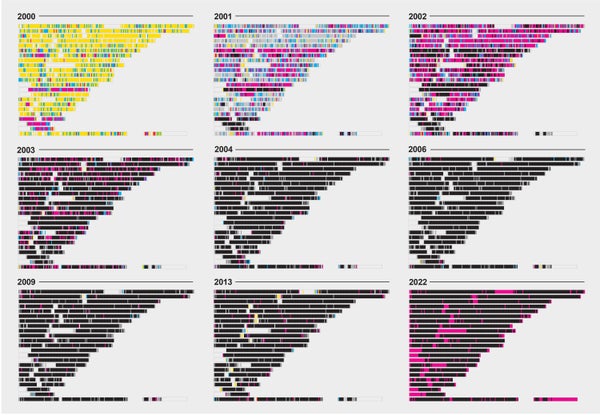
Series of charts shows how much of the human genome was sequenced over time since 2000, ending in completion in 2022.

Martin Krzywinski

Join Our Community of Science Lovers!


On supporting science journalism

If you're enjoying this article, consider supporting our award-winning journalism by subscribing. By purchasing a subscription you are helping to ensure the future of impactful stories about the discoveries and ideas shaping our world today.


The human genome is at last complete. Researchers have been working for decades toward this goal, and the Human Genome Project claimed victory in 2001, when it had read almost all of a person's DNA. But the stubborn remaining 8 percent of the genome took another two decades to decipher. These final sections were highly repetitive and highly variable among individuals, making them the hardest parts to sequence. Yet they revealed hundreds of new genes, including genes involved in immune responses and those responsible for humans developing larger brains than our primate ancestors. “Now that we have one complete reference, we can understand human variation and how we changed with respect to our closest related species on the planet,” says geneticist Evan Eichler of the University of Washington, one of the co-chairs of the Telomere-to-Telomere consortium that finished the genome.

Credit: Martin Krzywinski; Sources: UCSC Genome Browser; “The Complete Sequence of a Human Genome,” by Sergey Nurk et al., in Science, Vol. 376; April 2022

Editor’s Note (7/22/22): The graphic in this article was edited after posting to correct the number of bases in a totally gapless genomic sequence in 2022.

Clara Moskowitz is chief of reporters at Scientific American, where she covers astronomy, space, physics and mathematics. She has been at Scientific American for more than a decade; previously she worked at Space.com. Moskowitz has reported live from rocket launches, space shuttle liftoffs and landings, suborbital spaceflight training, mountaintop observatories, and more. She has a bachelor’s degree in astronomy and physics from Wesleyan University and a graduate degree in science communication from the University of California, Santa Cruz.

More by Clara Moskowitz

Martin Krzywinski is a staff scientist at Canada's Michael Smith Genome Sciences Center.

More by Martin Krzywinski
Scientific American Magazine Vol 327 Issue 2This article was published with the title “3,117,275,501 Bases, 0 Gaps” in Scientific American Magazine Vol. 327 No. 2 (), p. 92
doi:10.1038/scientificamerican0822-92

It’s Time to Stand Up for Science

If you enjoyed this article, I’d like to ask for your support. Scientific American has served as an advocate for science and industry for 180 years, and right now may be the most critical moment in that two-century history.

I’ve been a Scientific American subscriber since I was 12 years old, and it helped shape the way I look at the world. SciAm always educates and delights me, and inspires a sense of awe for our vast, beautiful universe. I hope it does that for you, too.

If you subscribe to Scientific American, you help ensure that our coverage is centered on meaningful research and discovery; that we have the resources to report on the decisions that threaten labs across the U.S.; and that we support both budding and working scientists at a time when the value of science itself too often goes unrecognized.

In return, you get essential news, captivating podcasts, brilliant infographics, can't-miss newsletters, must-watch videos, challenging games, and the science world's best writing and reporting. You can even gift someone a subscription.

There has never been a more important time for us to stand up and show why science matters. I hope you’ll support us in that mission.

Thank you,

David M. Ewalt, Editor in Chief, Scientific American

Subscribe