
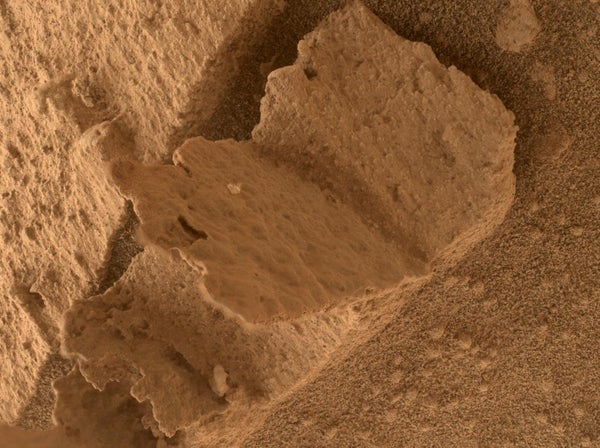
A cute new photo courtesy of the Mars rover Curiosity shows a miniature book-shaped rock nestled in the soil of the Gale Crater.
The shape is the result of an interplay of wind, water—and the human brain. While many of the rock shapes on Mars hint at a dynamic past, says mineralogist Susanne Schwenzer of the Open University in England, the rocks often objectively look like plain, rounded pebbles. A few, though, remind the human eye of familiar objects. For instance, the Curiosity rover recently captured images of rocks that look like jagged shark teeth and delicate corals.
The human propensity to see familiar objects in ambiguous patterns is called pareidolia. Famously, in 1976 a photo taken from the Viking I spacecraft exemplified this phenomenon on a large scale. The image seemed to show an eerie face peering up from Mars’s surface. The “Face on Mars” became a pop culture sensation and fuel for conspiracy theories about alien monuments. Later, higher-resolution photographs with fewer shadows showed a pretty plain mesa.
On supporting science journalism
If you're enjoying this article, consider supporting our award-winning journalism by subscribing. By purchasing a subscription you are helping to ensure the future of impactful stories about the discoveries and ideas shaping our world today.
Curiosity captured the picture of the book rock on April 15. It’s a tiny feature, just 2.5 centimeters (about one inch) long. The origin of this miniature sculpture likely stretches back some four billion years, when the sediments that make up the base of Gale Crater were being deposited, Schwenzer says. At the time, the region hosted liquid water that traveled through pores in the rocks, depositing minerals in some spots and dissolving them away from others. This leads to uneven properties within rocks, Schwenzer says, so that when the rocks erode to the point they are on the planet’s surface and the wind whips against them, they don’t wear away evenly. “The softer parts weather away quicker,” she says.
In the case of the book rock, an ancient fracture might have created the sheetlike “page” portion of the formation, Schwenzer says. When rocks crack, either because of strain from sediments layered on top of them or because of meteorite strikes, fluids can move into those cracks and deposit new minerals. If those minerals are harder than the surrounding rock, they’ll remain after the rest of rock weathers away.
“You have an at least three-step process,” Schwenzer says. “You’ve got the rock, you’ve got the formation of that harder part, and then you have the weathering.”
Gale Crater went through wet and dry periods for the first billion or so years of its existence. The last time liquid water flowed in this region was likely about 2.6 billion years ago, Schwenzer says, with wind taking over all of the sculpting since.