
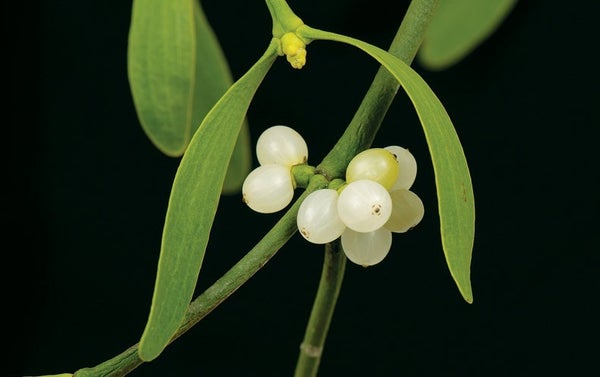
Many people today associate mistletoe with holiday kisses. But for centuries the plant was known more for its remarkable stickiness; ancient Greeks and Romans used gooey mistletoe berries for applications ranging from bird traps to skin ulcer ointment. Now biochemists are investigating whether mistletoe's clinginess can provide a natural alternative to synthetic glues.
For the parasitic mistletoe plant, stickiness is essential. Inside each berry are seeds coated in a mucuslike substance called viscin. After a bird gobbles up and digests a berry, it expels globs of seeds in strands of this substance, which drape over tree branches and glue the seeds in place. The mistletoe then embeds itself into the tree, siphoning water and nutrients from its host.
To determine what makes this natural adhesive so tacky, McGill University chemical biologist Matt Harrington and researchers at the Max Planck Institute of Colloids and Interfaces in Potsdam harvested mistletoe plants growing on apple trees in Germany. Using tweezers, they pulled the stringy viscin from the berries for a closer look.
On supporting science journalism
If you're enjoying this article, consider supporting our award-winning journalism by subscribing. By purchasing a subscription you are helping to ensure the future of impactful stories about the discoveries and ideas shaping our world today.
In a study published in PNAS Nexus, the team found that viscin's structure sets it apart from other adhesives. Whereas many synthetic glues start as puddles of sticky chemicals, viscin is made of stiff strands of cellulose that help it hold firm. These strands are encased in a humidity-sensitive coating that keeps the substance extremely malleable: Under humid conditions, a viscin thread about a half centimeter long can be stretched to over two meters in length. When it dries, the goo stiffens like cement. “This multifunctional, humidity-responsive nature is what blew my mind,” Harrington says.
The researchers found that viscin is strong—it supported weights 50 times heavier than mistletoe seeds—and it is also quite versatile. Viscin is adapted to adhere to bark and feathers, but the team found that it sticks to just about anything, including skin. (Wetting hands covered in viscin doesn't remove the compound, Harrington says, but rubbing them together generates enough warmth and moisture to loosen its grip.)
The scientists say viscin could be used as a biodegradable agent to seal fresh wounds. They tested viscin on cuts made to a piece of pork from a local butcher shop; once the viscin dried, it kept the gashes sealed, even when force was applied.
According to Juliann Aukema, a researcher at the USDA Forest Service who studies mistletoe ecology and was not involved in the study, this alternative to petroleum-based synthetic glues could revitalize the ancient importance of mistletoe. “There's this wealth of mistletoe knowledge that we had and lost,” Aukema says. “And we're relearning it now in 2022.”