
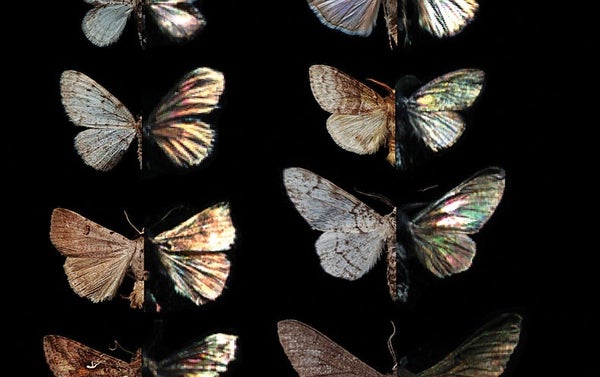
Moths' drab gray and brown coats may not capture our imaginations as much as their colorful butterfly cousins do, but according to a recent study, that's more a failure of human eyesight than of moths themselves.
By photographing the wing scales of 82 moths from 26 different species using a camera that captures an extra wide spectrum of light, researchers viewed the insects in the infrared: wavelengths of light too long for humans to see. In infrared, the buff and beige wings we are used to seeing flutter around outdoor lights take on vibrant, iridescent colors, the researchers reported in the Journal of the Royal Society Interface.
Beyond exposing moths' beauty, the new data also revealed species-specific structural differences in how the insects' wings reflect and scatter infrared light. The diversity of these infrared features—which come from microscopic scales that cover moth wings—could eventually help scientists identify moth species using lidar (light detection and ranging), a tool that emits and senses infrared light.
On supporting science journalism
If you're enjoying this article, consider supporting our award-winning journalism by subscribing. By purchasing a subscription you are helping to ensure the future of impactful stories about the discoveries and ideas shaping our world today.
Scientists already use radar to count moths in the field. But species details could help scientists keep track of the creatures' varying nocturnal migrations, which serve as major food sources for birds and other animals.
Radar entomologist Alistair Drake of the University of New South Wales in Australia notes the potential limitations of lidar for moth monitoring. “The thing about lidar is it has a very narrow beam,” says Drake, who was not involved in this study. The radar beams used to detect insects can be 60 to 100 feet across, big enough to capture lots of individual organisms flying past, whereas lidar beams span only a few inches—about the size of a single hawk moth. “So we don't really know whether the vertical-pointing lidar beam is going to produce enough insect crossings to be useful.”
To test the proposed moth-spotting method, study lead author Meng Li, an optics expert researching tools for remote detection of insects at Lund University in Sweden, and her team are evaluating how well lidar captures the different moths around their study site. “We've been monitoring since April with radar and lidar and a trap,” she says. “So if there is a big migration of certain moths, it will appear in all three.”