
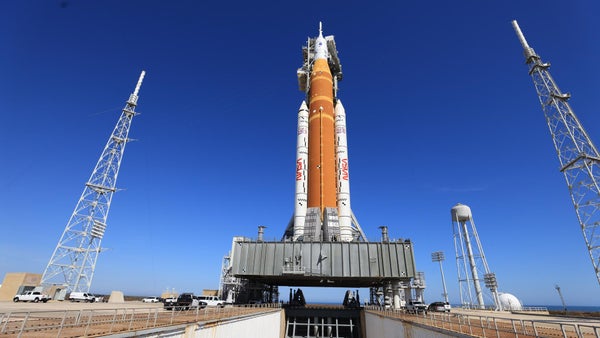
The second time is the charm, apparently. NASA successfully completed a major test of its upcoming moon mission, Artemis II, on Thursday. On Friday Lori Glaze, acting associate administrator for NASA's Exploration Systems Development Mission Directorate, said that, with the test done, the agency is now targeting a March 6 launch date for Artemis II.
Known as a wet dress rehearsal, the test involved fueling the mission’s rocket, the Space Launch System (SLS), readying the crew capsule and initiating a mock launch countdown. Its apparent success marked significant progress for the agency: NASA’s first attempted wet dress rehearsal on February 2 exposed several issues with both the SLS and the Orion capsule, including hydrogen fuel leaks—a problem that also plagued the mission’s predecessor, Artemis I.
At a press conference on Friday, NASA’s Artemis launch director Charlie Blackwell-Thompson said the agency is confident it has fixed the leaks and that none arose during Thursday’s fueling and mock launch countdown.
On supporting science journalism
If you're enjoying this article, consider supporting our award-winning journalism by subscribing. By purchasing a subscription you are helping to ensure the future of impactful stories about the discoveries and ideas shaping our world today.
The test is critical to Artemis II: The SLS cannot launch without passing it. And the failure of the first wet dress rehearsal forced NASA to delay its target launch date to March at the earliest. NASA still has to review data from the wet-dress rehearsal and conduct some further tests of flight readiness prior to liftoff, Glaze said.
The Artemis II mission will see four astronauts—NASA’s Christina Koch, Reid Wiseman, and Victor Glover and Canadian astronaut Jeremy Hansen—fly on a 10-day journey that will take them on an extended loop around the moon and back to Earth.
Together, they will observe the moon’s elusive farside and perform critical tests that will help form the basis for Artemis III—NASA’s planned mission to, by 2028, return humans to the lunar surface for the first time in more than half a century.
Editor’s Note (2/20/26): This article was updated after posting to include additional information from NASA. The text was previously amended to correct Jeremy Hansen’s name. This is a developing story and may be updated further.