
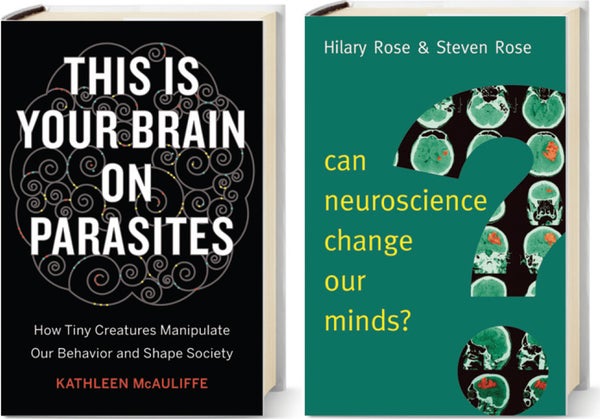
This Is Your Brain on Parasites: How Tiny Creatures Manipulate Our Behavior and Shape Society
by Kathleen McAuliffe
Houghton Mifflin Harcourt, 2016 ($27; 288 pages)
Suicidal zombie insects, a wild-eyed scientist from Eastern Europe, bloodsucking and mind control. These are normally the stuff of vampire fiction, but they also loom large in neuroparasitology, the study of how parasites manipulate the behavior of their hosts. In This Is Your Brain on Parasites, science writer McAuliffe vividly delves into this burgeoning field, weaving in stories that are fascinating—and full of the kind of factoids you can't wait to share: Did you know that there's a tiny parasite that tricks crickets into drowning themselves so it can get into the water and lay eggs? Or a bug that makes rats run kamikaze right into cats' mouths?
As riveting as such trivia are, the book could prove challenging for the faint of heart (or weak of stomach, like this reviewer). There are moments of pure nature-channel gore, such as when McAuliffe delineates the life cycle of a guinea worm, a parasite that migrates from a human's intestinal muscle through the tissues of the body all the way to the lower limbs or sole of the foot where it—no, that's enough. Equally unnerving is the underlying existential question McAuliffe poses: Are some teeny creatures directing the behavior of bigger animals, including us? As she writes, the concept of such puppetry evokes “the horror of losing control.”
On supporting science journalism
If you're enjoying this article, consider supporting our award-winning journalism by subscribing. By purchasing a subscription you are helping to ensure the future of impactful stories about the discoveries and ideas shaping our world today.
Some of the most enjoyable parts in this book—for me, at least—come when McAuliffe takes a break from the bugs and biology to introduce some of the quirky scientists who study parasitic manipulation. Her writing is so rich and the interviews so sharp that you feel like you've met her subjects personally—and can't help but feel their passion for the work. These scenes also serve up a rare glimpse into the inner workings of a research lab and life as an academic. Take, for example, the French researcher who stole away during a romantic interlude with his wife to look for parasite-infected zombie crickets by their resort's pool (which he found).
The first and best half of the book focuses on animal research. McAuliffe loses some of her scientific footing later on when she takes the leap from crickets and rats to people. For example, some interesting work has found that, compared with mentally healthy individuals, those with schizophrenia are more likely to carry antibodies for Toxoplasma gondii, a parasite commonly found in cat feces. But in general, the data on human neuroparasitology are too new, and too thin, to build a compelling case. Because parasites seem less likely to control mammals than insects, fish and crustaceans, McAuliffe explores their possible indirect effects—such as how our desire to avoid them may make some societies more fearful of outsiders and more focused on the greater good. What I grew to love, though, is that even in these weaker moments, she makes a point of quoting people who disagree with her.
Overall, McAuliffe has crafted an engaging narrative that, despite the grislier bits, kept drawing me in. In the same way that a good biography captures the essence of a person—his or her quirks, mistakes and triumphs—this book exposes the no longer secret lives of parasites. “Nature is full of ghastly and glorious surprises,” McAuliffe writes—and her book is, too. —S.S.G.
Can Neuroscience Change Our Minds?
by Hilary Rose and and Steven Rose
Polity, 2016 ($45; 176 pages)
Neuroscience has gained mega-science status in recent years, with massive funding in the U.S. and the U.K. and major new initiatives under way in Japan and China. But just how advanced is neuroscience? Not very, according to some experts.
Almost 30 years ago, in Blaming the Brain, neuroscientist Elliot Valenstein argued that drug companies spawned the myth that brain science had discovered the causes of depression and anxiety. Both disorders remain mysterious to this day, however. Big pharma has few new drugs in the pipeline to treat them, and depression is increasing worldwide. In 1999 philosopher John T. Bruer said it was premature to use the little we understood about the brain as a guide for improving education or child rearing. And a 2006 essay by legal scholar Stephen Morse warned about the “brain overclaim syndrome”—or the tendency for experts in multiple fields, even judges, to conclude we understand much more about the brain than we actually do.
In this new book, Hilary Rose, an emerita professor of social policy at the University of Bradford, and Steven Rose, an emeritus professor of neuroscience at the Open University, both based in England, shine a critical light once again on glitzy neuroscience. The field, they say, is no closer to serving as a legitimate guide to education. Still, that has not stopped neuroscience from insinuating itself into classrooms worldwide in the form of teacher-training programs, computer applications and curriculum changes—not one of which is based on actual knowledge for the simple reason that we lack even “fundamental principles” of how the brain works, they write. We still do not even have a “theory of the brain.”
Meanwhile the influence of neuroscience on education continues to mushroom, thanks to “opportunistic marketing” and promises that cannot be kept and even, in one prominent case, the fraudulent use of misleading false-color images of brain scans. A large, brightly colored image was said to demonstrate that early intervention programs with children produced healthy brains, whereas a small, dull scan was said to show how the failure to intervene produced sickly brains.
We are learning things from the brain sciences that might eventually help us repair damaged brains and understand mental illness, the authors say, but the frenzied, money-and-media-driven application of neuroscience from “neuroeducation” to “neuroeconomics” is premature. The solutions to the challenges we face are still social and behavioral, and neuroscience is distracting us from tackling the big variables, such as nutrition, inequality and poverty. “It's not necessary to understand the workings of the brain,” they conclude, “to know that precariously housed, underfed children find it hard to study and learn.”
This book is a bold, forthright and courageous commentary on looming cultural trends—a true tour de force. —R.E.
Roundup: New books tackle the science behind two intriguing questions
Can you undergo such extensive augmentation that you almost become another person? Some celebrities—take Michael Jackson, for example—have altered their appearance so significantly that they no longer look like themselves. But in Beyond Human: How Cutting-Edge Science Is Extending Our Lives (Thomas Dunne Books, 2016; 304 pages), science writer Eve Herold goes a step further and examines medical innovations emerging in robotics, genetics and nanotechnology that promise to enhance our bodies and minds. As Herold investigates these technologies, she raises important ethical questions about what these potential feats of engineering may mean for, or do to, our humanity.
People curse for a variety of reasons—to express anger, make a joke or emphasize their point. But does cursing really serve any notable purpose? In What the F: What Swearing Reveals about Our Language, Our Brains, and Ourselves (Basic Books, 2016; 288 pages), cognitive scientist Benjamin K. Bergen researches the science of expletives to uncover the real reasons we swear and the influence four-letter words can have. Overall, Bergen suggests that our use of profanity may provide new insights into how our brain works, how we process language and how we communicate with others. —V.S.