Our Bodies Replace Billions of Cells Every Day

Blood and the gut dominate cell turnover

Human cell turnover graphic concept

Jen Christiansen

Join Our Community of Science Lovers!


On supporting science journalism

If you're enjoying this article, consider supporting our award-winning journalism by subscribing. By purchasing a subscription you are helping to ensure the future of impactful stories about the discoveries and ideas shaping our world today.


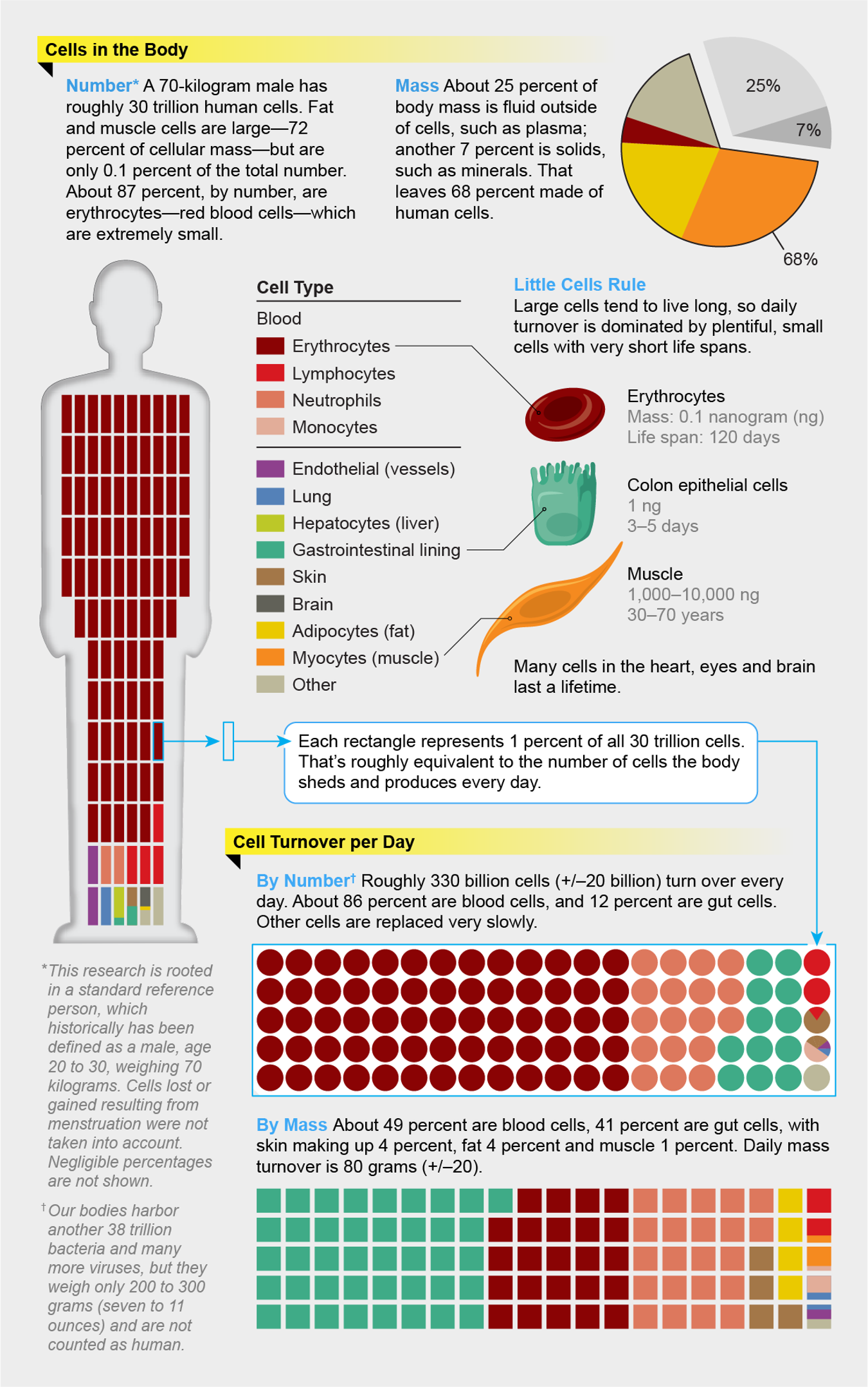
The human body replaces its own cells regularly. Scientists at the Weizmann Institute of Science in Rehovot, Israel, have finally pinned down the speed and extent of this “turnover.” About a third of our body mass is fluid outside of our cells, such as plasma, plus solids, such as the calcium scaffolding of bones. The remaining two thirds is made up of roughly 30 trillion human cells. About 72 percent of those, by mass, are fat and muscle, which last an average of 12 to 50 years, respectively. But we have far more, tiny cells in our blood, which live only three to 120 days, and lining our gut, which typically live less than a week. Those two groups therefore make up the giant majority of the turnover. About 330 billion cells are replaced daily, equivalent to about 1 percent of all our cells. In 80 to 100 days, 30 trillion will have replenished—the equivalent of a new you.
Credit: Jen Christiansen; Sources: “Revised Estimates for the Number of Human and Bacteria Cells in the Body,” by Ron Sender, Shai Fuchs and Ron Milo, in PLOS Biology, Vol. 14; August 2016 (total cell data), and “The Distribution of Cellular Turnover in the Human Body,” by Ron Sender and Ron Milo, in Nature Medicine, Vol. 27; January 2021 (cell turnover data)

Mark Fischetti was a senior editor at Scientific American for nearly 20 years and covered sustainability issues, including climate, environment, energy, and more. He assigned and edited feature articles and news by journalists and scientists and also wrote in those formats. He was founding managing editor of two spin-off magazines: Scientific American Mind and Scientific American Earth 3.0. His 2001 article “Drowning New Orleans” predicted the widespread disaster that a storm like Hurricane Katrina would impose on the city. Fischetti has written as a freelancer for the New York Times, Sports Illustrated, Smithsonian and many other outlets. He co-authored the book Weaving the Web with Tim Berners-Lee, inventor of the World Wide Web, which tells the real story of how the Web was created. He also co-authored The New Killer Diseases with microbiologist Elinor Levy. Fischetti has a physics degree and has twice served as Attaway Fellow in Civic Culture at Centenary College of Louisiana, which awarded him an honorary doctorate. In 2021 he received the American Geophysical Union’s Robert C. Cowen Award for Sustained Achievement in Science Journalism. He has appeared on NBC’s Meet the Press, CNN, the History Channel, NPR News and many radio stations.

More by Mark Fischetti

Jen Christiansen is acting chief of design and senior graphics editor at Scientific American, where she art directs and produces illustrated explanatory diagrams and data visualizations. She is also author of the book Building Science Graphics: An Illustrated Guide to Communicating Science through Diagrams and Visualizations (CRC Press). In 1996 she began her publishing career in New York City at Scientific American. Subsequently she moved to Washington, D.C., to join the staff of National Geographic (first as an assistant art director–researcher hybrid and then as a designer), spent four years as a freelance science communicator and returned to Scientific American in 2007. Christiansen presents and writes on topics ranging from reconciling her love for art and science to her quest to learn more about the pulsar chart on the cover of Joy Division’s album Unknown Pleasures. She holds a graduate certificate in science communication from the University of California, Santa Cruz, and a B.A. in geology and studio art from Smith College. Follow Christiansen on Bluesky @jenchristiansen.com

More by Jen Christiansen
Scientific American Magazine Vol 324 Issue 4This article was published with the title “A New You in 80 Days” in Scientific American Magazine Vol. 324 No. 4 (), p. 76
doi:10.1038/scientificamerican0421-76

It’s Time to Stand Up for Science

If you enjoyed this article, I’d like to ask for your support. Scientific American has served as an advocate for science and industry for 180 years, and right now may be the most critical moment in that two-century history.

I’ve been a Scientific American subscriber since I was 12 years old, and it helped shape the way I look at the world. SciAm always educates and delights me, and inspires a sense of awe for our vast, beautiful universe. I hope it does that for you, too.

If you subscribe to Scientific American, you help ensure that our coverage is centered on meaningful research and discovery; that we have the resources to report on the decisions that threaten labs across the U.S.; and that we support both budding and working scientists at a time when the value of science itself too often goes unrecognized.

In return, you get essential news, captivating podcasts, brilliant infographics, can't-miss newsletters, must-watch videos, challenging games, and the science world's best writing and reporting. You can even gift someone a subscription.

There has never been a more important time for us to stand up and show why science matters. I hope you’ll support us in that mission.

Thank you,

David M. Ewalt, Editor in Chief, Scientific American

Subscribe