
It's been more than a decade since her death, but the epic, years-long battle around the continued existence of Terri Schiavo so riveted the nation that it still feels recent. After she suffered a cardiac arrest in 1990, Schiavo's brain was damaged by loss of oxygen, and she fell into a persistent vegetative state. Her husband, believing that she would never awaken and would not have wanted to keep living that way, petitioned the courts for her feeding tube be removed. Her parents, who thought their daughter might recover, fought the decision. After multiple appeals, Schiavo ultimately died in 2005 after her feeding tube was disconnected. She was 41 and had been in a vegetative state for nearly half her life. The autopsy later showed the damage was irreversible—her brain weighed half of what it should have because of a massive loss of neurons.
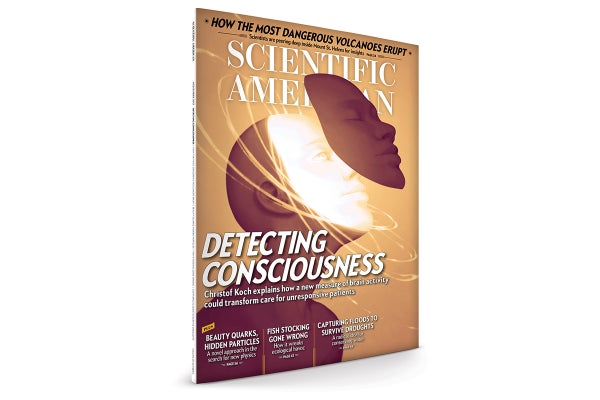
Even with brain-imaging tools, at the time it was impossible to tell definitively whether Schiavo was somehow aware of her surroundings. But as neuroscientist Christof Koch writes in his cover story, scientists are now working on “How to Make a Consciousness Meter.” Researchers are using a method called “zap and zip” to probe the brain with magnetic pulses while measuring its electrical activity to be able to detect consciousness. In principle, the technique could make it possible to tell what level of awareness a person with a consciousness disorder has. Someday families and doctors might be able to use such technologies to determine a patient's needs or to make decisions about long-term care.
In this issue, you'll find plenty of other examples of how scientists are advancing discovery in ways that are helping to solve some of humanity's greatest challenges. Consider public health. The slime on a bathtub drain, a biofilm, looks innocent enough. On a tub, we simply wipe away these 3-D mats of bacteria. But when they colonize medical equipment or form in the body, they can be deadly. In “The War on Slime,” biologist Karin Sauer explains how understanding the cellular communication of biofilms can save lives.
On supporting science journalism
If you're enjoying this article, consider supporting our award-winning journalism by subscribing. By purchasing a subscription you are helping to ensure the future of impactful stories about the discoveries and ideas shaping our world today.
Elsewhere in the issue, researchers are exploring the mechanisms behind volcanic eruptions (“The Next Big Bang,” by Steve Olson) and testing a novel idea to use floodwaters to survive droughts (“The Radical Groundwater Storage Test,” by Erica Gies).
That's not to say we leave no room for the profound. For instance, check out “Measuring Beauty,” in which particle physicist Guy Wilkinson describes an experiment at CERN's Large Hadron Collider and “the race to discover hidden particles, thereby building a fuller picture of nature at its tiniest scales.” Who knows what we'll find?