
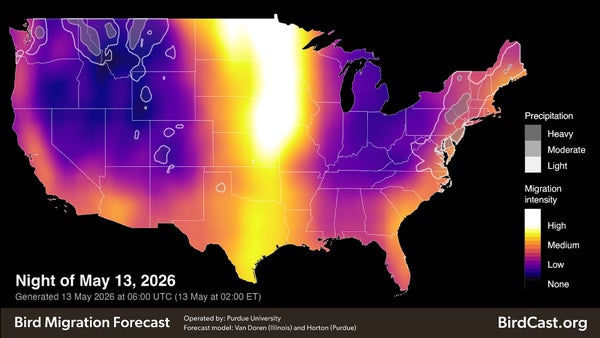
Right now hundreds of millions of birds are making their annual trek to settle down in their northern breeding grounds. As they fly hundreds to even thousands of miles, they stop occasionally to refuel—delighting birders as they go. The majority of their travelling happens at night, however; that’s one reason experts say to turn off unneeded lights during migration season. So how are bird enthusiasts able to track these migrations? It turns out the same radar that helps track storms has a big part to play.
“If you turned on the Weather Channel or your local news, and the meteorologist was pointing out, ‘Oh, it's going to be raining in this area...,’ those are the same radars that we use as ecologists to quantify birds moving through the atmosphere,” says Kyle Horton, a Purdue University ecologist, who studies migratory birds and is a member of BirdCast, a collaboration that tracks bird migration.
Horton’s lab and the BirdCast collaboration use radar data to study bird migration patterns and generate a number of bird tracking maps that give birders a glimpse into how many birds are on the move—and offer birding forecasts for the next few days.
On supporting science journalism
If you're enjoying this article, consider supporting our award-winning journalism by subscribing. By purchasing a subscription you are helping to ensure the future of impactful stories about the discoveries and ideas shaping our world today.
Radar systems send out radio waves and then record any energy that is reflected back to their receivers. Information about how long it takes for the signal to return to the receiver is used to calculate how far away something is from the radar tower. Just like radar beams reflect off of the water droplets in brewing storms, they reflect off migrating birds.
Across the top of this radar loop, rainclouds move from west to east. The growing blob of blue and green around the radar shows birds in flight.
Kyle Horton, National Weather Service
When radar aeroecologists like Horton first look at radar data, they include everything radar can sense in the atmosphere—birds, storms, insects, debris and smoke, among other things. The challenge then comes in isolating specific data. “We always like to say, ‘We just do the inverse of what meteorologists do.’ They remove the birds to maintain the rain. We remove the rain to maintain the birds,” Horton says.
The signatures birds and rain make on radar readouts are different enough that they are relatively easy to separate, Horton says. Birds tend to migrate along a north-south axis, whereas storms generally move west to east, for example. Storms are also very structured and denser than flocks of birds. “Rain is really consistent. It’s homogenous. Birds are flapping. They're oriented in odd ways. There's different sized birds, and so they get filtered very quickly,” Horon says.
One wrinkle in isolating bird migration from the radar data comes in the form of other flying animals: bats. The trick here, Horton says, is to look at the shape the flock takes. When bats come out of a cave, they form a doughnutlike pattern as they spread out in search of food. Some types of birds show this behavior, too, but additional information can be used to determine if birds or bats are on the radar. For example, bats also emerge from a cave with a fixed location, whereas birds take off from a wide variety of spots.
Insects also call the lower atmosphere home and must be removed from datasets—but crucially, birds can fly much faster than insects can. “Entomologists wouldn’t like this, but we call insects ‘the detritus of the atmosphere,’” Horton says, because they generally move along with the winds, “whereas birds can fly faster than the speed of the wind.”
With bats, insects and weather taken care of, the processed radar data can be made into maps that give a sense of how many birds are on the move at any given time—up to about 400 million birds during peak migration.
What the bird migration forecasts can’t tell us, though, is what birds are flying or where they are hanging out during the day.
“A forecast can be one of two things. It could be birds arriving to your area, or it could be all the birds that you were excited to see the day before leaving your area,” Horton says. “We don't have a perfect science of it, and I think that’s what makes bird-watching fun.”