
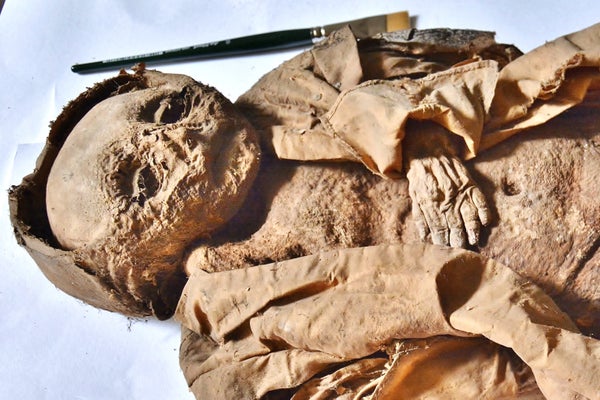
About 400 years ago in Austria, someone wrapped the body of a baby boy in a beautiful silk coat, placed him in an unlabeled wooden coffin and sealed his corpse in a family crypt. In this environment, protected from outside air, the child’s body mummified.
Now researchers studying this mummy have finally matched the anonymous little boy with a name: Reichard Wilhelm, part of the elite Starhemberg family of Upper Austria. They also found that while the child was well-fed, he showed signs of rickets, a condition caused by lack of vitamin D, a nutrient that is found in certain foods and that the body makes when it is exposed to sunlight. The researchers reported these observations on October 26 in the journal Frontiers in Medicine.
“We have only one case and have to be cautious, but it may well have been that other infants also suffered from a similar lack of sunlight exposure and a vitamin deficiency,” says study leader Andreas Nerlich, a pathologist at Munich Clinic Bogenhausen in Germany.
On supporting science journalism
If you're enjoying this article, consider supporting our award-winning journalism by subscribing. By purchasing a subscription you are helping to ensure the future of impactful stories about the discoveries and ideas shaping our world today.
Nerlich and his colleagues examined the child’s mummy during restoration at the family crypt of the Counts of Starhemberg in Hellmonsödt, a village nine miles outside of Linz, Austria. Records of the family date back to the 11th century, whereas the crypt was first built around 1500 and was expanded and renovated around 1600. Firstborn sons of the family and sometimes their wives were interred there.
The boy, less than two feet tall, was surprisingly well-preserved, Nerlich says. His body was swaddled in a hooded coat with his left hand—fingernails intact—resting on his belly. His skull is slightly deformed from being placed in the too small coffin, and his mouth is frozen in an eternal pout.
The researchers took a tiny skin sample for radiocarbon dating and used computed tomography to virtually autopsy the mummy. Their results suggest that the child was well-fed, perhaps even obese, with thick fat on his abdomen and thighs. This body fat could partially explain his mummification, says Michele Koons, curator of archaeology at the Denver Museum of Nature & Science, who was not involved in the research. The fat had reacted with moisture to create a waxy substance called adipocere, which can protect a body from decay. The child’s bones and teeth suggest that he was between 10 and 18 months old when he died.
The boy’s rib bones were studded with knobs, and the ends of his long bones were slightly enlarged, both signs of rickets. This disorder softens the bones and causes the overgrowth of cartilage at the joints. The root of the problem is a lack of vitamin D, which the body requires to metabolize calcium and build strong bones. The boy’s diet was clearly calorie-rich, given his ample fat tissue, but he may have still been lacking necessary nutrients, the authors wrote in their new paper.
The body can produce vitamin D using energy from the sun, so perhaps the boy also lived a sheltered existence. He may have been kept from the sun, the authors speculated, to keep his skin pale, as was often stylish among aristocrats in this era in Europe.
Whatever the reason, the resulting rickets may have contributed to the child’s death. His lung tissue showed signs of pneumonia, which rickets can predispose children to.
Radiocarbon dating, along with the age of the crypt, suggests the boy most likely died between 1550 and 1635, the researchers wrote. In that time frame, there were only three firstborn sons in the Starhemberg family, and only one had died after the crypt renovation. That was Reichard, first son of Erasmus the Younger and grandson of Reichard von Starhemberg, the first member of the family interred in the renovated crypt. Baby Reichard died in 1626, according to family records.
There are not many baby mummies from Europe, making young Reichard’s remains an unusual discovery. The kinds of information gleaned from adult and child mummies can be similar, says Bob Genheimer, curator of archaeology at the Cincinnati Museum Center (CMC), who was not involved in the study. The emotional aspects of studying a child can be different, however, he says. “Children are always the victims of premature death, and people seem to be much more protective of children,” Genheimer says. CMC has a Roman-era Egyptian mummy of a child, nicknamed “Umi,” in its collections. “We gave our child mummy a name because none was listed on his cartonnage...,” Genheimer adds. “We wantedto go that small step to restore some measure of humanity to him.”
And now baby Reichard has a name as well.