
MISOGYNY’S COLD SHOULDER
In “Women on Ice” [Observatory], Naomi Oreskes describes how she applied to a geologist position at the British Antarctic Survey (BAS) in 1981 and was rejected because she was a woman. I applied to the BAS in 1972, when they were looking for meteorological observers. I received a response similar to Oreskes’s. There was no mention of tents, but the letter essentially said, “It is not that we are misogynists, but we do not have facilities for women.” Ah, well. I went off and did something else!
CHRISTINE VIBERT Jersey, British Isles
On supporting science journalism
If you're enjoying this article, consider supporting our award-winning journalism by subscribing. By purchasing a subscription you are helping to ensure the future of impactful stories about the discoveries and ideas shaping our world today.
I continue to be angered by the ways women in science are treated. I am reminded of a former student’s experience with her male high school guidance counselor: When she told him she intended to study biochemistry at a university and then head to medical school to pursue a career in research, he shrugged and asked, “Wouldn’t it just be easier to be a nurse?” Although I teach in the humanities, I will forever champion young women in whatever direction their dreams take them. I heard from my former student several years later: she was preparing to graduate from medical school and to receive a Ph.D. in biochemistry.
VIRGIL MILLER Madison Area Technical College
AI AND PREJUDICE
I became concerned when reading “Spying on Your Emotions,” John McQuaid’s article on companies using artificial intelligence to analyze people’s feelings. As an autistic person, I am hyperaware of the discrimination autistic individuals face in the workforce for what are, in essence, cultural differences between them and their neurotypical counterparts. The emotion-reading technology described sounds like it will reinforce the deep, if often unconscious, prejudices against autistic people that already exist.
Lack of eye contact is a common autistic trait that most neurotypical people believe indicates a lack of trustworthiness. The article did not allay my concerns when researcher Rosalind Picard related an anecdote about a colleague who disagreed with her and, to illustrate cluelessness, said that person “looked at my feet the whole time.”
MICHAEL A. LEVINE via e-mail
MERGING GALAXIES
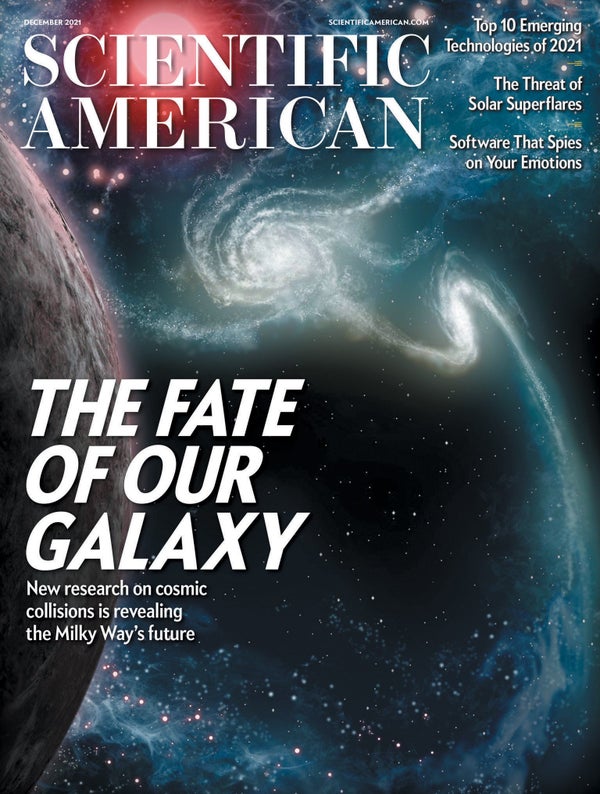
“Cosmic Crashes,” by Aaron S. Evans and Lee Armus, shows a simulation of the Milky Way and Andromeda colliding. No mention is made of dark matter, but it must have a significant effect on the dynamics of galaxy mergers. Do we know enough about it to make such detailed merger models?
PAUL COLBOURNE Ottawa
Until now, I had not considered that galactic “collisions” only minimally involve component stars. As Evans and Armus explain, “most stars just pass right by one another during the event.” I’m curious about those other poor stars that don’t simply pass by. What effect do they have on the event?
PHILIP JAN ROTHSTEIN Brookfield, Conn.
THE AUTHORS REPLY: To answer Colbourne: There is still a lot about dark matter that is unknown, but it is thought that galaxies are surrounded by dark matter halos that explain the motion of their stars and of galaxies in groups and clusters. Dark matter makes up the vast majority of all matter but reveals itself only through gravity. Merger models routinely incorporate simple models of dark matter distribution, which greatly improves their ability to reproduce observed properties of galactic mergers, for example, by absorbing much of the orbital energy during the collision.
Regarding Rothstein’s question: Stars are powered by fusion reactions in their core. The sun derives its energy by fusing hydrogen into helium. Stellar collisions can increase the mass of the remnant star, and more massive stars burn brighter and hotter, producing more energy. This happens in dense stellar clusters and could also be enhanced in a galactic merger. Yet these rare collisions would be energetically insignificant, compared with the energy generated by the nuclear starburst—or by a rapidly accreting supermassive black hole that just received a supply of fuel from the galactic merger. Both phenomena can easily surpass 100 billion times the sun’s luminosity.
WORKING GROUP NEEDED
In “IPCC, Your Job Is Partly Done” [Observatory, November 2021], Naomi Oreskes calls for the closure of the physical science Working Group I (WGI) of the Intergovernmental Panel on Climate Change (IPCC). She argues that because human influence on global temperature is now clear, WGI’s job is finished. We could not disagree more.
The world has just been surprised by a series of extreme climate events. Quantifying the human role in global heating is the beginning rather than the end of evaluating current and future risks to communities. The physical science evaluation of those risks is a cornerstone for societal action.
The IPCC’s primary function is the assessment of scientific information that is sorely needed to make progress within the international United Nations Framework Convention on Climate Change (UNFCCC) and its policy instruments, particularly the Paris Agreement. Closing WGI would be a serious mistake and counterproductive in confronting the problem for three reasons.
First, attribution studies have evolved from global indicators to regional and local extreme climate events. These findings are extremely relevant to policy in the discussion of loss and damages at the level of the UNFCCC and beyond. Second, emerging kilometer-scale global and regional climate models have not yet been assessed, but they are a prerequisite for the next generation of the WGI Interactive Atlas on regional climate change, a key instrument for policy makers. Third, quantifiable information to evaluate adaptation and mitigation options requires the combination of physical and impact models. If vulnerable countries ask, for example, how their water resources will change in the coming decades, only carefully evaluated climate model information can deliver the key numbers on which policies should be based. The presence of a WGI community within the IPCC, providing this basis, remains indispensable for Working Groups II and III to fulfill their tasks.
The burden on the WGI scientists should indeed be reduced so that they can focus on the physical understanding needed to best support these policy needs with confidence. In our view, the problem is the proliferation of scenarios and the expectation that they be used with the latest and most expensive climate models. Since the fourth IPCC assessment cycle, this has created an unnecessary spiral in which valuable resources have been wasted. But comprehensive scientific assessments, including the physical science basis, will continue to clarify and inform and help to build the political will required to face this global challenge.
THOMAS F. STOCKER University of Bern and co-chair, WGI, Fifth Assessment Report (AR5), IPCC
SUSAN SOLOMON Massachusetts Institute of Technology and co-chair, WGI, Fourth Assessment Report (AR4), IPCC
QIN DAHE China Meteorological Administration and co-chair, WGI, AR4 and AR5, IPCC
VALERIE MASSON-DELMOTTE University of Paris-Saclay and co-chair, WGI, Sixth Assessment Report (AR6), IPCC
PANMAO ZHAI China Meteorological Administration and co-chair, WGI, AR6, IPCC
ERRATUM
“Radioactive Recycling,” by Nikk Ogasa [Advances], incorrectly said americium and curium have forms that decay much more slowly than uranium. The most stable isotopes of americium and curium decay faster than uranium’s most stable isotopes.