Scientific American’s Colorful Covers Reveal 175 Years of Change

The magazine’s hues provide a record of publishing technology and trends

Nicholas Rougeux

Join Our Community of Science Lovers!

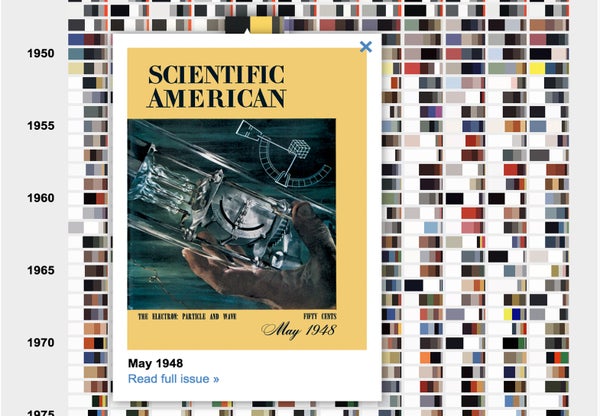
Starting with its first issue in 1845, Scientific American has faithfully reported on technology used to produce the magazine. Some advances have been shown directly on the cover, such as a digital letterform in May 1969 (above). Echoes of other advances are visible in the cover color analysis here. After more than 75 years of weekly publishing—largely in black and white, with occasional washes of color—the magazine shifted to a rotary offset lithography press for covers in 1917, which allowed for the lush paintings that marked its transition to a monthly in 1921. In 1931 covers scaled back to two colors, likely to save money during the Great Depression. As the economy rebounded, a wider range of tones emerged in 1933 in the form of black-and-white photography. In 1948 the look changed again, this time because of a shift in ownership and editorial vision: color paintings returned, in a square image set on a solid background, which became white in 1952 and remained white for about 43 years. As desktop publishing arose at the end of the 20th century, designs became more experimental: images broke out of the box, ushering in a period of bold—primarily digitally crafted—illustrations.

Credit: Scientific American


On supporting science journalism

If you're enjoying this article, consider supporting our award-winning journalism by subscribing. By purchasing a subscription you are helping to ensure the future of impactful stories about the discoveries and ideas shaping our world today.


Covering Color Interactive

Scientific American’s cover corpus—5,148 issues from August 1845 through December 2019— is a complex yet intriguing puzzle.* In the interactive grid below, weekly issues are binned by year. A sample cover is revealed with a tap or hover: click through to the archive to view the full year. Although you’ll spot specialty issues with color covers or cover wraps intermittently as early as 1901, we start the color analysis below with the November 1921 issue, marking the shift to a monthly magazine. Each month’s tile represents a single issue. The vertical stripes indicate the top five colors on each cover, arranged from the color used most (at left) to least (at right).

*Our own digital archive occasionally presents a scan of the first internal black-and-white page as representative of the issue, as the full bound collection is missing some coversheets, and some rare vintage issues have handling restrictions.

Nicholas Rougeux is a web designer and data visualization artist in Chicago. For more than 20 years, he has been playing, exploring, and building with data to create interactive tools and wall posters featured in publications and exhibitions around the world.

More by Nicholas Rougeux

Jen Christiansen is acting chief of design and senior graphics editor at Scientific American, where she art directs and produces illustrated explanatory diagrams and data visualizations. She is also author of the book Building Science Graphics: An Illustrated Guide to Communicating Science through Diagrams and Visualizations (CRC Press). In 1996 she began her publishing career in New York City at Scientific American. Subsequently she moved to Washington, D.C., to join the staff of National Geographic (first as an assistant art director–researcher hybrid and then as a designer), spent four years as a freelance science communicator and returned to Scientific American in 2007. Christiansen presents and writes on topics ranging from reconciling her love for art and science to her quest to learn more about the pulsar chart on the cover of Joy Division’s album Unknown Pleasures. She holds a graduate certificate in science communication from the University of California, Santa Cruz, and a B.A. in geology and studio art from Smith College. Follow Christiansen on Bluesky @jenchristiansen.com

More by Jen Christiansen
Scientific American Magazine Vol 322 Issue 1This article was published with the title “Covering Color” in Scientific American Magazine Vol. 322 No. 1 (), p. 70
doi:10.1038/scientificamerican0120-70

It’s Time to Stand Up for Science

If you enjoyed this article, I’d like to ask for your support. Scientific American has served as an advocate for science and industry for 180 years, and right now may be the most critical moment in that two-century history.

I’ve been a Scientific American subscriber since I was 12 years old, and it helped shape the way I look at the world. SciAm always educates and delights me, and inspires a sense of awe for our vast, beautiful universe. I hope it does that for you, too.

If you subscribe to Scientific American, you help ensure that our coverage is centered on meaningful research and discovery; that we have the resources to report on the decisions that threaten labs across the U.S.; and that we support both budding and working scientists at a time when the value of science itself too often goes unrecognized.

In return, you get essential news, captivating podcasts, brilliant infographics, can't-miss newsletters, must-watch videos, challenging games, and the science world's best writing and reporting. You can even gift someone a subscription.

There has never been a more important time for us to stand up and show why science matters. I hope you’ll support us in that mission.

Thank you,

David M. Ewalt, Editor in Chief, Scientific American

Subscribe