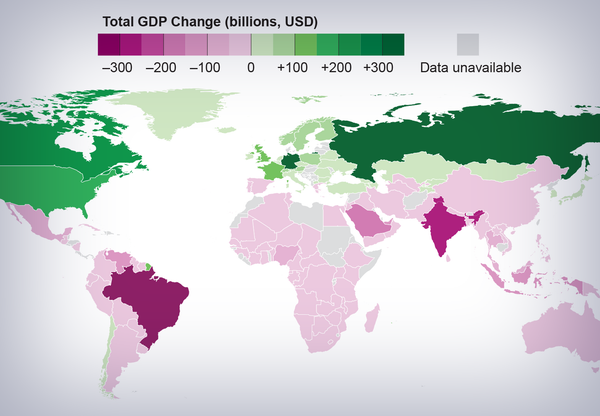
See How Much Climate Change Has Cost Different Countries

Low-income nations bear the brunt of costs from climate change

Color-coded world map shows billions of dollars in GDP lost or gained in each country.

Amanda Montañez

Join Our Community of Science Lovers!


On supporting science journalism

If you're enjoying this article, consider supporting our award-winning journalism by subscribing. By purchasing a subscription you are helping to ensure the future of impactful stories about the discoveries and ideas shaping our world today.


The top five greenhouse gas–emitting nations—the U.S., China, Russia, Brazil and India—collectively caused $6 trillion in global economic losses between 1990 and 2014, according to a recent study of available data. And those losses haven’t been felt equally. Dartmouth College climate scientists Christopher W. Callahan and Justin S. Mankin used climate models to determine how much of the planet’s warming could be attributed to each country’s emissions and calculated what those emissions have cost every other country. The scientists linked global average temperature rise to the warming in each nation (because some parts of the world are warming faster than others) and then to the associated change in that country’s gross domestic product. “A striking feature of the results was the compounding inequalities,” Callahan says. Whereas wealthier countries burned more fossil fuels to drive economic growth, low-income countries—which are already less able to adapt to a changing climate—bore the brunt of the losses.

Credit: Amanda Montañez; Source: “National Attribution of Historical Climate Damages,” by Christopher W. Callahan and Justin S. Mankin, in Climatic Change, Vol. 172; July 12, 2022

Credit: Amanda Montañez; Source: “National Attribution of Historical Climate Damages,” by Christopher W. Callahan and Justin S. Mankin, in Climatic Change, Vol. 172; July 12, 2022

Andrea Thompson is senior desk editor for life science at Scientific American, covering the environment, energy and earth sciences. She has been covering these issues for nearly two decades. Prior to joining Scientific American, she was a senior writer covering climate science at Climate Central and a reporter and editor at Live Science, where she primarily covered earth science and the environment. She has moderated panels, including as part of the United Nations Sustainable Development Media Zone, and appeared in radio and television interviews on major networks. She holds a graduate degree in science, health and environmental reporting from New York University, as well as a B.S. and an M.S. in atmospheric chemistry from the Georgia Institute of Technology. Follow Thompson on Bluesky @andreatweather.bsky.social

More by Andrea Thompson

Amanda Montañez is senior graphics editor and been at Scientific American since 2015. She produces and art directs information graphics for the Scientific American website and print magazine. Montañez has a bachelor's degree in studio art from Smith College and a master's in biomedical communications from the University of Toronto. Before starting in journalism, she worked as a freelance medical illustrator. Follow her on Bluesky @unamandita.bsky.social

More by Amanda Montañez
Scientific American Magazine Vol 327 Issue 5This article was published with the title “The Cost of Climate Change” in Scientific American Magazine Vol. 327 No. 5 (), p. 88
doi:10.1038/scientificamerican1122-88

It’s Time to Stand Up for Science

If you enjoyed this article, I’d like to ask for your support. Scientific American has served as an advocate for science and industry for 180 years, and right now may be the most critical moment in that two-century history.

I’ve been a Scientific American subscriber since I was 12 years old, and it helped shape the way I look at the world. SciAm always educates and delights me, and inspires a sense of awe for our vast, beautiful universe. I hope it does that for you, too.

If you subscribe to Scientific American, you help ensure that our coverage is centered on meaningful research and discovery; that we have the resources to report on the decisions that threaten labs across the U.S.; and that we support both budding and working scientists at a time when the value of science itself too often goes unrecognized.

In return, you get essential news, captivating podcasts, brilliant infographics, can't-miss newsletters, must-watch videos, challenging games, and the science world's best writing and reporting. You can even gift someone a subscription.

There has never been a more important time for us to stand up and show why science matters. I hope you’ll support us in that mission.

Thank you,

David M. Ewalt, Editor in Chief, Scientific American

Subscribe