
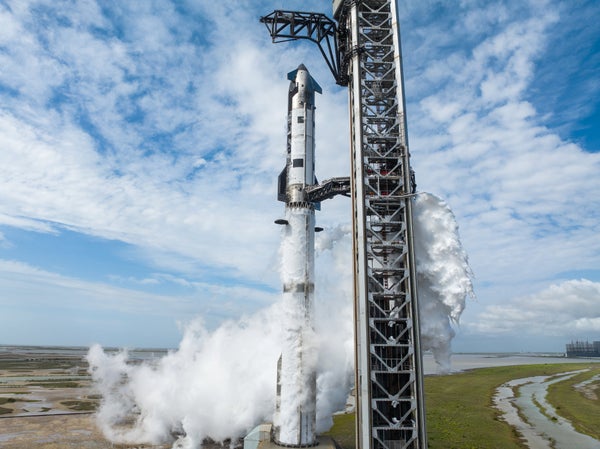
The latest version of SpaceX’s Starship megarocket just completed its launch rehearsal—a key test ahead of an anticipated liftoff that could take place as soon as May 19.
The launch vehicle—made up of SpaceX’s Super Heavy Version 3 (V3) booster and Starship—stands some 124 meters tall and is designed to haul up to 150 metric of cargo into space in its fully reusable configuration. On Monday SpaceX successfully filled the rocket with more than 5,000 metric tons of propellant, the company announced in a social media post.
The rehearsal augurs Starship’s coming test flight—its 12th—which will mark the first time the latest version of vehicle is put through its paces. The launch could take place around May 19.
On supporting science journalism
If you're enjoying this article, consider supporting our award-winning journalism by subscribing. By purchasing a subscription you are helping to ensure the future of impactful stories about the discoveries and ideas shaping our world today.
SpaceX has a lot riding on this test: Although the two most recent Starship flights were successes, many of the vehicle’s previous tests ended in fiery explosions, and the rocket’s development has fallen behind schedule. The company’s purported initial public offering (IPO) adds to the pressure; SpaceX has touted Starship as a way to rapidly grow its satellite Internet megaconstellation Starlink, which is a major profit driver for the company. And SpaceX is doubling down on plans to launch and operate artificial intelligence data centers in orbit.
Like all the previous test flights, the next demonstration will not see Starship attempt to enter low-Earth orbit—a crucial capability that SpaceX still needs to prove ahead of NASA’s planned 2027 Artemis III mission to low-Earth orbit, which will be followed by the Artemis IV mission to the moon. Artemis III, itself a demonstration mission, aims to show that SpaceX’s Starship Human Landing System or Blue Origin’s Blue Moon rocket, or both, can dock with an Orion crew capsule in orbit around the moon. Ultimately, the space agency hopes to use Starship or Blue Origin’s landing vehicle as a ferry to take astronauts from lunar orbit to the moon’s surface as soon as 2028. But some experts have questioned whether SpaceX’s megarocket will be ready on time.