
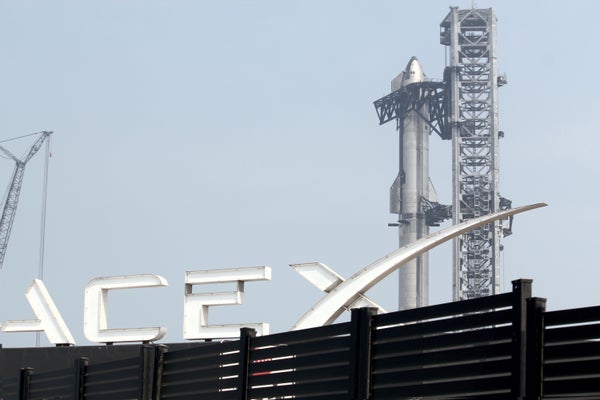
SpaceX has pulled off another successful test flight of Starship, the world’s largest and most powerful rocket.
This was the 11th test flight for Starship, which is meant to be the first-ever fully reusable spaceflight system in history, consisting of a Super Heavy first-stage booster and an upper-stage ship that can carry cargo or even crew. It was also the program’s last test flight in a problem-plagued 2025: Prior to its successful 10th flight on August 26, Starship had suffered explosive failures in three back-to-back test flights this year. These and other setbacks had raised concerns about Starship’s technical feasibility—and about the wisdom of NASA making the in-development rocket a linchpin of the agency’s down-to-the-wire plans for returning astronauts to the moon.
Launching from SpaceX’s Starbase site in South Texas at 6:23 P.M. CDT—and lifted by nearly 17 million pounds of thrust from 33 Raptor engines at—Flight 11 aimed to mostly replicate the feats of Flight 10. After throwing the ship on a long suborbital trajectory, the booster would somersault and fire some of its engines to steer itself back to a splashdown in the Gulf of Mexico. Meanwhile the ship would continue its ascent to test the deployment of several dummy spacecraft to simulate plans for SpaceX’s global satellite Internet service Starlink, relight one of its six Raptor engines in space and finally attempt atmospheric reentry, followed by a gentle, powered splashdown in the Indian Ocean. Flight 11 delivered on these objectives with flying colors; it achieved its objectives flawlessly, with the booster splashing down about 6.5 minutes after launch and the ship doing the same on the other side of the world about an hour later.
On supporting science journalism
If you're enjoying this article, consider supporting our award-winning journalism by subscribing. By purchasing a subscription you are helping to ensure the future of impactful stories about the discoveries and ideas shaping our world today.
One important difference in this latest test was the ship’s heat shield, which featured multiple patches of subtly reconfigured protective tiles, and some that were deliberately missing, to test Starship’s tolerance to shedding tiles during flight. Unlike the tiles of Flight 10, most of the thousands that covered the ship’s exterior during Flight 11 had also been nestled in a lining of heat-resistant felt—nicknamed “crunch wrap”—to enhance their performance. During Flight 11’s official live stream, a SpaceX commentator noted that the missing tiles had been removed in “some of the spots that see the highest level of heating” on Starship to push the vehicle to its limits in enduring the extreme heat of atmospheric reentry.
Another difference was in the booster’s carefully choreographed return from space—which, in recent flights, had involved firing 13 of its 33 Raptor engines and immediately going down to three. This time the booster’s return began with a burn of 13 engines before dwindling to five and then three—a dress rehearsal of sorts for the landing maneuvers of SpaceX’s next-generation Starship booster. That booster is slated to begin test flights alongside a new version of the ship next year, and both will be augmented with improved Raptor engines. Outside of its maneuvers, Flight 11’s booster was also in itself notable: this was its second trip to space after previously flying in Starship Flight 8 in March. For Starship to be successful, its hardware will have to be reused again and again but at a much higher cadence than the more than half-year-long period that separated this booster’s two spaceflights.
With another successful suborbital test flight on the books, SpaceX is now closer than ever before to what could be a revolutionary new era of space science and exploration. From here, the company will prioritize planning for further test flights of the next-generation Starship hardware, and these are set to begin next year. If an initial suborbital flight of this “Block 3” version of the system is successful, the following flight may well see a Starship at last reach orbit. This would be a critical milestone for the program, allowing Starship not only to deliver real spacecraft to bolster the Starlink satellite mega constellation but also to demonstrate the rendezvous and refueling maneuvers that are required for NASA’s Artemis III crewed lunar landing mission, slated for 2027, as well as for SpaceX’s lofty aspirations for human voyages to Mars.