
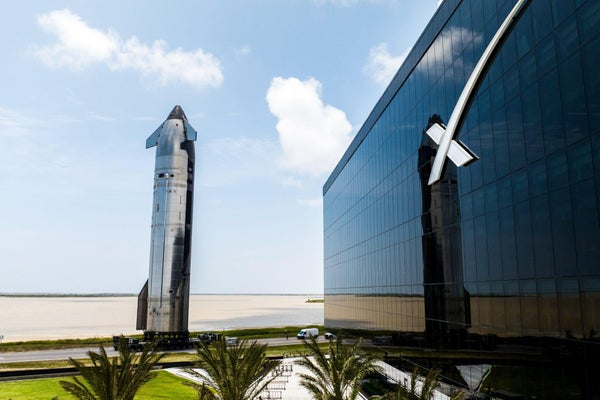
SpaceX successfully test launched its Starship rocket on Tuesday, overcoming past failures that had raised questions about the capabilities—and planetary aspirations—of the pioneering space launch firm.
“Splashdown confirmed! Congratulations to the entire SpaceX team on an exciting tenth flight test of Starship!” the company announced on X (formerly Twitter), following the successful conclusion of the controlled landing.
The 6:30 P.M. CDT liftoff from Texas carried a massive “Super Heavy” booster to the edge of space, some 119 miles high, where it dropped off from Starship’s upper-stage spacecraft, somersaulted and fired two of its engines to soft land in the Gulf of Mexico. The upper stage continued into orbit, released eight test satellites and then braked to make its own splashdown in the Indian Ocean about an hour and six minutes after launch.
On supporting science journalism
If you're enjoying this article, consider supporting our award-winning journalism by subscribing. By purchasing a subscription you are helping to ensure the future of impactful stories about the discoveries and ideas shaping our world today.
Starship is the world’s tallest rocket, standing more than 400 feet, and the most powerful. It’s intended to carry 110 to 165 tons of cargo (although recent reports suggest that a range of 55 to 110 tons is more likely) into orbit and then return to Earth to be reused again. SpaceX chief Elon Musk has promised a successful Starship will cut the cost of shooting satellites into space significantly. Starship’s upper-stage spacecraft is also intended to land NASA astronauts on the moon for the Artemis III mission, which is scheduled for 2027 but will almost certainly be delayed. The vehicle is envisioned to touch down in upright fashion like one in a 1950s space flick.
Despite some minor structural damage to Starship on its reentry, this was “overall a good flight putting the program back on track,” wrote astronomer Jonathan McDowell on X. The trajectory of the spacecraft was designed to test its limits on reentry, including removing heat tiles from the flight-damaged skirt, SpaceX commentators noted. The damage came about 47 minutes into the flight at an altitude of 55 miles.
This year two previous Starship test flights exploded over the Caribbean, and a third spun out of control over the Indian Ocean—mishaps that were all tied to explosions in rocket fuel systems. That has spurred concern that the rocket’s design fundamentally lacks the stability needed to dampen damaging vibrations from its multiple engines. Experts have speculated that adding stabilizing mass to Starship’s fuel system may be necessary, but such a move would cut into its cargo capacity.
The successful launch and planned water landings of both the Super Heavy booster and Starship’s upper-stage spacecraft reaffirms SpaceX’s policy of rapid testing spacecraft prototypes. According to SpaceX’s website, Starship’s reentry on this launch, for example, was “designed to intentionally stress the structural limits of the upper stage’s rear flaps,” which steer the spacecraft while it feels the maximum pressure on reentry from orbit, as well as the limits of various heat tile prototypes. The larger booster tested its ability to land using only two engines instead of the usual three. The company plans to begin testing a third version of the spacecraft next. This version is intended to travel into low-Earth orbit to refuel other rockets in space, a new technology that is needed for moon missions.