
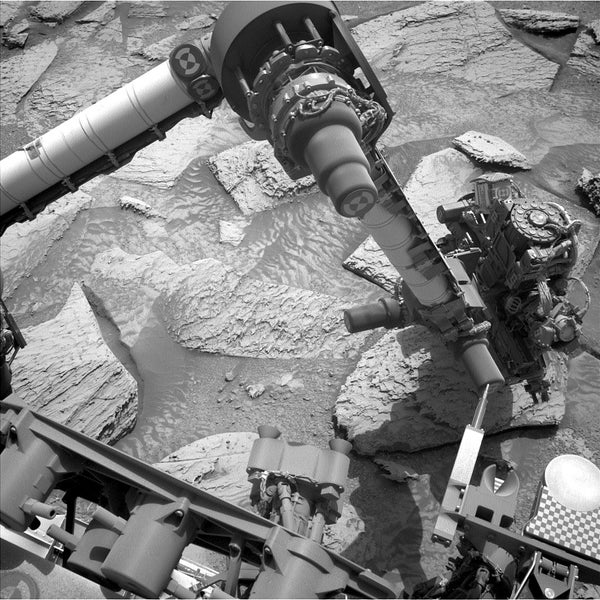
NASA’s Curiosity Mars rover keeps cruisin’ and can’t stop, won’t stop movin’—except when its drill got stuck in some rock.
The problem started on April 25. That date was supposed to be Curiosity’s second day of drilling into a 28.6-pound, 1.5-foot-wide, six-inch-thick rock called Atacama. But as the rover attempted to pull out its drill arm, the rock came up with it, having gotten lodged onto the sleeve that surrounds the tool’s bit.
Back on Earth, Curiosity’s human controllers first tried to just shake the rock loose, like a parent trying to free a child with their hand stuck in the cookie jar, but that didn’t work. Then the controllers tried vibrating the drill to knock the rock loose and had no luck. Finally, on May 1, they tilted and rotated the drill while spinning the bit and, after a few tries, the rock came loose, breaking into smaller parts as it hit the ground.
On supporting science journalism
If you're enjoying this article, consider supporting our award-winning journalism by subscribing. By purchasing a subscription you are helping to ensure the future of impactful stories about the discoveries and ideas shaping our world today.
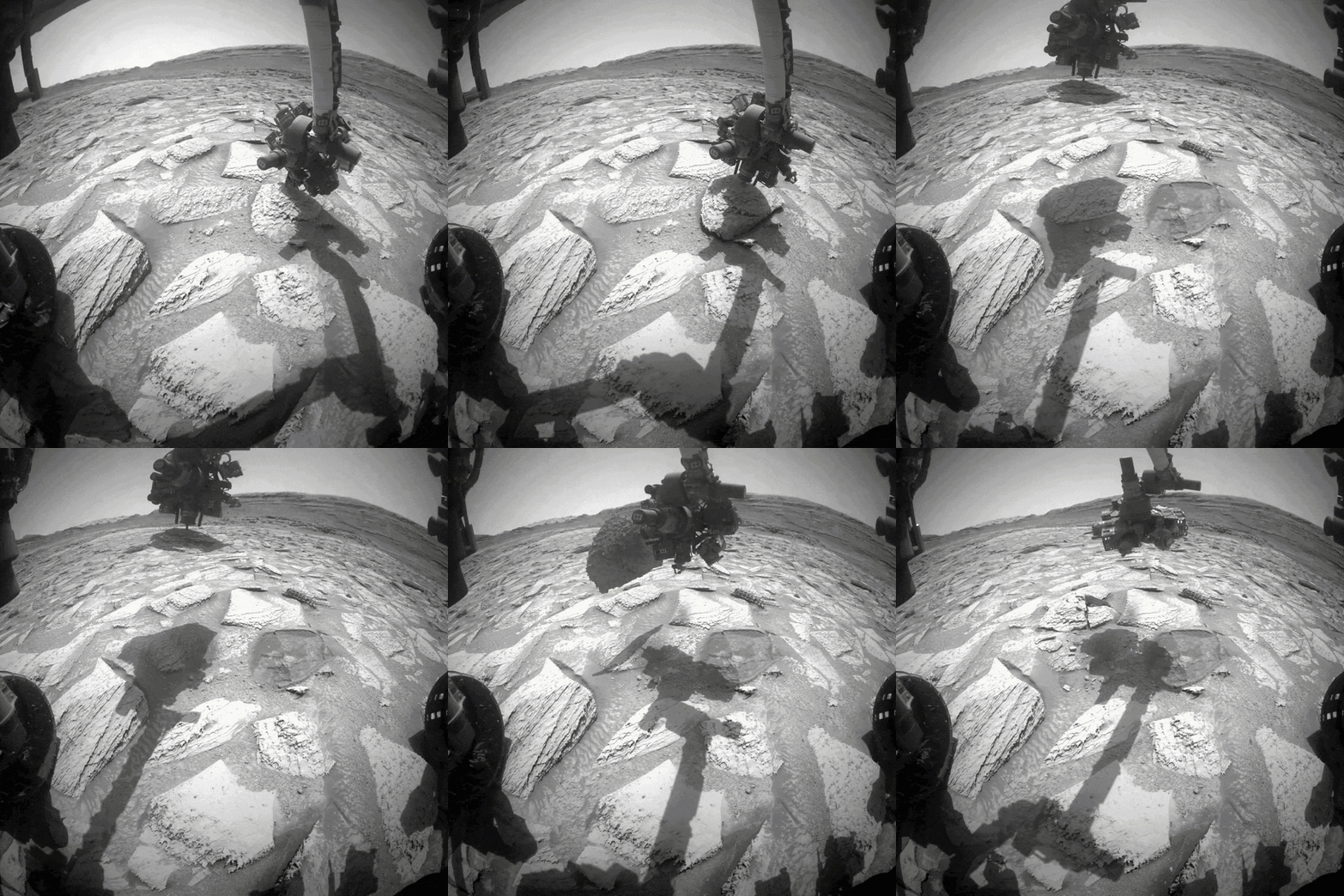
NASA/JPL-Caltech
Debris from the rock will be analyzed by Curiosity’s Chemistry and Mineralogy (CheMin) instrument and compared with samples taken at another site, Mineral King, located nearly 525 feet below the rover’s current location.
With the tool free, Curiosity can continue exploring Mars’s Gale Crater, where it has spent the past 14 years, or nine Taylor Swift eras. Currently, the rover’s environmental team back on Earth is using the robot to monitor atmospheric dust on Mars, as well as to study cloud movements and document the activity of short-lived whirlwinds called dust devils.