
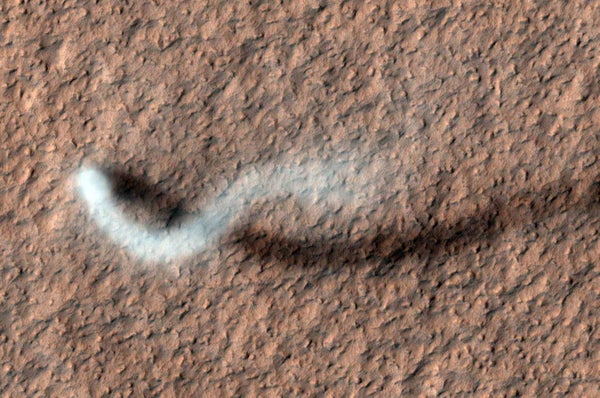
For years scientists have suspected that there is electrical activity on Mars. A study now confirms it: particles in the dusty Martian atmosphere rub against one another, building up electrical charge that discharges in the form of tiny lightning arcs. Aside from Earth, lightning and electrical activity were only known to occur on Saturn and Jupiter.
On Earth, wind-blown dust and sand particles can become electrified because of a process called triboelectrification, or the transfer of charge between two objects when they rub against each other, a result of friction. Mars’s atmosphere has dust and sand and is prone to dust devils and dust storms. Some dust storms range over thousands of kilometers, making the likelihood of electrification high.
The research team analyzed 28 hours of microphone recordings captured by NASA’s Perseverance rover over two Martian years, picking up electromagnetic signatures and acoustic signals typical of electrical activity, according to the study, which was published in Nature on November 26.
On supporting science journalism
If you're enjoying this article, consider supporting our award-winning journalism by subscribing. By purchasing a subscription you are helping to ensure the future of impactful stories about the discoveries and ideas shaping our world today.
The scientists identified 55 electrical events, all but one of which occurred during periods when winds were in the top 30 percent over the two years. This pattern indicates that wind plays a crucial role in initiating electrical charge on Mars. Dust devil activity, the researchers say, is highly variable on the planet. The Perseverance readings were taken in the Jezero Crater, but other regions on Mars may get 20 times more dust devils.
"On Earth, the electrification of dust, sand and snow particles is well-documented, particularly in desert regions, but it rarely results in actual electrical discharges,” says study co-author Baptiste Chide of the Université de Toulouse in France. “On Mars, however, the thin CO₂ atmosphere makes this phenomenon far more likely, as the amount of charge required to generate sparks is much lower than on Earth."
This is the first time there has been convincing evidence that electrical activity on Mars is actually occurring, says Francis Nimmo, a planetary scientist at the University of California, Santa Cruz, who wasn’t involved in the study. “Now there will be renewed interest in looking for it with other instruments, either orbiting spacecraft or radio telescopes on Earth,” Nimmo says.
The presence of electrical activity on Mars has implications for surface chemistry, future human exploration and habitability. For instance, it could affect dust dynamics and create an electrochemically reactive environment, enhancing oxidizing conditions that would affect the preservation of organic molecules and pose risks to equipment.
"The discovery of sparks in Mars dust storms and dust devils illustrates one of the risks of Mars exploration, as space hardware can become far more easily damaged than on Earth,” says study co-author Roger Wiens of Purdue University. “The very first spacecraft to land on Mars [the Soviet Mars 3] came down in the middle of a dust storm; it transmitted for 15 seconds and went dead, never to be heard from again. We suspect that it might well have been a victim of triboelectric charging."
The researchers also reproduced the characteristic features of triboelectric discharges in a lab setup and observed them with a ground-based replica of Perseverance’s SuperCam camera. “[This] is a good indication that their conclusions are robust,” Nimmo says.
In the future, dedicated instruments and improved atmospheric models could be deployed to further study and quantify electrical phenomena and their chemical consequences on Mars, the scientists say.
Editor’s Note (12/3/25): This article was edited after posting to correct the description of the type of electrical activity found on Mars.