
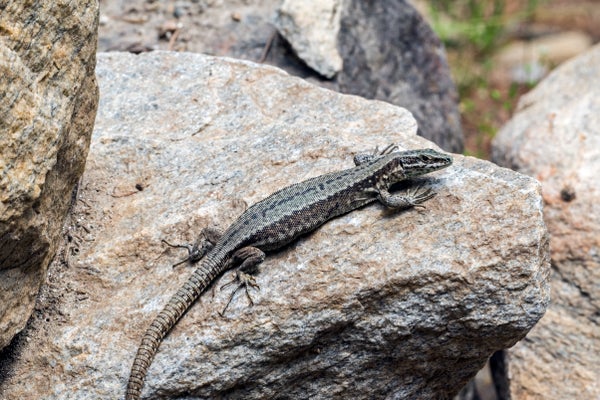
In a world full of fierce competition, gathering intel on opponents is a matter of life or death. One common reptile called the wall lizard uses a particularly clever tactic to sniff out fights it can win—literally. A new study shows that these lizards, which can reach eight inches long and live in Europe and North America, manage to estimate a competitor's size based on chemical scent cues alone.
Male wall lizards, like many geckos and iguanas, secrete a waxy fluid from pores in their inner thighs to mark their territory. Rival lizards can smell these chemicals, called femoral secretions, with a simple flick of their tongues. Scientists have long thought such secretions hold clues that let the lizards evaluate one another's sizes from afar—but “this is the first experimental demonstration confirming it,” says study co-author Stefano Scali, herpetology curator at the Natural History Museum of Milan in Italy. The results were published in Behavioral Ecology.
Scali and his team captured 60 male wall lizards from gardens across Milan. They kept each lizard in a transparent box for three days—long enough for the lizards to claim the boxes as their territory. The researchers then placed mirrors in front of each lizard, along with plastic strips coated with secretions from other lizards of varying sizes.
On supporting science journalism
If you're enjoying this article, consider supporting our award-winning journalism by subscribing. By purchasing a subscription you are helping to ensure the future of impactful stories about the discoveries and ideas shaping our world today.
The lizards only ever saw their own reflections, which they consistently mistook for enemies and became hostile toward. But they were most aggressive when exposed to secretions from similar-size or smaller individuals. They would even try to bite the mirror when presented with secretions from significantly smaller donors that they could probably take in a fight. “It seemed as if the lizard somehow learned that it is bigger and stronger, so it attacked,” Scali says. Researchers still don't know how the involved chemicals reveal a lizard's size, but Scali and his colleagues have identified a handful of proteins that may play a role. Next, they plan to use genetic tools to identify the rest of the proteins in these telltale smelly fluids.
Ashwini Mohan, a herpetologist at the Natural History Museum in London, who was not involved in the study, wonders how the lizards' confrontations might change as territories shift and temperatures rise—a process that could even chemically affect the protein secretions. “It would be fascinating to see how such behavior influences their continued survival in light of climate change and changes that humans are bringing by the destruction of habitats,” she says.