
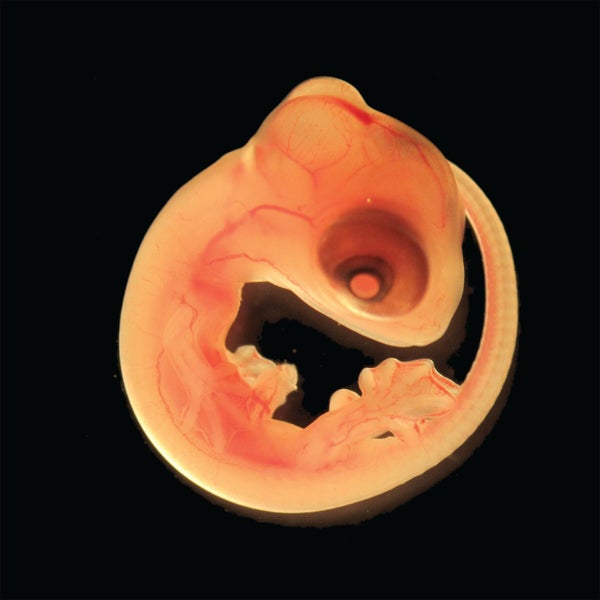
When Nathalie Feiner spotted a tiny nematode worm wriggling in an embryonic lizard's brain from the French Pyrenees, she thought it was a freak accident. She was dissecting hundreds of common wall lizard embryos for a study and had never encountered this invader before—but soon she started finding them in more of the still unhatched reptiles' brains.
Intrigued, Feiner, then with the University of Oxford, and a colleague examined the embryos' parents. They found nematodes only in the ovaries of mothers that had produced infected embryos, suggesting the parasites were migrating to their offspring in a way researchers had thought impossible.
Parasites such as nematodes, which do not multiply in their hosts, often pass from mother to children through mammals' placentas or milk. But scientists had assumed that in birds and reptiles, the eggshell that forms around the developing animal acts as a barrier to such invasions. Parasite infection through a reptile egg had never been observed before, Feiner says: “It seems like we have hit on an entirely new lifestyle that these nematodes have evolved.”
On supporting science journalism
If you're enjoying this article, consider supporting our award-winning journalism by subscribing. By purchasing a subscription you are helping to ensure the future of impactful stories about the discoveries and ideas shaping our world today.
For a paper accepted by the American Naturalist last December, Feiner and her colleagues examined 720 eggs laid by 85 female common wall lizards from six locations. The researchers found the nematodes in lizards from only that first Pyrenees population. Infected females transmitted the parasite to between 50 and 76.9 percent of their embryos.
DNA analysis showed these nematodes are similar to, though much smaller than, a species found in the lizards' gut; researchers say they may have evolved from that species.
Feiner says scientists could have missed the possibility of egg transmission because they have mainly looked at parasites in birds and turtles, whose eggshells form shortly after fertilization when the embryo is just a clump of cells—too small to act as a host. But in lizards and snakes, the shells form when the embryo is bigger, making parasite transmission more plausible. James Harris of the Research Center in Biodiversity and Genetic Resources in Portugal, who was not involved with the work, says this form of transmission could be widespread if the team's hypothesis is correct.
Feiner suspects the nematode could change its host's behavior—a technique brain parasites often use to infect an animal's predators. For instance, mice infected with Toxoplasma drop their tendency to avoid cat urine. This makes them more easily eaten, transmitting the parasite to the next part of its life cycle. “Identifying the presence of ‘our’ nematode in a predator of the European wall lizard would make [this strategy] more likely,” Feiner says.