
The number pi (π) appears in the most unlikely places. It can be found in circles, of course—as well as in pendulums, springs and river bends. This everyday number is linked to transcendental mysteries. It has inspired Shakespearean thought puzzles, baking challenges and even an original song. And pi keeps the surprises coming—most recently in January 2024, when physicists Arnab Priya Saha and Aninda Sinha of the Indian Institute of Science presented a completely new formula for calculating it, which they later published in Physical Review Letters.
Saha and Sinha are not mathematicians. They were not even looking for a novel pi equation. Rather these two string theorists were working on a unifying theory of fundamental forces, one that could reconcile electromagnetism, gravity, and the strong and weak nuclear forces. In string theory the basic building blocks of the universe are not particles, such as electrons or photons, but instead tiny threads that vibrate like the strings of a guitar and in so doing cause all visible phenomena. In their work, Saha and Sinha investigated how these strings could interact with one another—and accidentally discovered new formulas that are related to important mathematical quantities.
For millennia, humans have been trying to determine the exact value of pi. This enduring interest is not surprising given the utility of calculating the circumference or area of a circle, which pi enables. Even ancient scholars developed geometric approaches to calculate this value. One famous example is Archimedes, who estimated pi with the help of polygons: by drawing one n-sided polygon inside and one outside a circle and calculating the perimeter of each, he was able to narrow down the value of pi.
On supporting science journalism
If you're enjoying this article, consider supporting our award-winning journalism by subscribing. By purchasing a subscription you are helping to ensure the future of impactful stories about the discoveries and ideas shaping our world today.
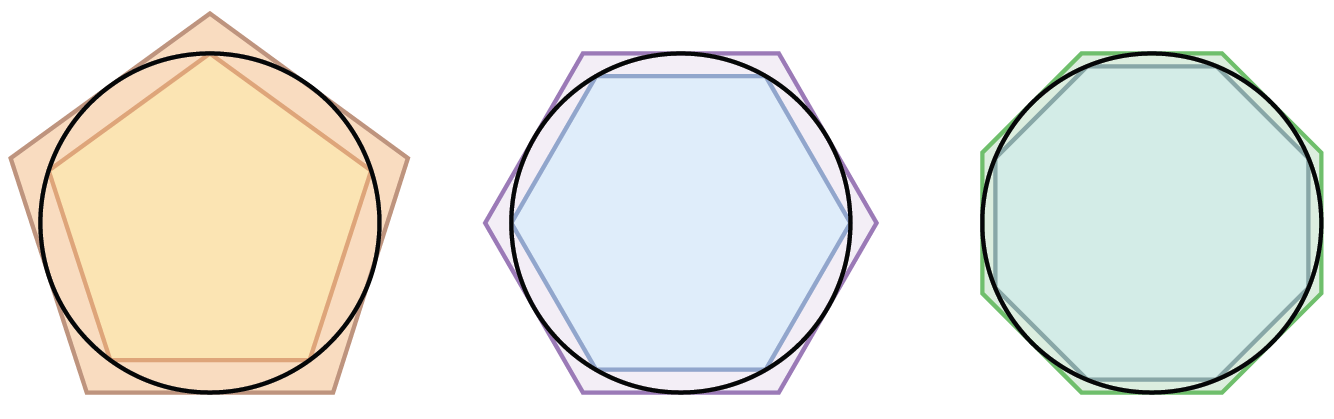
A common method for determining pi geometrically involves drawing a bounding polygon inside and outside a circle and then comparing the two perimeters.
Fredrik/Leszek Krupinski/Wikimedia Commons
Teachers often present this method in school. But even if you don’t remember it, you can probably imagine that the process is quite complex. Archimedes went so far as to compare the perimeters of polygons with 96 vertices to prove that pi is between 3.1408 and 3.1429. This approach is therefore not really practical for calculating pi exactly.
An Infinite Series to Determine Pi
In the 15th century experts found infinite series as a new way to express pi. By adding up their numbers one by one, you can obtain pi’s value. And the more summands you look at, the more accurate the result becomes.
For example, Indian scholar Madhava, who lived from 1350 to 1425, found that pi equals 4 multiplied by a series that begins with 1 and then alternately subtracts or adds fractions in which 1 is placed over successively higher odd numbers (so 1/3, 1/5, and so on). One way to express this would be:

This formula makes it possible to determine pi as precisely as you like in a very simple way. You don’t have to be a master of mathematics to work out the equation. But you do need patience. It takes a long time to get accurate results. Even if you evaluate 100 summands, you will still be far off the mark.
As Saha and Sinha discovered more than 600 years later, Madhava’s formula is only a special case of a much more general equation for calculating pi. In their work, the string theorists discovered the following formula:

This formula produces an infinitely long sum. What is striking is that it depends on the factor λ, a freely selectable parameter. No matter what value λ has, the formula will always result in pi. And because there are infinitely many numbers that can correspond to λ, Saha and Sinha have found an infinite number of pi formulas.
If λ is infinitely large, the equation corresponds to Madhava’s formula. That is, because λ only ever appears in the denominator of fractions, the corresponding fractions for λ = ∞ become zero (because fractions with large denominators are very small). For λ = ∞, the equation of Saha and Sinha therefore takes the following form:

Saha and Sinha’s formula can be adapted based on the assumption of an infinitely large parameter.
The first part of the equation is already similar to Madhava’s formula: you sum fractions with odd denominators. But the last part of the sum, (−n)n − 1, is less familiar. The subscript n − 1 is the so-called Pochhammer symbol. In general, the expression (a)n corresponds to the product a × (a + 1) × (a + 2) × ... × (a + n − 1). For example, (5)3 = 5 × 6 × 7 = 210. And the Pochhammer symbol in this formula therefore results in (−n)n − 1 = (−n) × (−n + 1) × (−n + 2) × ... × (−n + n − 3) × (−n + n − 2).
A Few Steps to Madhava’s Formula
All of these elements look complicated at first, but they can be simplified quickly. First, subtract −1 from each factor. The value in front of the huge product is therefore −1 if n is odd and +1 if n is even, so you get (−n)n − 1 = (−1)n × n × (n − 1) × (n − 2) × ... × (n − n + 3) × (n − n + 2). The last factors can be simplified further: (−n)n − 1 = (−1)n × n × (n − 1) × (n − 2) × ... × 3 × 2 × 1.
This elongated expression is actually (−n)n − 1 = (−1)n × n!, resulting in the following:

This corresponds to Madhava’s formula. The equation found by Saha and Sinha therefore also contains the series discovered by Madhava.
As the two string theorists report, however, pi can be calculated much faster for smaller values of λ. Whereas Madhava’s result requires 100 terms to get within 0.01 of pi, Saha and Sinha’s formula for λ = 3 requires only the first four summands. And whereas “[Madhava’s] series takes 5 billion terms to converge to 10 decimal places, the new representation with λ between 10 [and] 100 takes 30 terms,” the authors write in their paper. Saha and Sinha did not find the most efficient method for calculating pi, though. Other series have been known for several decades that provide an astonishingly accurate value much more quickly. What is truly surprising in this case is that the physicists came up with a new pi formula when their paper aimed to describe the interaction of strings. They developed a method to indicate the probability with which two closed strings would interact with each other—something many string theorists have been seeking for decades without success.
When Saha and Sinha took a closer look at the resulting equations, they realized that they could express the number pi in this way, as well as the zeta function, which is the heart of the Riemann conjecture, one of the greatest unsolved mysteries in mathematics. Given the string theorists’ interests, their formulas for pi and the zeta function adorn only the very last paragraph of their paper. “Our motivation, of course, was not to find a formula for pi,” Sinha said in a YouTube video from Numberphile. “Pi was just a by-product.”
This article originally appeared in Spektrum der Wissenschaft and was reproduced with permission.