
Succinctly, pi—which is written as the Greek letter for p, or π—is the ratio of the circumference of any circle to the diameter of that circle. Regardless of the circle's size, this ratio will always equal pi. In decimal form, the value of pi is approximately 3.14.
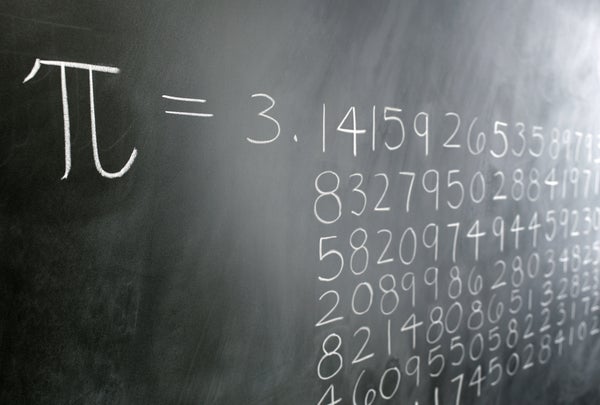
But pi is an irrational number, meaning that its decimal form neither ends (like 1/4 = 0.25) nor becomes repetitive (like 1/6 = 0.166666...). (To only 18 decimal places, pi is 3.141592653589793238.) Hence, it is useful to have shorthand for this ratio of circumference to diameter.
According to Petr Beckmann's A History of Pi, the Greek letter π was first used for this purpose by William Jones in 1706, probably as an abbreviation of periphery, and became standard mathematical notation roughly 30 years later.
On supporting science journalism
If you're enjoying this article, consider supporting our award-winning journalism by subscribing. By purchasing a subscription you are helping to ensure the future of impactful stories about the discoveries and ideas shaping our world today.
Try a brief experiment: Using a compass, draw a circle. Take one piece of string and place it on top of the circle, exactly once around. Now straighten out the string; its length is called the circumference of the circle. Measure the circumference with a ruler. Next, measure the diameter of the circle, which is the length from any point on the circle straight through its center to another point on the opposite side. (The diameter is twice the radius, the length from any point on the circle to its center.)
If you divide the circumference of the circle by the diameter, you will get approximately 3.14—no matter what size circle you drew! A larger circle will have a larger circumference and a larger radius, but the ratio will always be the same. If you could measure and divide perfectly, you would get 3.141592653589793238..., or pi.
By the start of the 20th century, about 500 digits of pi were known.
Otherwise said, if you cut several pieces of string equal in length to the diameter, you will need a little more than three of them to cover the circumference of the circle.
Pi is most commonly used in certain computations regarding circles. Pi not only relates circumference and diameter. Amazingly, it also connects the diameter or radius of a circle with the area of that circle by the formula: the area is equal to pi times the radius squared. Additionally, pi shows up often unexpectedly in many mathematical situations. For example, the sum of the infinite series
1 + 1/4 + 1/9 + 1/16 + 1/25 + ... + 1/n2 + ... is π2/6
The importance of pi has been recognized for at least 4,000 years. A History of Pi notes that by 2000 B.C., "the Babylonians and the Egyptians (at least) were aware of the existence and significance of the constant π," recognizing that every circle has the same ratio of circumference to diameter. Both the Babylonians and Egyptians had rough numerical approximations to the value of pi, and later mathematicians in ancient Greece, particularly Archimedes, improved on those approximations.
By the start of the 20th century, about 500 digits of pi were known. With computation advances, thanks to computers, we now know more than the first six billion digits of pi.