
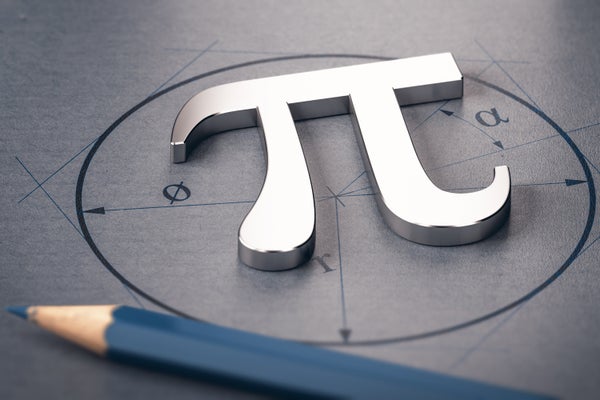
An age-old problem known as squaring the circle stumped mathematicians for more than 2,000 years. During that time, professionals and amateurs alike unknowingly published thousands of false proofs that they claimed resolved it. False proof attempts are natural stumbling blocks on the road to mathematical progress. They tend to fall by the wayside, either when peers uncover flaws in expert research or when crank arguments fail basic smell tests for legitimacy. But one didn’t fade quietly. Instead it forced a volunteer mathematician to tutor state senators, sparked media ridicule and nearly got an incorrect value of pi (π) codified into law.
Here’s the problem that has consumed ancient Greek mathematicians and countless others: given a circle, construct a square with the same area as it using only a compass and straightedge. You may remember compasses from school. They let you take any two points and draw a circle centered at one of them and passing through the other. A straightedge helps you draw straight lines; it’s like a ruler without measurement markings. As the founders of the geometric proof, the Greeks placed special emphasis on the ability to draw, or construct, their objects of study with these simplest-possible tools.
The task seems straightforward, but a solution remained surprisingly elusive. In 1894 physician and mathematical dabbler Edward J. Goodwin believed he had found one. He felt so proud of his discovery that, in 1897, he drew up a bill for his home state of Indiana to enshrine what he thought was a mathematical proof into law. In exchange, he would allow the state to use his proof without paying royalties. At least three major red flags should have prompted lawmakers to regard Goodwin with skepticism. Math research has no norm about charging royalties or precedent for legally ratifying theorems, and the supposed proof was nonsense. Among other errors, it claimed that pi, the ratio of a circle’s circumference to its diameter, is 3.2 rather than the well-established 3.14159.... Yet, in a bizarre legislative oversight, the Indiana House of Representatives passed the bill in a unanimous vote.
On supporting science journalism
If you're enjoying this article, consider supporting our award-winning journalism by subscribing. By purchasing a subscription you are helping to ensure the future of impactful stories about the discoveries and ideas shaping our world today.
In 1897, the Chicago Tribune wrote that “a circle originating in Ohio will find its proportions modified as soon as it lands on Indiana soil.”
Why would politicians enact hogwash and sully their sterling reputation for passing fact-based policy? In their defense, they seemed confused about the bill’s contents and played hot potato with it, tossing it to the Committee on Canals, which flung it over to the Committee on Education. They held three formal readings of the bill before voting. Goodwin had also managed to publish his work in the American Mathematical Monthly, a highly reputable journal to this day. This probably made him seem credible to outside eyes, even though the journal had a policy back then of uncritically publishing all submissions with a “by request of the author” tag. Perhaps Indiana’s House of Representatives wanted to punt the problem to the state senate to determine the fate of the imperiled constant.
As if this story weren’t outlandish enough, Goodwin’s endeavor to square the circle was doomed from the start: German mathematician Ferdinand von Lindemann proved the task impossible in 1882. Furthermore, Lindemann’s argument explains why so many false proofs of squaring the circle hinge on erroneous values of pi.
To see how, consider a circle with radius 1. When we calculate its area as A = πr2, that circle has an area of π. A square—whose area is calculated as the square of the length of one side—would need sides of length √π for its area to equal the circle’s. So the great geometric puzzle of antiquity boils down to this question: Given a reference length of 1 unit, can you draw a line segment of length exactly √π using only a compass and straightedge? If you can, then finishing the other edges of the square at right angles is the easy part. Hordes of mathematicians wrestled with this problem, and although nobody resolved it, they had made significant progress by the time Lindemann stepped in.
By then the math community knew it was possible to construct only certain lengths. Strangely, you can construct a line of some given length with a compass and straightedge only if that length can be expressed in integers and by using the algebraic operations of addition, subtraction, multiplication, division and square root. Thus, the simple tools of the Greeks can be used to construct some highly complicated numbers, such as this one:

But those tools can’t help us construct comparatively simple numbers such as the cube root of 2 (the number that, when multiplied by itself three times, equals 2) because there is no way to express it in terms of the five permissible operations alone.
Lindemann proved that pi is a transcendental number. This means that not only do +, −, ×, / and √ fall short of expressing it, but even more exotic operations such as cube roots, fifth roots, and so on wouldn’t help. Lindemann extended earlier work by French mathematician Charles Hermite, who had demonstrated that another famous constant, e (Euler’s number, 2.71828...), is transcendental. Though entwined with geometry’s simplest shape, pi cannot be expressed with algebra’s simplest language. Because pi is not a constructible length, neither is √π, rendering the task of squaring the circle impossible. The discovery even seeped into idiomatic language. Today “squaring the circle” means attempting the impossible.
These insights also explain why Goodwin could seemingly achieve the unachievable after assuming that pi equals 3.2. We can write 3.2 as 16⁄5, which clearly uses only integers and division. By substituting a neat, rational number for pi, Goodwin sidestepped the fundamental difficulty of the problem.
Of course, nobody in the Indiana state government in 1897 knew any of this. Having passed the state house sans a single dissenting vote, the bill was a state senate hearing away from upending the foundations of math by fiat. By pure coincidence, the head professor of math at Purdue University, Clarence A. Waldo, happened to visit the statehouse just when lawmakers needed him. Waldo, who had come to lobby for his school’s budget, overheard a mathematical discussion. Appalled at the proceedings, Waldo resolved to derail the bill. He stuck around to educate the state senators on geometric matters, hoping to end the farce. At debate time, the senators came equipped with Waldo’s tutelage and probably felt pressured by media attention, given that news outlets had begun to cover the story in an unflattering light.
An editorial in the Chicago Tribune brimmed with scathing sarcasm:
The immediate effect of this change will be to give all circles when they enter Indiana either greater circumferences or less diameters. An Illinois circle or a circle originating in Ohio will find its proportions modified as soon as it lands on Indiana soil.... A Pi that is so simple as 3.2 ought to be free from any entangling features, but if perchance it still proves obdurate no doubt the Legislature will promptly lop off another decimal and call it 3.
Indiana’s senate didn’t vote down the bill. The state senators did, however, agree to postpone it indefinitely. Had it not been for a mathematician in the right place at the right time, they might have continued to go around in circles.