
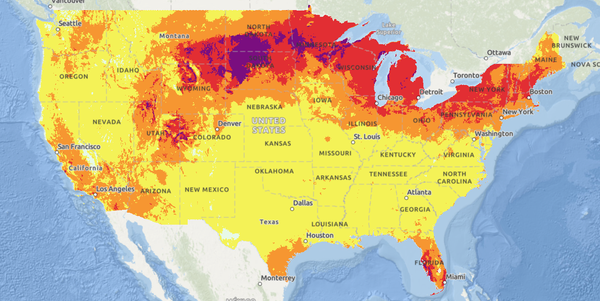
Temperatures across the western and central U.S. are smashing records: On Sunday Billings, Mont., set a new all-time high of 111 degrees Fahrenheit (nearly 44 degrees Celsius), Salt Lake City and Sheridan, Wyo., both reached 109 degrees F (around 43 degrees C), and Idaho Falls, Idaho, hit 103 degrees F (around 39 degrees C), according to preliminary data from the National Weather Service (NWS).
“We’re looking at temperatures that have not been seen or are very rare in some of these locations,” says NWS meteorologist Frank Pereira.
That’s thanks to a “heat dome”—an area of high pressure in the atmosphere—that traps heat beneath it like a lid on a “pot of boiling water,” Pereira explains. “It doesn’t allow the heat to escape. It just kind of builds upon itself, even at night.” As the heat dome extends eastward, forecasters expect unusually high and possibly record-breaking temperatures this week from the Midwest to the Northeast and mid-Atlantic region, including Richmond, Va., Washington, D.C., and Boston in yet another heat wave.
On supporting science journalism
If you're enjoying this article, consider supporting our award-winning journalism by subscribing. By purchasing a subscription you are helping to ensure the future of impactful stories about the discoveries and ideas shaping our world today.
It’s not just the U.S. that has suffered. Around the globe, this summer has been historically hot. France, for instance, recorded its hottest average temperature ever, part of a series of heat waves that’s estimated to have claimed thousands of lives across Europe. Earlier this month New York City’s Central Park hit 100 degrees F (around 38 degrees Celsius) for the first time since 2012. And parts of Asia and the Middle East have seen scorching temperatures so far this year, too.
“Heat domes” are behind many of these heat waves, says Zachary Labe, a climate scientist at the research nonprofit Climate Central. Though heat domes aren’t a new phenomenon, what is abnormal is the influence of climate change.
“We’re getting so many of these heat domes building across the Northern Hemisphere that they’re all kind of blending together at this point for keeping track of them,” Labe says. “It’s really in line with what we have expected to see and expect to see going forward into the future: we’re going to see more of these more intense, larger and more widespread heat waves every single summer.”
READ MORE: This Hot Summer Is One of the Coolest of the Rest of Our Lives
Research shows heat waves are becoming more frequent, too. “Our research shows quite clearly that with an increase in global temperatures due to human-induced climate change, we see both an increasing likelihood of heat waves, as well as an increase in the temperatures that come with them,” says Friederike Otto, a climatologist and co-founder of the research group World Weather Attribution. “Increasing the likelihood of heat waves in every month and every region means we see a lot of back-to-back heat waves.”
The challenge is figuring out exactly how and why heat domes form, as well as the role of climate patterns such as El Niño, Labe adds. “What we're trying to figure out now ... is, this summer in particular, ‘What’s the driver for these heat domes over individual regions?’”
To be safe in the heat, the World Health Organization recommends staying hydrated, limiting time outdoors and checking in on older adults or those with disabilities. Cars and other vehicles can heat up fast, so don’t leave children or pets unattended inside.
If you’re in the U.S., you can expect some relief from the heat—for now—later in the week, when the heat dome will give way to a cold front and temperatures will “back off, relatively speaking,” Pereira says. “We’ll be looking at above-normal temperatures but perhaps not quite to the extreme that they’ll be record-breaking.”
