
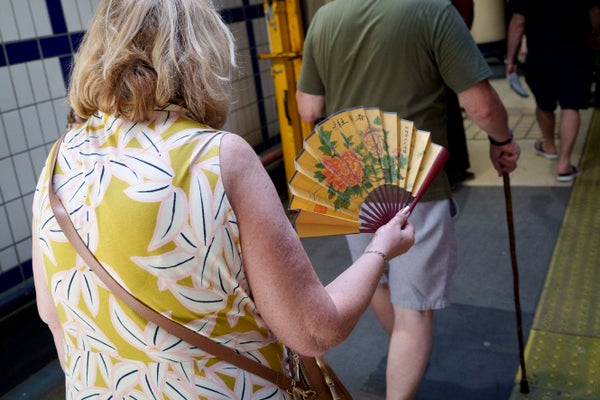
Western Europe is sweltering under a record-breaking heat wave. This week, London set a new all-time high temperature record for May of around 95 degrees Fahrenheit (about 35 degrees Celsius), while parts of France hit about 99 degrees F (about 37 degrees C) and Spain saw temperatures surpass 100 degrees F (about 38 degrees C).
The reason for the searing temperatures is a “heat dome” hanging over Western Europe—this is essentially a blob of high-pressure air that traps hot air like a Dutch oven. And climate change is helping to drive that hot air toward extremes.
“This record-breaking heat has the fingerprints of climate change all over it,” said Friederike Otto, a professor of climate science at Imperial College London, in a statement. “Temperatures on this scale were once exceptional even at the height of summer.”
On supporting science journalism
If you're enjoying this article, consider supporting our award-winning journalism by subscribing. By purchasing a subscription you are helping to ensure the future of impactful stories about the discoveries and ideas shaping our world today.
A study released on Tuesday from ClimaMeter, a research organization based in France that does real-time climate attribution research, found that the ongoing heat wave is likely “exacerbated” by climate change. Heat conditions leading up to this week’s event were as high as 4.5 degrees F (2.5 degrees C) above historical temperatures. This has contributed to the area of high pressure that is blocking atmospheric mixing, cloud formation and rainfall while allowing the suns rays to “continuously warm” the land across much of western Europe, according to the study.
The heat has already turned deadly. In France, officials said that the high temperatures have reportedly been linked to seven deaths. Early heat waves can be particularly dangerous because our bodies haven’t had much time to adapt to the heat after the cooler winter months.
“Temperature records will continue to tumble until we fundamentally halt global emissions and reach net zero,” said Otto, who was not involved in the study, in the same statement. “The climate we are living in today is simply not the one we grew up with, and our buildings and infrastructure are woefully unprepared for what’s next.”