
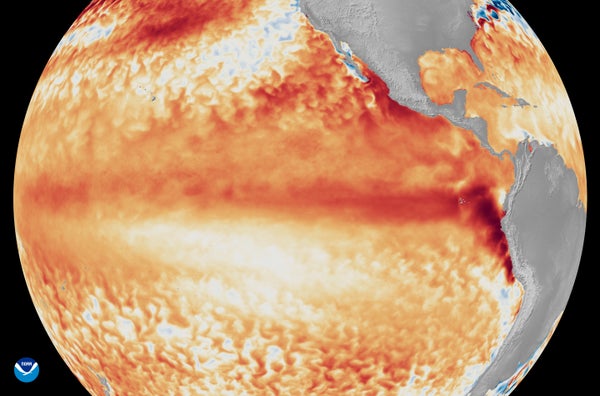
The ongoing El Niño has become more powerful over the past month and will likely continue to strengthen well into 2027, according to updated data from the National Weather Service (NWS). Such a "Super El Niño" could mean an increased risk of deadly and destructive extreme weather events in various places across the planet and would tip the odds of having record hot years globally.
El Niño is a global climate pattern that originates in the Pacific Ocean. Waters in the eastern portion of the tropical Pacific are normally colder than those in the west, but during an El Niño, those cooler waters heat up. That, in turn, changes where heat is released into the atmosphere, changing major wind patterns. The downstream effects of that cascade can bring devastation to some places, such as by raising the risks of famines, fires and floods in Southeast Asia. But they can also bring benefits to others, such as by resulting in a less active Atlantic hurricane season.
The weather-related effects of a strong El Niño can be so devastating that some scientists have proposed geoengineering solutions to weaken the climate phenomenon, though such an action isn’t currently technically feasible and raises thorny ethical questions.
On supporting science journalism
If you're enjoying this article, consider supporting our award-winning journalism by subscribing. By purchasing a subscription you are helping to ensure the future of impactful stories about the discoveries and ideas shaping our world today.
The famed climate pattern’s emergence was confirmed by the National Oceanic and Atmospheric Administration in June, and the new data show it’s only picked up steam since then. In an advisory issued on July 9, the NWS said sea surfaces in a large area of the eastern and central Pacific have been higher than the norm by one degree Celsius or more, with some areas reaching almost three degrees C warmer. If a Super El Niño materializes, it will be among only a handful of such very strong events since 1950. The NWS gave the system an 81 percent chance of reaching that status, alongside a 97 percent chance that the El Niño will last through early spring 2027.
The stronger the El Niño is, the better the odds are that it will cause 2026 or 2027, or both, to be the hottest year on record, as previous Super El Niños have done.