
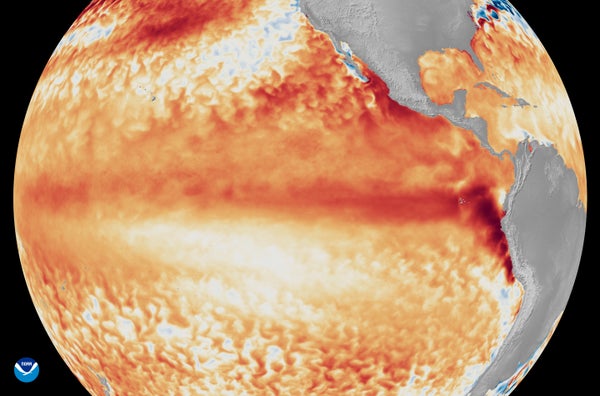
El Niño is officially here—and the whole planet is likely to feel the brunt of it in the coming months.
The weather pattern officially took hold within the past month, according to a statement from the National Oceanic and Atmospheric Administration released on June 11. In addition, forecasts are very confident that this will be a strong El Niño throughout the fall and into the winter—possibly even among the strongest El Niños on record, which occurred during 1982–1983, 1997–1998 and 2015–2016.
The announcement is not a surprise—May’s installment of the forecast noted that models suggested El Niño would form this month, and scientists have long been seeing hints of it brewing. “The models started showing signs of it last November,” says Emily Becker, an atmospheric scientist at the University of Miami, who works on the official NOAA El Niño forecast.
On supporting science journalism
If you're enjoying this article, consider supporting our award-winning journalism by subscribing. By purchasing a subscription you are helping to ensure the future of impactful stories about the discoveries and ideas shaping our world today.
The confirmation that El Niño is here, however, lets scientists warn communities around the world about what they might face throughout the rest of this year.
What is El Niño?
To understand what the planet is in store for, let’s start by explaining what El Niño is: The phenomenon is one phase of a global climate pattern that scientists call the El Niño–Southern Oscillation, which incorporates both the oceans and the atmosphere and has its roots in the Pacific Ocean around the equator. Under average conditions, this region’s surface waters are characterized by a “warm pool” in the west and a “cold tongue” stretching out to the east, says Antonietta Capotondi, a physical oceanographer at the University of Colorado Boulder.
During an El Niño, that cold tongue is completely overpowered, with warm waters stretching throughout the equatorial Pacific, sometimes aided by a planetary-scale ocean wave called a Kelvin wave, Capotondi notes. One such wave has been plowing across the Pacific. (During El Niño’s counterpart, called La Niña, which occurred last year, the cold tongue expands westward.)
Formal demarcations of an El Niño vary internationally, but at their root, they look for sustained sea surface temperatures that are noticeably warmer than average across a set swath of the eastern Pacific. Temperatures in NOAA’s defining region spiked higher than the average in mid-April and have remained high ever since.
These changes in the ocean temperatures change where heat is pumped into the atmosphere, which in turn causes changes to wind patterns. As an El Niño takes hold in the atmosphere, winds blowing from east to west over the region slacken, says Sarah Larson, an atmospheric scientist at North Carolina State University.
How El Niño changes the weather
These changes in heat distribution and wind patterns create a domino effect through the atmosphere that has major implications for the weather people around the world experience in the coming months. Changes in wind patterns tend to strengthen the eastern Pacific hurricane season while dampening the Atlantic hurricane season. Across North America, El Niño tends to push the jet stream south. By winter, when the phenomenon is strongest, the southern U.S. tends to be wetter than normal, while the northern swath of the country and much of Canada tends to be warmer than usual, Larson notes.
Globally, El Niño can contribute to record-breaking heat spells in addition to shifting rainfall patterns around the planet. The burgeoning El Niño is already interfering with India’s monsoon, leading to low rainfall estimates for the crucial season. Recent El Niños have also worsened wildfire conditions in regions that include the Amazon, Canada and Australia. Meanwhile the Horn of Africa can see flooding from unusually intense rainfall.
These patterns can have important real-world consequences, worsening famines, fires and floods in various parts of the globe. The patterns of El Niño—and scientists’ ability to read the strength of an event months in advance—offer experts somewhere to start understanding and preparing for potential effects months in advance.
“El Niño pushes the future odds in certain directions,” said Michelle L’Heureux, a physical scientist at NOAA’s Climate Prediction Center, who leads the team that produces the official El Niño forecast, to Scientific American before producing the new outlook. “Stronger events tend to shift the odds a bit more than weaker events, so this forecast is an opportunity to assess risk and prepare based on El Niño’s typical influence.”
A record hot year is likely
Pacific El Niño events unfold slowly—the closely watched patch of ocean will likely continue warming compared with its average temperature all the way through November or December, when the phenomenon usually peaks before the planet’s systems trend back toward normal. And El Niño unfolds a little bit differently each time, so the exact effects aren’t certain. “There’s always plenty of variability,” Becker says.
But the event will raise global temperatures, likely to record levels. Whether that happens this year, next year or both is still uncertain. It is unclear, though, how climate change is influencing the strength or timing of El Niño events. And seeing a very strong El Niño this year isn’t necessarily a concerning sign about climate change, Becker notes.
All told, the El Niño–Southern Oscillation is a key factor shaping Earth’s climate each year. “It’s one of the most important emergent features of the climate system beyond the seasons,” says Maike Sonnewald, a physical oceanographer at the University of California, Davis.