
Read Our Coverage
How Long Will Wildfire Smoke Last, and Where Will It Spread?
How to Protect Yourself from Smoky Wildfire Air
On supporting science journalism
If you're enjoying this article, consider supporting our award-winning journalism by subscribing. By purchasing a subscription you are helping to ensure the future of impactful stories about the discoveries and ideas shaping our world today.
How to Use the Air Quality Index
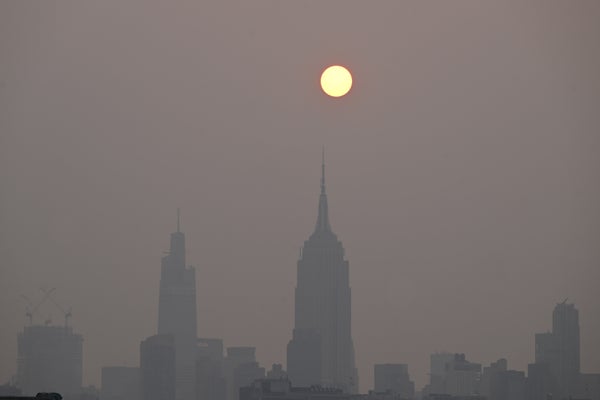
Smoke from wildfires raging in Canada has been pouring south into the U.S, and giving parts of the Northeast their worst air quality in decades. An apocalyptic orange haze has shrouded the Manhattan skyline, and noxious brown clouds have been clearly visible in satellite images. Scientific American will be rounding up some of the most striking visuals and notable updates in this climate-change-charged situation.
Canada has had one of the worst starts to a fire season on record, with more than 400 blazes currently spewing smoke into the atmosphere. Among the biggest of these fires is the Donnie Creek Complex, which, as of June 6, was burning across 2,656 square kilometers in British Columbia.
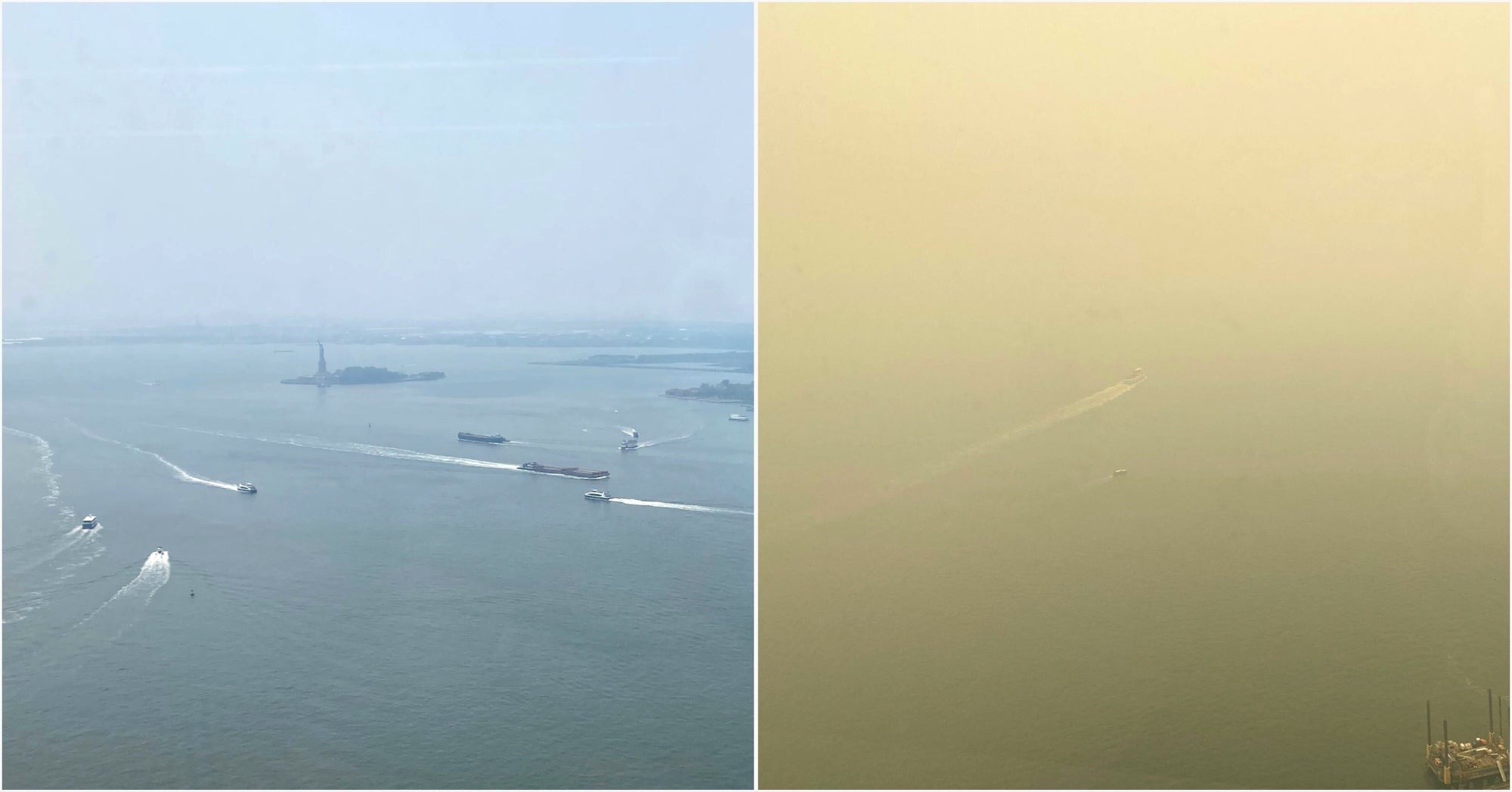
Caption: Haze-shrouded buildings in downtown Manhattan seen from the Scientific American offices. Credit: Andrea Thompson (left), June Minju Kim (right)
Wildfire smoke swirling around an upper level Low over New England is depicted in the smoke forecast for today. Hazardous air quality levels are forecast for much of the Northeast and Mid-Atlantic, including major metro areas along the I-95 corridor. https://t.co/nCd0zl3kwi pic.twitter.com/kt451APVdd
— UW-Madison CIMSS (@UWCIMSS) June 8, 2023
Say it isn't smoke... but yet here we still are. The highest concentrations of smoke should be dissipating through the morning hours and into the afternoon across the region. However late this evening, we anticipate the haze and smoke to become more dense. pic.twitter.com/QwouQYq4s7
— NWS Mount Holly (@NWS_MountHolly) June 8, 2023
Smoke from Canadian fires continues into the Northeast, but when will it end? A stalled low pressure system directing smoke southward may shift away from the region this weekend, but as long as the fires continue, the smoke may simply be directed towards other areas of the U.S. pic.twitter.com/XleLN4gx1O
— NWS Weather Prediction Center (@NWSWPC) June 7, 2023
The bad news: Looks outside the window at the orange skies over NYC. The good news: The smoke should probably be less of an issue the rest of the summer. https://t.co/NvoEpuj7ot
— Andrea Thompson (@AndreaTWeather) June 7, 2023
Here are some views of the smoky sky from the top of the Washington Monument this morning.#WashingtonDC
Pics by Jake Sawyer, National Park Service. pic.twitter.com/de5TlztneP
— National Mall NPS (@NationalMallNPS) June 7, 2023
Smoke & haze continue to move in from the north. In this satellite loop, you can see a thicker plume over central NY and northern PA which will be shifting in over the next few hours. Expect a reduction in visibility, poor air quality & the smell of smoke. #NYwx #NJwx #CTwx pic.twitter.com/Fzeq1u20Wh
— NWS New York NY (@NWSNewYorkNY) June 7, 2023
Syracuse, NY with 316.8 µg/m³ last hour, more than twice its max yesterday. The smoke plume hitting NYC this afternoon will be perhaps far worse than yesterday
— Ryan Stauffer (@ryans_wx) June 7, 2023