
The SciencesSeptember 1, 2015
Your Cat Questions Answered
A cat expert fields a host of questions from cat owners
Kate Wong is an award-winning science writer and senior editor for features at Scientific American, where she has focused on evolution, ecology, anthropology, archaeology, paleontology and animal behavior. She is fascinated by human origins, which she has covered for nearly 30 years. Recently she has become obsessed with birds. Her reporting has taken her to caves in France and Croatia that Neandertals once called home to the shores of Kenya’s Lake Turkana in search of the oldest stone tools in the world, as well as to Madagascar on an expedition to unearth ancient mammals and dinosaurs, the icy waters of Antarctica, where humpback whales feast on krill, and a “Big Day” race around the state of Connecticut to find as many bird species as possible in 24 hours. Wong is co-author, with Donald Johanson, of Lucy’s Legacy: The Quest for Human Origins. She holds a bachelor of science degree in biological anthropology and zoology from the University of Michigan. Follow her on Bluesky @katewong.bsky.social
Your Cat Questions Answered
A cat expert fields a host of questions from cat owners
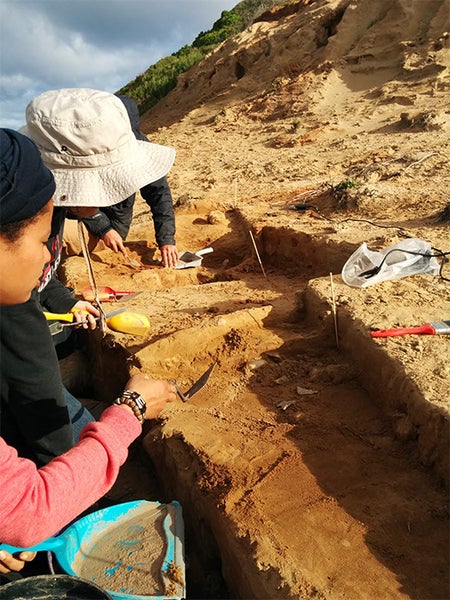
Clues to How Homo sapiens Conquered Earth Emerge from Digs in South Africa [Slide Show]
Archaeological sites along the southern coast are yielding fresh insights into an enduring mystery of human evolution

What Siberian Burials Reveal about the Relationship between Humans and Dogs
The Kitoi hunter–gatherers gave their dogs elaborate mortuary rituals
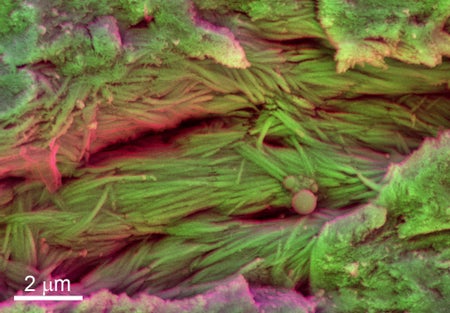
75-Million-Year-Old Dinosaur Soft Tissue Suggests Ancient Organic Preservation May Be Common
Researchers have found what appear to be collagen fibers and blood cells in unremarkable-looking fossils

Archaeologists Take Wrong Turn, Find World's Oldest Stone Tools [Update]
Archaeologists working in the Kenyan Rift Valley have discovered the oldest known stone tools in the world. Dated to around 3.3 million years ago, the implements are some 700,000 years older than stone tools from Ethiopia that previously held this distinction.
Meet the New Tyrannosaurs [Video]
Recent fossil discoveries fill in long-standing holes in Tyrannosaurus rex’s family tree
Neandertals Turned Eagle Talons into Jewelry 130,000 Years Ago
As longtime readers may have noticed, I have an abiding interest in Neandertals. To help me keep up with the latest scientific insights into these mysterious relatives of ours, I have a Google alert set for "Neandertal" (and the alternate spelling, "Neanderthal").
The Neandertal Mystique
Our heavy-browed cousin remains the most fascinating member of the human family
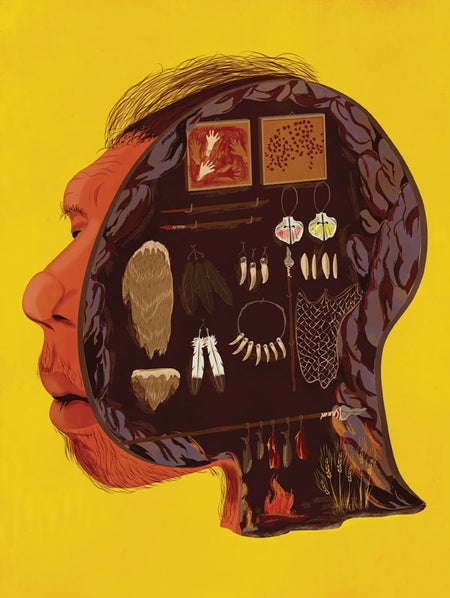
Secrets of Neandertal Cognition Revealed
Analyses of anatomy, DNA and cultural remains have yielded tantalizing insights into the inner lives of our mysterious extinct cousins
Stunning Images from the 2014 Olympus BioScapes International Digital Imaging Competition [Slideshow]
Microscopes find beauty in the most unexpected places
More Wondrous Images from the 2014 Bioscapes Competition
Microscopes find beauty in strange places--from a fossil fern to fruit fly sperm
Tiny Fossil Is North America's Oldest (and Cutest) Horned Dinosaur
A tiny skull from southern Montana represents a new kind of horned dinosaur that had a distinctive hooked beak and was about the size of a crow.
World's Oldest Engraving Upends Theory of Homo sapiens Uniqueness
It is getting harder and harder to figure out what distinguished Homo sapiens from other members of the human family and fueled our extraordinary success as a species.
Stunning Artwork Opens New Window on Mighty Maya Civilization
Long-sought clues to Maya governance emerge from an exquisitely preserved frieze
These Amazing Spiders Look Remarkably Like Ants [Slide Show]
Ant-mimicking spiders are the ultimate imposters
40 Years After Lucy: The Fossil That Revolutionized the Search for Human Origins
Forty years ago today, a young American paleoanthropologist named Donald Johanson made the discovery of a lifetime in the arid badlands of Ethiopia's remote Afar region: a 3.2-million-year-old skeleton of a small-brained creature that walked upright like we do.
Mind-Blowing Fossil Preserves Tiny Horse Carrying Unborn Foal
BERLIN: The former oil shale mining site of Messel, near Frankfurt, Germany, is well known for its spectacular fossils of organisms that lived between 47 million and 48 million years ago, during the Eocene epoch.
Human or Hobbit?
The arguments over an ancient skeleton just won’t die
Ancient Indonesian Cave Paintings Force Rethink of Art's Origin
Archaeologists have determined that artwork found in limestone caves on the Indonesian island of Sulawesi is far older than previously thought.
Coffee Crisis Spurs Hunt for Helpful Genes [Slide Show]
With cultivated coffee in decline, researchers are turning to wild plants for help
Ancient Engraving Strengthens Case for Sophisticated Neandertals
One of the longest-running, most fervent debates in the history of human evolution research concerns the cognitive abilities of the Neandertals.
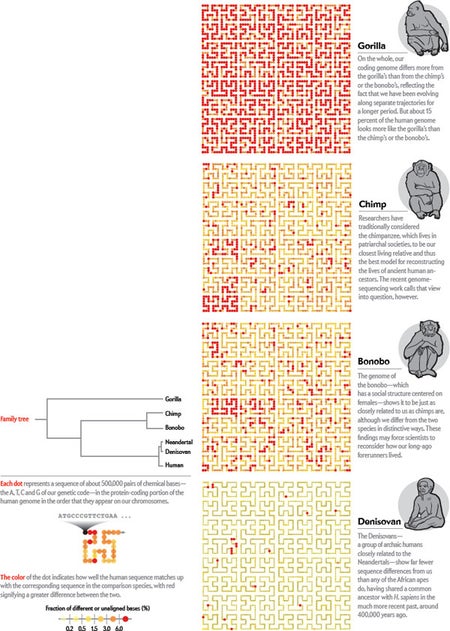
Tiny Genetic Differences between Humans and Other Primates Pervade the Genome
Genome comparisons reveal the DNA that distinguishes Homo sapiens from its kin
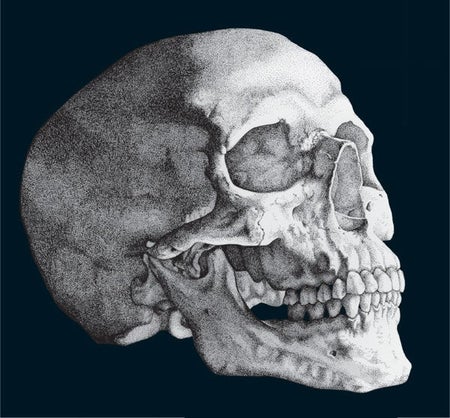
The New Science of Human Origins
Awash in fresh insights, scientists have had to revise virtually every chapter of the human story
The Most Incredible Human Evolution Discoveries of the New Millennium
New fossil and archaeological finds, along with insights from genetics, are upending the story of our origins