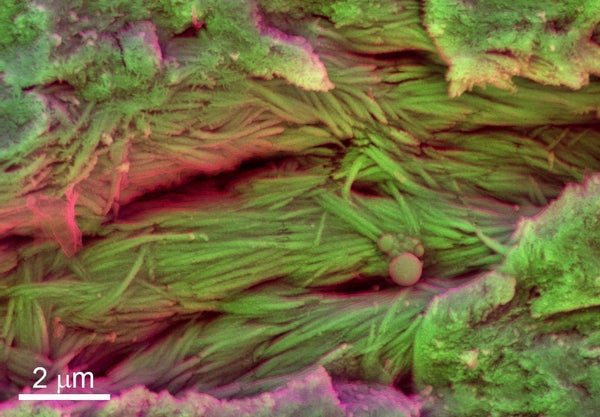
Scanning electron micoscrope analysis revealed apparent collagen fibers in 75-million-year-old dinosaur bone.
Image: Sergio Bertazzo
Join Our Community of Science Lovers!
This article was published in Scientific American’s former blog network and reflects the views of the author, not necessarily those of Scientific American
During the process of fossilization, all organic compounds--such as those that make up cells and tissues—disappear, leaving behind remains composed strictly of mineral. That’s the conventional wisdom, anyway. But discoveries made over the past two decades have steadily chipped away at this tenet of paleontology, revealing what appear to be blood cells, bone cells and other organic materials in a handful of exceptionally well-preserved dinosaur fossils. Now new findings suggest that such organic preservation may actually be relatively common. Sergio Bertazzo of University College London and his colleagues analyzed eight dinosaur specimens that did not show any external signs of being particularly well preserved, and found apparent blood cells and collagen fibers in six of them. The remains are some 75 million years old. The researchers describe their findings in a report published in the June 9 Nature Communications. (Scientific American is part of Nature Publishing Group.)
If you're enjoying this article, consider supporting our award-winning journalism by subscribing. By purchasing a subscription you are helping to ensure the future of impactful stories about the discoveries and ideas shaping our world today.
Great science journalism requires human expertise, time, effort and creativity. And it costs money. That’s why I and the journalists here at Scientific American hope you’ll join our community.
When you subscribe, you are supporting staff and freelance journalists who are passionate about telling science stories that are true, important and compelling. Our editors and reporters are often experts in their fields, which means they understand the nuances of big discoveries and can untangle the breakthroughs from the hype. With a subscription, you are also supporting rigorous fact-checking to ensure the words we publish are precise and accurate. And you’re supporting original illustrations, graphics and photos that bring you closer to an advanced laboratory, an ice sheet in Antarctica or a space mission in orbit. You’re helping us craft other types of high-quality journalism as well: Our newsletters are carefully written, edited and curated by staffers you have or will come to know and love. Our Science Quickly podcast is based on original reporting, collaboration with editors and scientists and exacting production.
Subscriptions keep this engine running so we can continue to deliver thoughtful, rigorous and independent science journalism to you. In an era of viral misinformation, this work is crucial. If you value what we do, I hope you’ll consider joining us as a subscriber
Thank you,
Jeanna Bryner, Editor in Chief, Scientific American