
This article was published in Scientific American’s former blog network and reflects the views of the author, not necessarily those of Scientific American
Scientific American celebrates its 171st birthday this month: The publication's first issue was dated August 28, 1845. Initially a weekly four-page broadsheet, it shifted over to a monthly magazine with the November 1921 issue, and has been rolling off printing presses as such ever since, making it the the oldest continuously published magazine in the United States.
I'm a graphics editor here at Scientific American, so it may not surprise you that some of my favorite articles from the archive are rooted in the process of making and printing images. Lucky for me, the topic is built into the very core of the magazine. As stated in the first issue by founding editor Rufus Porter, not only would each issue “be furnished with from two to five original Engravings,” but the content would be dedicated, among other things, to “useful information and instruction in various Arts and Trades.”
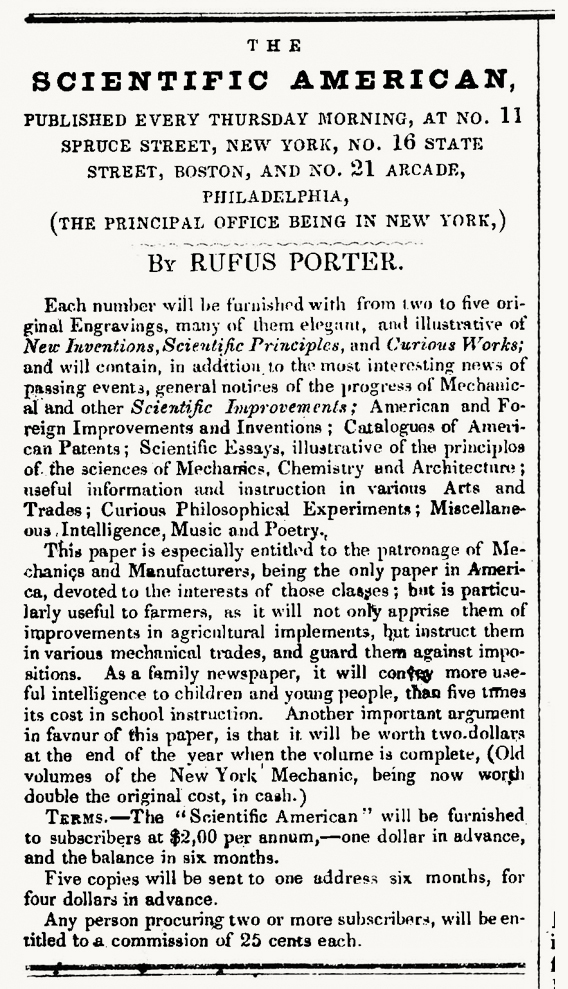
Volume 1, Number 1 of Scientific American, August 28, 1845
On supporting science journalism
If you're enjoying this article, consider supporting our award-winning journalism by subscribing. By purchasing a subscription you are helping to ensure the future of impactful stories about the discoveries and ideas shaping our world today.
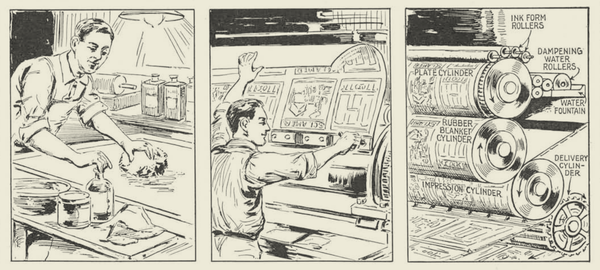
Even when Porter moved on to other adventures and the magazine was bought by Munn & Company, that tradition continued. Indeed, my favorite article in the benchmark November 1921 issue is “From Easel to Cover—Offset Lithography as Applied to the Scientific American Covers,” by Austin C. Lescarboura. Check out the illustrations that accompanied the article below.

Panel 1 of 4.
“From Easel to Cover—Offset Lithography as Applied to the Scientific American Covers,” by Austin C. Lescarboura. Scientific American, November 1921

Panel 2 of 4.
“From Easel to Cover—Offset Lithography as Applied to the Scientific American Covers,” by Austin C. Lescarboura. Scientific American, November 1921

Panel 3 of 4.
“From Easel to Cover—Offset Lithography as Applied to the Scientific American Covers,” by Austin C. Lescarboura. Scientific American, November 1921

Panel 4 of 4.
“From Easel to Cover—Offset Lithography as Applied to the Scientific American Covers,” by Austin C. Lescarboura. Scientific American, November 1921
Lest you think that this habit of covering printing technology in the magazine was a quaint product of the industrial age, fast forward nearly 75 years to a letter from publisher John Moeling on the occasion of the magazine’s first issue printed without negatives/film. Every page—including advertisements—in the March 1995 special issue The Computer in the 21st Century was transmitted directly from computer to plate.

Scientific American: The Computer in the 21st Century, March 1995
Some accounts assert that Scientific American was the first offset-printed magazine to do this, but most count it as “among the first” in embracing an entirely digital workflow. (Note that The Computer in the 21st Century special anthology issue—printed in addition to the usual March issue of the magazine—should not be confused with the 1991 article by a similar name “The Computer for the 21st Century.” Sadly, and ironically, the 1995 anthology issue is not available online.)
These gems from the archive got me wondering...how, exactly, does a magazine that covers advances in science and technology illustrate emerging ideas before they have fully emerged? How did Scientific American illustrate topics in innovation and information at the dawn of the digital age and beyond: a time during which technological advances in imaging were being reported on before those technologies were mainstream enough to produce the magazine with them?
Earlier this summer, I answered those questions for an Eyeo Festival presentation, with the help of a deep dive into the archives. The full talk is available online. (I highly recommend spending some time on the Eyeo 2016 Vimeo channel and exploring other presentations—most of which focus on topics in art, interaction, information, data and/or technology).
I’m lucky to call Ed Bell, the former art director of the magazine and someone who was crucial in Scientific American’s traditional-to-digital transition, my mentor and good friend. In the course of researching the topic, I sat down with him to ask how digital technology impacted the magazine’s workflow and its relationships with artists. Here are some excerpts from that conversation (video below).
For more on the history of magazine, check out this special report published on the occasion of Scientific American's 170th birthday.