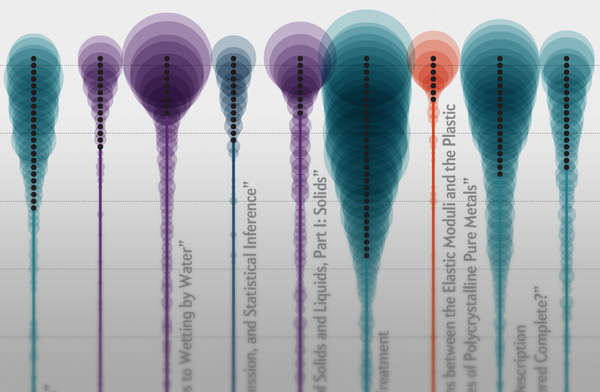
Sleeping Beauties of Science

Scientific American graphic about slumbering research papers wakes up for an award

Join Our Community of Science Lovers!

This article was published in Scientific American’s former blog network and reflects the views of the author, not necessarily those of Scientific American


The 25th annual Malofiej International Infographics Summit—hosted in Pamplona, Spain by the Spanish chapter of the Society for News Design and the School of Communication at the University of Navarra—concluded last week with award announcements. I’m happy to report that Scientific American won a silver medal in the print category for this page in the January 2016 issue, featuring a graphic by Tiffany Farrant-Gonzalez, text by Amber Williams, and research by Qing Ke, Emilio Ferrara, Filippo Radicchi, and Alessandro Flammini.

Credit: Tiffany Farrant-Gonzalez (graphic)

Here's a version of the graphic optimized for viewing online.


On supporting science journalism

If you're enjoying this article, consider supporting our award-winning journalism by subscribing. By purchasing a subscription you are helping to ensure the future of impactful stories about the discoveries and ideas shaping our world today.
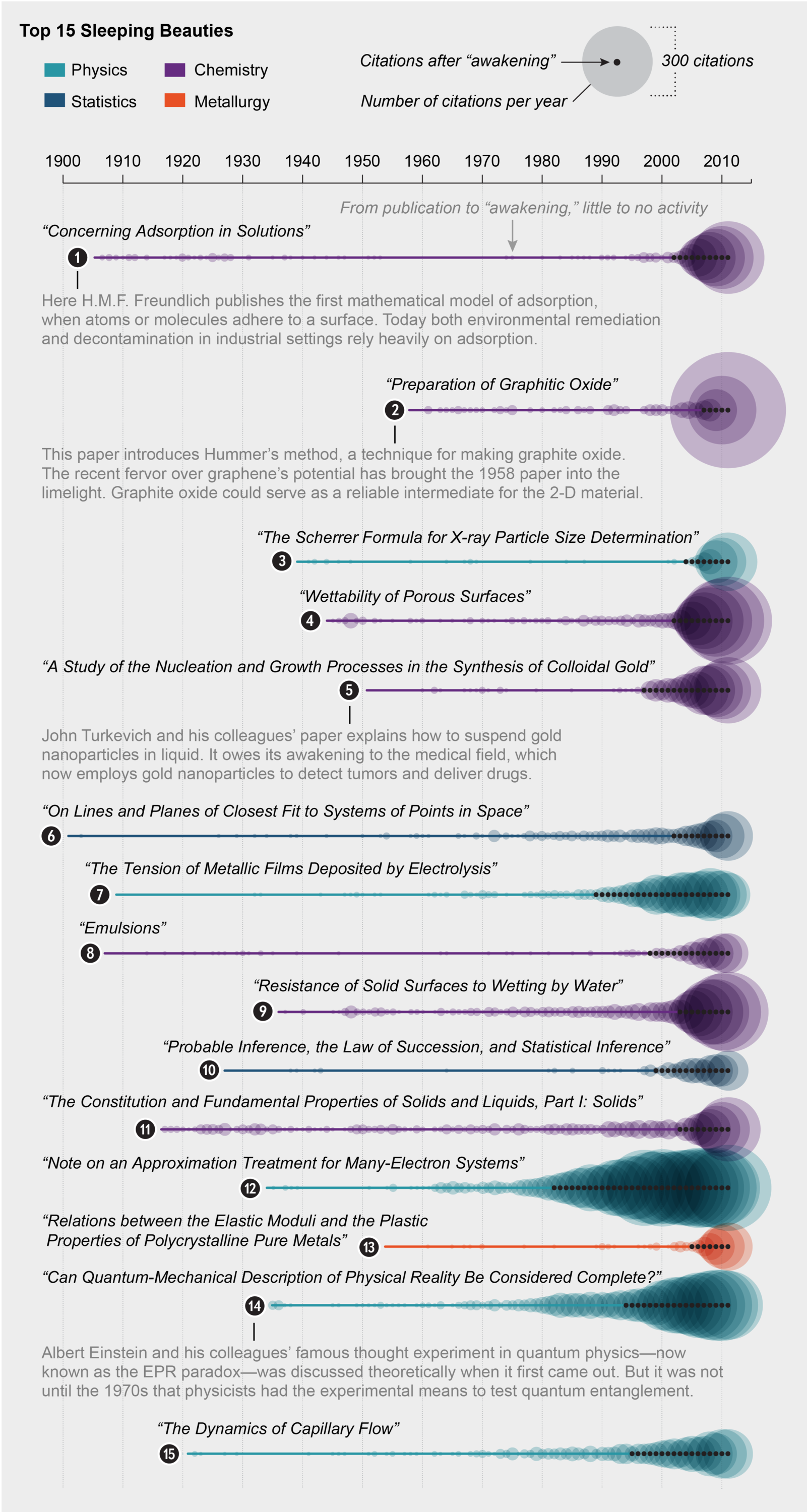

Credit: Tiffany Farrant-Gonzalez; SOURCE: “Defining and identifying Sleeping Beauties in science,” By Qing Ke et al., In Proceedings of the National Academy of Sciences USA, vol. 112, NO. 24; June 16, 2015 

Discovery lies at the core of science, but rediscovery can be just as important. Indiana University Bloomington researchers recently combed through 22 million scientific papers published over the past century and found, to their surprise, dozens of “Sleeping Beauties”—studies that sat dormant for years and then suddenly got noticed. The top finds—the ones that languished in obscurity the longest and later got the most intense attention from the scientific community—came from chemistry, physics and statistics. What tended to wake up these sleeping findings? Scientists from other disciplines, such as the medical field, in search of fresh insights, as well as the ability to test once theoretical postulations. Qing Ke, a graduate student in informatics who worked on the project, says that most likely Sleeping Beauties will become even more common in the future because of the increasing availability and accessibility of scientific literature. –Amber Williams 

Over 1,300 entries from 134 media companies across 31 countries participated in the contest. In total, 10 gold medals, 47 silver medals, and 98 bronze medals were awarded in print and online categories combined. Best of Show awards were bestowed upon La Lettura (Italy) for “The Journey of Foreign Fighters” (print), and The New York Times (U.S.) for  "Olympic Races Social Series" (online). For a full list of awards [pdf], see the Malofiej website.

Jen Christiansen is acting chief of design and senior graphics editor at Scientific American, where she art directs and produces illustrated explanatory diagrams and data visualizations. She is also author of the book Building Science Graphics: An Illustrated Guide to Communicating Science through Diagrams and Visualizations (CRC Press). In 1996 she began her publishing career in New York City at Scientific American. Subsequently she moved to Washington, D.C., to join the staff of National Geographic (first as an assistant art director–researcher hybrid and then as a designer), spent four years as a freelance science communicator and returned to Scientific American in 2007. Christiansen presents and writes on topics ranging from reconciling her love for art and science to her quest to learn more about the pulsar chart on the cover of Joy Division’s album Unknown Pleasures. She holds a graduate certificate in science communication from the University of California, Santa Cruz, and a B.A. in geology and studio art from Smith College. Follow Christiansen on Bluesky @jenchristiansen.com

More by Jen Christiansen

It’s Time to Stand Up for Science

If you enjoyed this article, I’d like to ask for your support. Scientific American has served as an advocate for science and industry for 180 years, and right now may be the most critical moment in that two-century history.

I’ve been a Scientific American subscriber since I was 12 years old, and it helped shape the way I look at the world. SciAm always educates and delights me, and inspires a sense of awe for our vast, beautiful universe. I hope it does that for you, too.

If you subscribe to Scientific American, you help ensure that our coverage is centered on meaningful research and discovery; that we have the resources to report on the decisions that threaten labs across the U.S.; and that we support both budding and working scientists at a time when the value of science itself too often goes unrecognized.

In return, you get essential news, captivating podcasts, brilliant infographics, can't-miss newsletters, must-watch videos, challenging games, and the science world's best writing and reporting. You can even gift someone a subscription.

There has never been a more important time for us to stand up and show why science matters. I hope you’ll support us in that mission.

Thank you,

David M. Ewalt, Editor in Chief, Scientific American

Subscribe