
Discovery lies at the core of science, but rediscovery can be just as important. Indiana University Bloomington researchers combed through 22 million scientific papers published over the past century and found, to their surprise, dozens of “Sleeping Beauties”—studies that sat dormant for years and then suddenly got noticed. The top finds—the ones that languished in obscurity the longest and later got the most intense attention from the scientific community—came from chemistry, physics and statistics. What tended to wake up these sleeping findings? Scientists from other disciplines, such as the medical field, in search of fresh insights, as well as the ability to test once theoretical postulations. Qing Ke, a graduate student in informatics who worked on the project, says that most likely Sleeping Beauties will become even more common in the future because of the increasing availability and accessibility of scientific literature.
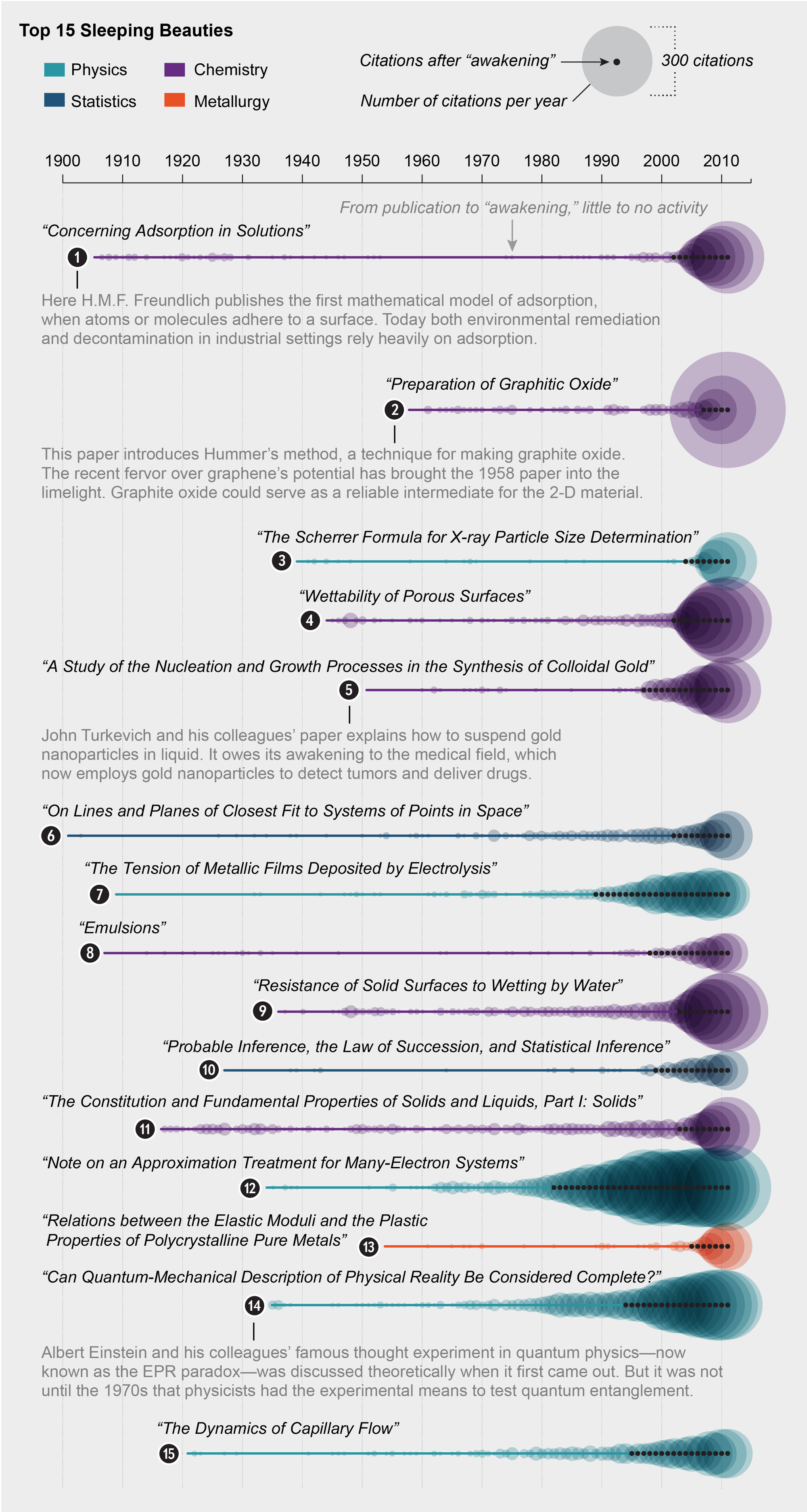
Many of these reawakened findings have been covered by Scientific American:
On supporting science journalism
If you're enjoying this article, consider supporting our award-winning journalism by subscribing. By purchasing a subscription you are helping to ensure the future of impactful stories about the discoveries and ideas shaping our world today.
#2: “Preparation of Graphitic Oxide”
Carbon Wonderland (April 2008)
#4: “Wettability of Porous Surfaces”
Self-Cleaning Materials: Lotus Leaf-Inspired Nanotechnology (August 2008)
Ferry Tale: Fire Ants Aggregate into Living Rafts to Escape Floods (April 2011)
(Both articles discuss the Cassie–Baxter law of wetting, which explains that increasing the roughness of a surface can increase its water repellency.)
#5: “A study of the Nucleation and Growth Processes in the Synthesis of Colloidal Gold”
The Midas Touch: Using Gold Nanoparticles to Block HIV (June 2008)
Gold Nanowires Grow on Their Own (November 2001)
#9: “Resistance of Solid Surfaces to Wetting by Water”
Lotus Leaf Inspires Waterproofing Scheme (March 2003)
How to Make Materials Everything-Proof (November 2008)
#11: “The Constitution and Fundamental Properties of Solids and Liquids”
Articles written by the study’s author, Irving Langmuir (1920, 1933, 1937).
#14: “Can Quantum-Mechanical Description of Physical Reality Be Considered Complete?”
What Einstein Really Thought about Quantum Mechanics (September 2015)
Was Einstein Right? (September 2004)
Full Citations:
1. “Concerning Adsorption in Solutions,” by H. Z. Freundlich in Zeitschrift für Physikalische Chemie, Vol. 57, 444–448; 1906.
2. “Preparation of Graphitic Oxide,” by William Hummers, Jr., and Richard Offeman in Journal of the American Chemical Society, Vol. 80, No. 6; March 1958.
3. “The Scherrer Formula for X-Ray Particle Size Determination,” by A. Patterson in Physical Review Letters, Vol. 56, No. 978; November 15, 1939.
4. “Wettability of Porous Surfaces,” by A. Cassie and S. Baxter, in Transactions of the Faraday Society, Vol. 40, 546–551; 1944.
5. “A Study of the Nucleation and Growth Processes in the Synthesis of Colloidal Gold,” by John Turkevich et al, in Discussions of the Faraday Society, Vol. 11, 55–75; 1951.
6. “On Lines and Planes of Closest Fit to Systems of Points in Space,” by Karl Pearson, in Philosophical Magazine, 559–572; 1901.
7. “The Tension of Metallic Films Deposited by Electrolysis,” by G. Gerald Stoney in Proceedings of the Royal Society of London Series A, Vol. 82, No. 553; May 6, 1909.
8. “Emulsions,” by Spencer Pickering in Journal of the Chemical Society, Transactions, Vol. 91; 1907.
9. “Resistance of Solid Surfaces to Wetting by Water,” by Robert Wenzel in Industrial & Engineering Chemistry, Vol. 28, No. 8, 988–994; 1936.
10. “Probable Inference, the Law of Succession and Statistical Inference,” by Edwin Wilson in Journal of the American Statistical Association, Vol. 22, No. 158, 209–212; June 1927.
11. “The Constitution and Fundamental Properties of Solids and Liquids, Part 1: Solids,” by Irving Langmuir in Journal of the American Chemical Society, Vol. 38, No. 11; 1916.
12. “Note on an Approximation Treatment for Many-Electron Systems,” by Chr. Møller and M. S. Plesset in Physical Review, Vol. 46, No. 618; October 1, 1934.
13. “Relations between the Elastic Moduli and the Plastic Properties of Polycrystalline Pure Metals,” by S. F. Pugh in The London, Edinburgh and Dublin Philosophical Magazine and Journal of Science, Vol. 45, No. 367; 1954.
14. “Can Quantum-Mechanical Descriptions of Physical Reality Be Considered Complete?,” by Albert Einstein et al in Physical Review, Vol. 47, No. 777; May 15, 1935.
15. “The Dynamics of Capillary Flow,” by Edward Washburn in Physical Review, Vol. 17, No. 273; March 1, 1921.