
The SciencesNovember 21, 2011
What Is Life Like in Other Parts of the Multiverse? [Video]
In a clip from the NOVA miniseries "The Fabric of the Cosmos," Brian Greene and his fellow physicists ponder the implications of multiple universes
What Is Life Like in Other Parts of the Multiverse? [Video]
In a clip from the NOVA miniseries "The Fabric of the Cosmos," Brian Greene and his fellow physicists ponder the implications of multiple universes
Fresh Start: Scientists Glimpse Unsullied Traces of the Infant Universe
For the first time, astronomers discover pockets of pristine gas formed in the universe's first few minutes

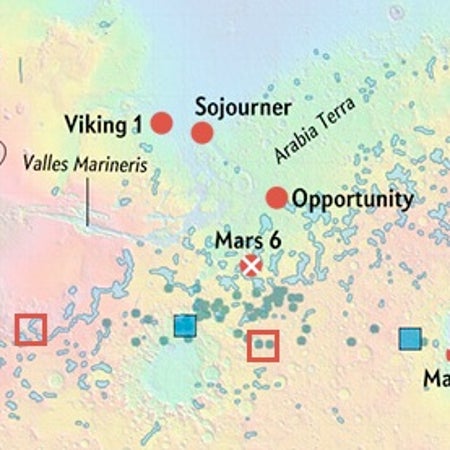
Mapping Mars: Where Have All the Landers Gone? [Interactive]
The first man-made object to land on Mars arrived 40 years ago this month, and NASA's Curiosity rover should soon depart for the Red Planet. Here is a look at where humankind's many Mars landers have touched down, and where the planet betrays a history of all-important liquid water. Find out more in Exploring the Red Planet
The Fabric of the Cosmos: A Q&A with Brian Greene, November 2, 10:00--11:00 P.M. ET [Live Stream]
After watching the premiere of PBS's NOVA program, ask host Brian Greene a question about it
The Story of the Higgs Boson, as Told by Higgs Himself [Video]
In a clip from Brian Greene's new NOVA miniseries The Fabric of the Cosmos, physicist Peter Higgs describes the bumpy road that led him to hypothesize his eponymous, elusive particle
2011 Hunting Season for Higgs Particle Ends at Large Hadron Collider
But researchers confident that the existence of the Higgs boson will be decided in 2012.
Did Saturn's Moon Iapetus Once Have Its Own Moon?
A sub-satellite of the Saturnian moon would explain two of the most puzzling features of Iapetus. John Matson reports
Leading Light: What Would Faster-Than-Light Neutrinos Mean for Physics?
Most physicists are betting against the idea that neutrinos can pierce the cosmic speed limit, but that has not stopped some researchers from exploring the implications
Heliophysicists Hope Giant Sun-Gazing Telescope Will Get Green Light
Observatory would reveal structures that trigger sunspots and space weather.
A Day on Neptune Is Less Than 16 Hours Long
A new study finds that previous estimates for this gaseous planet's swirling rotation were inaccurate
An Accelerating Universe: The 2011 Nobel Prize in Physics
Listen to the announcement of the 2011 Nobel Prize in Physics, to Saul Perlmutter, Brian Schmidt and Adam Riess, from the Royal Swedish Academy of Sciences. Following the formal announcement comes an explanation of the research, which tracked type Ia supernovae to discover that the expansion of the universe was accelerating, and a phone conversation with new Nobel laureate Brian Schmidt
2011 Nobel Prize in Physics
Saul Perlmutter, Brian Schmidt and Adam Reiss share the 2011 Nobel Prize in Physics for their observations that type Ia supernovae indicate that the expansion of the universe is accelerating. Steve Mirsky reports