Our Taste for Alcohol Goes Back Millions of Years
Genetics research sheds light on a long human relationship

Our Taste for Alcohol Goes Back Millions of Years
Genetics research sheds light on a long human relationship

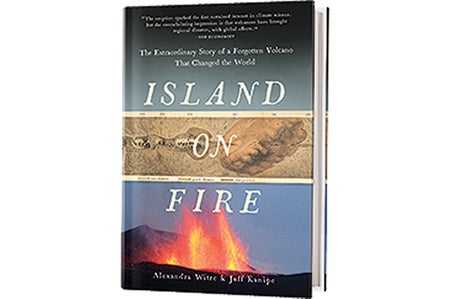
Book Review: Island on Fire


X-Rays at War, 1915
Reported in Scientific American, This Week in World War I: January 30, 1915 X-rays were used for medical operations within a couple of months after they were discovered by Wilhelm Roentgen in late 1895.

Two-Billion-Year-Old Fossils Reveal Strange and Puzzling Forms
To a human, two billion years is an unfathomable interval. But that, a team of European, Gabonese, and American scientists now say, is how long ago a recently discovered hoard of fossils suggests Earth’s first big life evolved — large enough to see with the naked eye, and in a spectrum of forms that tease [...]

Apply for Science Communication Awards, Fellowships and Internship Programs
Participation of broader audiences in science, technology, engineering, mathematics (STEM) requires engaging under-served audiences. The conduit of this engagement is communication.

Why 76 Beavers Were Forced to Skydive into the Idaho Wilderness in 1948
Some time in the late 1940s, a very patient, elderly beaver called Geronimo was put in a box, flown to an altitude of between 150 and 200 metres, and tossed out the side of an aeroplane.

As Cuba–U.S. Relations Thaw, Medical Researchers Still Struggle to Connect
The economic embargo is still in place, so warming connections between the countries can only take biomedicine so far, scientists say

Remembering NASA Challenger and #STEMDiversity
The crew of STS-51-L: Front row from left, Mike Smith, Dick Scobee, Ron McNair. Back row from left, Ellison Onizuka, Christa McAuliffe, Greg Jarvis, Judith Resnik.

Genetic Memory: How We Know Things We Never Learned
I met my first savant 52 years ago and have been intrigued with that remarkable condition ever since. One of the most striking and consistent things in the many savants I have seen is that that they clearly know things they never learned.

Doomsday Clock Set at 3 Minutes to Midnight
Humanity's failure to reduce global nuclear arsenals as well as climate change prompted the Bulletin of the Atomic Scientists to advance their warning about our proximity to a potentially civilization-ending catastrophe

Did Edgar Allan Poe Foresee Modern Physics and Cosmology?
I’ve always been an Edgar Allan Poe fan, so much so that I even watched the horrifying—not in a good way–2012 film The Raven.

The Murals of Scientific American Founder Rufus Porter
Perhaps the tweet below from editor-in-chief Mariette DiChristina last weekend shouldn’t have been a surprise. After all, I knew that Rufus Porter, founding editor and publisher of Scientific American, was a well-rounded fellow.