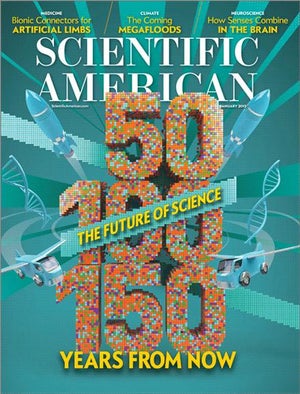
The Science of the Next 150 Years
Scientific American asked leading scientists and science writers to look forward to what the world will be like in the years 2063, 2113 and 2163, and tell us what role science and technology will play in our future

You are currently logged out. Please sign in to download the issue PDF.

The Science of the Next 150 Years
Scientific American asked leading scientists and science writers to look forward to what the world will be like in the years 2063, 2113 and 2163, and tell us what role science and technology will play in our future

The Flying Car Will Finally Fly—and Drive
The only way to bring flying cars to the masses is to leave the flying to the car

Will We Come to Grips with Nuclear Weapons?
If the world can't manage to cast off the ultimate weapons by the middle of the century, we may face extinction

Gene Therapies Will Cure Many a Disease
Gene therapy, once off to a rocky start, transforms medicine by getting at the root cause of many diseases

Extinction Countdown: The End for Many Species
By the next century lions, tigers and other marquee species will be gone or confined to zoos

Will High Tech Cool a Hot Earth?
Solar engineering and other exceptionally ambitious new technologies to deal with the reality of rising global temperatures come riddled with uncertainties. To illustrate how complex the problem is and what kind of challenges lie ahead, here are three contrasting, and somewhat fantastical, scenarios

Computing in 2165
What today's prophets of technology say about the day after tomorrow

How Humans Will Evolve on Multigenerational Space Exploration Missions
How future generations will make the voyage from our earthly home to the planets and beyond—and what it means for our species

String Theory Helps to Explain Quantum Phases of Matter
Newly discovered states of matter embody what Einstein called “spooky action at a distance.” They defy explanation, but lately answers have come from a seemingly unrelated corner of physics: string theory

How Artificial Arms Could Connect to the Nervous System
A new way to link artificial arms and hands to the nervous system could allow the brain to control prostheses as smoothly as if they were natural limbs

Small Wonders: Science Meets Art under the Lens [Slide Show]
Light microscopy reveals hidden marvels of the natural world

The Multisensory Revolution: Why Your Brain Is a Sensory Smoothie
Our many different senses collaborate even more than previously realized. What we hear depends a lot on what we see and feel

Megastorms Could Drown Massive Portions of California
Huge flows of vapor in the atmosphere, dubbed "atmospheric rivers," have unleashed massive floods every 200 years, and climate change could bring more of them