

Karen Hopkin: Sounds can convey a lot of information. They can alert animals to potential danger...,
[CLIP: Colobus monkeys vocalize]
... let parents know when their offspring are hungry ...
On supporting science journalism
If you're enjoying this article, consider supporting our award-winning journalism by subscribing. By purchasing a subscription you are helping to ensure the future of impactful stories about the discoveries and ideas shaping our world today.
[CLIP: Baby lamb bleats]
... or serve as mating calls, territorial warnings or just a way to let others in the area know you’re there.
[CLIP: Wolves in chorus]
And it turns out that even embryos pay attention to this natural soundscape. A growing body of research shows that for many animal species, embryos use audio from their environment to guide their development—a trick that can give them an advantage after they’re born.
Mylene Mariette: In the species that I study, the zebra finch, we found that the parents make a special call when it’s hot. And those heat calls prepare the development of the embryos for heat.
Hopkin: Mylene Mariette of Deacon University in Australia. She made this discovery by chance.
Mariette: I was studying the communication between the parents at the nest when I noticed that sometimes, when the parent was incubating the eggs by itself, it was producing a call that was quite different to the others.
[CLIP: Zebra finch heat call]
Hopkin: And since there was no one else around, she wondered whether that parent might be talking to the eggs. So she hung around the aviary and listened in.
Mariette: So it soon became apparent that the parents were only calling to the eggs when it was really hot.
Hopkin: But what did that do for the developing chicks?
To find out, Mariette started borrowing the eggs. She’d take them to the incubator and play them either the zebra finch heat call or a different call, one that the parents make when they change shifts. Then she’d return them to their nests.
When the chicks hatched, Mariette found that the birds that had heard about the heat were actually smaller than the others.
Mariette: It was a little bit surprising at the time, but we then found that reducing growth in the heat was advantageous because those individuals then produced more babies when they were adult. And that’s probably because they avoided the costs of growing big in the heat, which takes a lot of energy.
Hopkin: And birds are not the only ones who learn about prevailing conditions via embryonic eavesdropping.
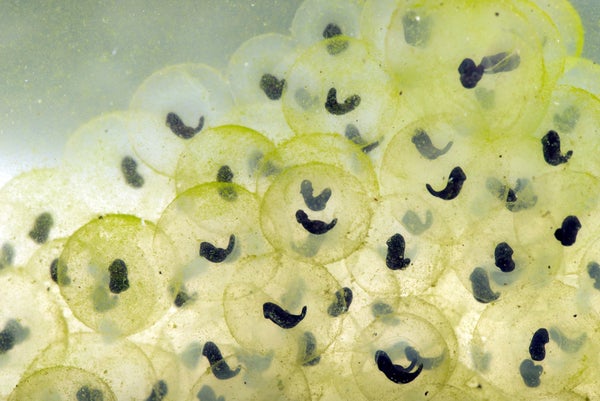
Mariette: In frog embryos, they use the vibration that snake predators make when they approach the eggs to know that they have to hatch to fall in the water and then not be eaten.
Hopkin: And cricket embryos pay attention to male courtship songs.
[CLIP: Crickets chirping]
If it sounds like there’s an abundance of available males...,
[CLIP: Denser audio of cricket sounds]
... the females speed up their development to take advantage of the situation, while males take their time so they will be stronger and bigger when they finally emerge.
Some embryos also communicate with their siblings to coordinate when they’ll hatch so no one gets left behind. And crocodile babies talk to their moms from inside the eggs.
[CLIP: Nile crocodile embryos]
Mariette: The call that the embryos make also tells the mother that they’re about to hatch so she can start digging out the nest and so that makes the hatching process a lot easier for all of the embryos in the clutch.
Hopkin: Of course, the next question becomes: How do all of these embryos actually listen through the shell or womb and, more importantly, act on what they hear?
Mariette: I had to go into neurobiology and look at how the brain may process this information and how it may be transmitted into changes in development.
Hopkin: And Mariette found that in these species, the brain regions that process sound are wired up to areas that control things like hormone production—work she describes in the journal Trends in Ecology & Evolution. [Mylene M. Mariette et al., Acoustic developmental programming: a mechanistic and evolutionary framework]
Mariette: So embryos can respond to the sound without really knowing what the sound is about. And so it’s not really that embryos can hear those sounds consciously. Basically, it’s just spontaneous physiological response.
Hopkin: But it helps them make the kind of sound decisions that will cue them up for future success.
[The above text is a transcript of this podcast.]
