
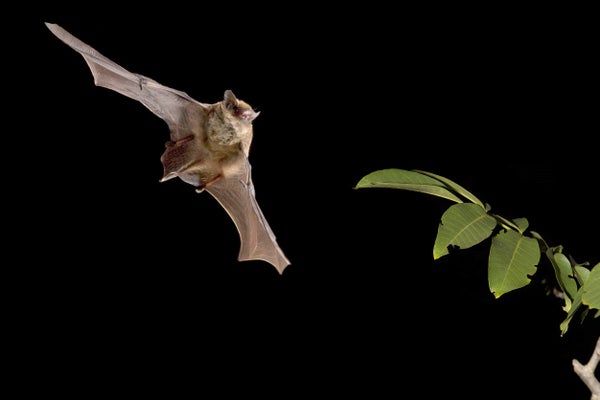

Karen Hopkin: Bats rely on echolocation to navigate the night skies and to chase down and capture even erratically moving prey. But even more impressive than their aerial acrobatics are the mental gymnastics bats must be performing to translate the time it takes for their echoed calls to return into a distance to their target.
Now those pings would not normally be audible to our human ears, but we slowed them down so that you can hear how a bat closes in on an object.
Now, to give them a leg up—or a wing up—on these calculations, a new study shows that bats have an innate feel for the speed of sound. The work appears in the Proceedings of the National Academy of Sciences. [Eran Amichai and Yossi Yovel, Echolocating bats rely on an innate speed-of-sound reference]
On supporting science journalism
If you're enjoying this article, consider supporting our award-winning journalism by subscribing. By purchasing a subscription you are helping to ensure the future of impactful stories about the discoveries and ideas shaping our world today.
Yossi Yovel: It has always been assumed that bats use the speed of sound in order to assess distance. So basically, their brains measure time, and then if they know the speed of sound, they can assess the distance to a target using it.
Hopkin: Yossi Yovel of Tel Aviv University.
Yovel: But this assumes that they know the speed of sound, and this was never actually tested.
Hopkin: That’s where the helium comes in.
Yovel: One of the things we did is: we took pups that were actually never exposed to regular air, and we reared them in an environment that is rich in helium in order to see whether they will learn a new speed of sound.
Hopkin: Because helium is lighter than air, sound travels faster in a helium-enriched medium, which means their echolocation sounds would come back faster—making objects seem closer than they really are.
Now, if bats learn to estimate distances based on the speed of sound they experience growing up, pups raised in the presence of helium, when they’re later placed in a chamber of dense, regular air, should act like targets are farther away—which means their echolocation “pings” should be longer and spaced farther apart than they were in the heliox mix and longer and farther apart than the echolocation calls of pups that were raised in regular air and are therefore used to its density. By the same logic, the “air pups” should mistake targets in heliox as closer than they are and use echolocation pings that are shorter and more tightly spaced.
Eran Amichai: We saw none of these.
Hopkin: Eran Amichai, now a postdoc at Dartmouth College, worked with these befuddled bats as a student in Yovel’s lab.
Amichai: They displayed the same sensory error, no matter where they were born and raised.
Hopkin: In other words, in the heliox mix, all the pups acted as if their target was closer than it was—which means they all came to the table with an innate “reference value” for the speed of sound, pegged to a world filled with regular air.
And the same was true of adult bats, which also couldn’t adjust their echolocation behavior to accommodate different concentrations of helium.
Amichai: They are unable to relearn a new reference to the speed of sound. And that tells us that this is fixed and not flexible.
Hopkin: This lack of flexibility might seem like a liability—especially because the speed at which sound travels can sometimes vary by a few percent, depending on air temperature and humidity. But Yovel hypothesizes that coming into the world with a fixed notion of the speed of sound is probably a plus.
Yovel: These bats, they’re born in summer, and they have to very quickly start flying and foraging independently. So therefore, it’s really important that they acquire their sensory—their echolocation sensory system—abilities very, very rapidly. And therefore, it might be beneficial to have an innate reference rather than something you have to learn and might take time, and you might learn an errorsome value ...
Hopkin: Especially if you find yourself in a heliox chamber in a certain lab in Tel Aviv.
[The above text is a transcript of this podcast.]
